
Recordings › Monday Nights with Mufti #202| Q&A Unscripted & Unrestricted! 😉 | Mufti Abu Layth · 16 Feb 2021 › Segment 9 of 57
Does the Quran really say Jesus had no father?
muftis jahannam jahanam jahannum koran quraan al-quran mufassir mufasir mufassireen quran commentator ayah aya ayat ayaat aayah aayat al-andalus andalus moorish spain salafi salafis salafism wahhabi wahabiThe supernatural and Quran 3:59: Jesus like Adam, and the virgin birth
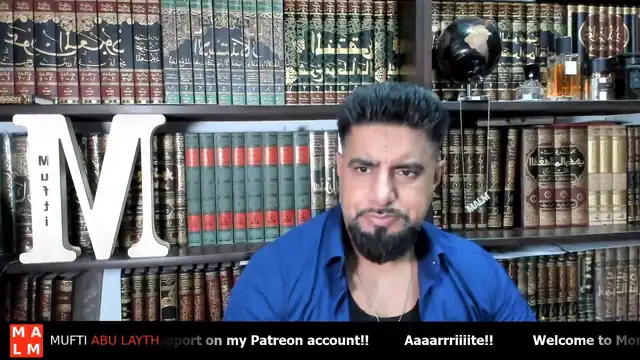 Play from 27:52
The video loads from YouTube only when you press play. Click a time in the transcript to seek.
Watch the answer
Open on YouTube at 27:52The player starts at 27:52, where the answer begins.
This segment27:52 to 33:30 · 5 min 38 sGeneral teaching
The answer in brief
machinesummary, machine-writtenMufti Abu Layth says the Quran's elliptical text leaves readers to fill gaps, and that 3:59 on Jesus and Adam allows many readings; he does not believe in the virgin birth.
In more detail
Mufti Abu Layth takes a partly received message about his saying that he does not believe in the supernatural. He says some people need folklore and can take it from the Quran, but a person can also see that the text does not say what is read into it: it is elliptical and leaves gaps that readers fill themselves, which he calls an amazing aspect of it. His example is Jesus having no father: the Quran could have stated it plainly but did not, and he says he does not believe in the virgin birth, as many of the mufassirun do not. He reads 3:59, that the likeness of Jesus is as that of Adam, created from dust and then told 'be', and says it allows many permutations: if Jesus had a father, so may Adam have had, which could be extrapolated towards evolution, and he asks why 'be' is said of one already created. He calls this the majestic, artistic aspect of Quranic scripture, while noting the Quran is not poetry.
Question as read aloud · questioner not identifiedMufti, you say you don't believe in the supernatural... (the rest of the message did not come through)
Position stated
Mufti Abu Layth says he does not believe in the virgin birth, as many of the mufassirun do not.
“but first of all i mean i don't obviously believe in the virgin birth as many of the mufasirin don't”
Category: teaching
Kind: general teachingTranscript
machine27:52 to 33:30 · click a time to seek · dotted terms open the glossary
meaning from it some poetry is more vague at times and the nature of the quran is it's quite unbounded like that it's you know it doesn't um give always definitives it it kind of answers something but leaves a lot of room a lot of leeway for people to maneuver this maneuverability is what makes it even more meaningful for more for more people because you might come to the quran and take a meaning that helps you in your life and i might read it and
somebody had sent a message about um about saying about supernatural you know this whole thing mufti you know you say about uh you don't believe in the supernatural i never got the the final part of the question but um you see now some people may read the quran and that's what they believe in i'm just saying you know they need folklore they need these stories in that kind of folkloric sense and they can take that from it but a person can approach the quran and say well actually it doesn't actually say that you know it it just has this part this
part there's a lot of uh ellipses there's a lot of this elliptical text with things missing and it doesn't actually you know you're filling in the gaps yourself but the nature of the quran is it does that a lot and i think that's an amazing aspect of it just take you see like take the example that they said that jesus didn't have a father now here allah could have just said let's just say let the quran could have said if you want to go with the fact that jesus did not have a father
that yes jesus you know up he didn't have a father allah could have said this oh you know let me a little or something you know he could have said something like this but first of all i mean i don't obviously believe in the virgin birth as many of the mufasirin don't but you see the verse of the quran says in response to those people inna is
the likeliness the the similitude or the the allegory that you guys are giving of asa of jesus is like that of adam so many things were said in this verse that leave you know it's it's amazing when you look at it that for some people they took a superficial understanding of saying well ah so adam never had a father so jesus
never had a father but some people could say well ah but adam you know are you saying then adam adam mazda and so in that case you know if jesus did have a mother and most likely he had a father that could be similarly the same case with adam then one one could also extrapolate from this well looking at evolution the understanding that well you see ah jesus wasn't just out of nothing
he didn't just emerge so adam won't have either but then you look at the latter part of the verse that created him from from dust and then said to him be and he was you see but why say be and he was if you created him [Laughter] this is the part that many people just brush over they don't really think about it allah could have said he said to him be and he was
but allah says he created him in torah so if that's allegoric you see the thing is the verse hinges itself on so many different permutations so and that to me is the the kind of um the majestic poetic aspect of the quran i mean the quran is not poetry but that's the kind of the artistic
aspect of the quranic scripture i hope that makes some sense mufti when are you gonna shook my mind man i watch those documentaries on wahhabism god damn they hit home shocking hell yeah man hell yeah um oh yep hardliners mariam says hardliners are also from the nutcases people they are unfortunately they are somebody said oh that's the same question on
malaysia um turn 80 says shukran for the super chat much love uh uh has said my wife says i'm a pain in the backside help [Laughter] [Music] well as the andalusia proverb goes that a look
Paragraphs overlapping 27:52 to 33:30. Full text on the recording page.
Cite this segment
Stable id, transcript version and tier are part of the citation. Every change to a transcript is logged.Mufti Abu Layth Archive, segment 2021-02-16-S09, auto-transcribed, may contain errors. https://muftiabulayth.org/r/--pntsar8ck/s/9/ (accessed 1 November 2026)
- APA 7
Mufti Abu Layth. (2021, February 16). Does the Quran really say Jesus had no father? [Video, segment 2021-02-16-S09, auto-transcribed, may contain errors]. Mufti Abu Layth Archive. Retrieved November 1, 2026, from https://muftiabulayth.org/r/--pntsar8ck/s/9/
- Chicago author-date
Mufti Abu Layth. 2021. "Does the Quran really say Jesus had no father?" Video, segment 2021-02-16-S09, auto-transcribed, may contain errors. Mufti Abu Layth Archive. Recorded February 16, 2021. Accessed November 1, 2026. https://muftiabulayth.org/r/--pntsar8ck/s/9/
- BibTeX
@misc{abulayth-2021-02-16-S09,
  author = {Mufti Abu Layth},
  title = {{Does the Quran really say Jesus had no father?}},
  year = {2021},
  month = {2},
  date = {2021-02-16},
  howpublished = {\url{https://muftiabulayth.org/r/--pntsar8ck/s/9/}},
  url = {https://muftiabulayth.org/r/--pntsar8ck/s/9/},
  organization = {Mufti Abu Layth Archive},
  urldate = {2026-11-01},
  note = {Segment 2021-02-16-S09, auto-transcribed, may contain errors}
}
Something wrong here?
Tell us what is wrong and it will be checked against the recording. Nothing changes until a person has reviewed it.
Sending a note needs JavaScript, which is off or unavailable in this browser. Nothing has been sent.
No name, email address or account is asked for or stored, and the inbox does not store your IP address. For rate limiting it keeps an unreadable fingerprint of your connection for 48 hours, and our database provider's own logs record connections as every website's do. Only your note, its kind, the page and the moment in the recording are kept, for review.