
Recordings › Monday Nights with Mufti #202| Q&A Unscripted & Unrestricted! 😉 | Mufti Abu Layth · 16 Feb 2021 › Segment 10 of 57
What does the Mufti think of liberal Islam?
imaam imams prayer leader muftis sahabah sahaba sahabi sahabiyyah sahabiyat ulama ulema ulamaa deen al-din ad-deen ad-dinLiberal Islam: political labels that do not fit Islam
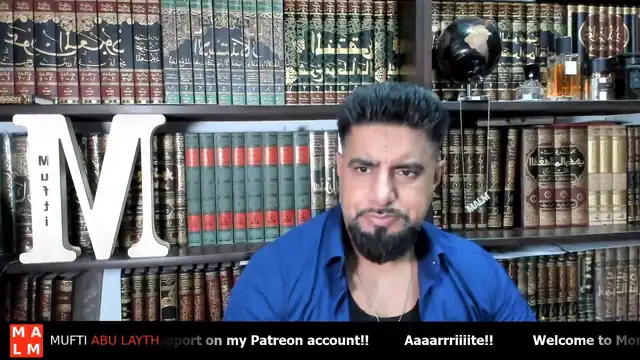 Play from 33:30
The video loads from YouTube only when you press play. Click a time in the transcript to seek.
Watch the answer
Open on YouTube at 33:30The player starts at 33:30, where the answer begins.
This segment33:30 to 37:10 · 3 min 40 sGeneral teaching
The answer in brief
machinesummary, machine-writtenLiberal and conservative are political labels about authority, he says, and they do not truly fit Islam, which never had a church-like hierarchy.
In more detail
After some banter with the chat, Mufti Abu Layth returns to the question of what he thinks about liberal Islam. He says terms like liberal and conservative defined political spectrums of where one stands in relation to authority and state control, and that in Europe liberation from the state also meant liberation from the church. He says it is very difficult to apply these parameters to Islam, which never had a papacy and whose scholars were usually independent, though there were power politics. He asks whether a liberal is someone who goes with the easy rulings, in which case some companions or Imam Abu Hanifa would be liberals, and says Muslims use the words to mean strict and not-so-strict Islam although those rulings come from scholars of the past who would not be called liberal.
Question as read aloud · questioner not identifiedWhat do you think about liberal Islam?
- The question was reconstructed from Mufti Abu Layth's restatement; the questioner's own words are not in the recording
Position stated
Mufti Abu Layth says labels such as liberal and conservative are very difficult to apply to Islam, which never really worked in that way.
“it's very difficult applying these parameters to islam because islam never really worked in that way there was never really a papacy or a pope system in islam”
Category: teaching
Kind: general teachingTranscript
machine33:30 to 37:10 · click a time to seek · dotted terms open the glossary
the nerves are connected people the nerves are connected so um let's go back to what do i think about liberal islam right now i mean i'm not sure what that exactly means because there's a lot of these labels and i don't know if you can really apply these things to religion in that sense because really these were
you see these terms like liberal and conservative and stuff like that were really uh defining spectrums of a polite of politics so it was to do with authority that where you stand in relation to authority that are you somebody who feels that the state should have more involvement in your life or do you feel that you know your anti kind
of totalitarianism and anti-control and you want people to have more liberties and this is what liberal was in essence today to be fair many like um if we're gonna look at um the uk i suppose by that standard most politicians are liberal by that standard and then yes because europe its state was also intertwined with the church so
liberalism being liberated from the state equally meant being liberated from the church because of its power it's very difficult applying these parameters to islam because islam never really worked in that way there was never really a papacy or a pope system in islam and it was never it's just a different paradigm the scholars were usually independent um and they are the ones who came up with the rulings now i'm not saying there were no power politics at play they were
but it's not the same kind of um you know how do you define a liberal is it somebody that just goes with the easy rulings then in that case would you say the companions some of the companions were liberals i mean you wouldn't really use that word for them would you say imam abu hanifa was a liberal i mean it's really difficult understanding what these words mean in terms of islam i know a lot of muslims use them but they're not really they don't not truly meaningful they they seem to be
using them to mean strict islam and not so strict islam but that's not you know because those rulings that they're going to go by will be said by scholars of the past nobody's making those rulings up so how does that work then because those scholars of the past wouldn't be defined as liberal so okay cool let's move on
Paragraphs overlapping 33:30 to 37:10. Full text on the recording page.
Cite this segment
Stable id, transcript version and tier are part of the citation. Every change to a transcript is logged.Mufti Abu Layth Archive, segment 2021-02-16-S10, auto-transcribed, may contain errors. https://muftiabulayth.org/r/--pntsar8ck/s/10/ (accessed 1 November 2026)
- APA 7
Mufti Abu Layth. (2021, February 16). What does the Mufti think of liberal Islam? [Video, segment 2021-02-16-S10, auto-transcribed, may contain errors]. Mufti Abu Layth Archive. Retrieved November 1, 2026, from https://muftiabulayth.org/r/--pntsar8ck/s/10/
- Chicago author-date
Mufti Abu Layth. 2021. "What does the Mufti think of liberal Islam?" Video, segment 2021-02-16-S10, auto-transcribed, may contain errors. Mufti Abu Layth Archive. Recorded February 16, 2021. Accessed November 1, 2026. https://muftiabulayth.org/r/--pntsar8ck/s/10/
- BibTeX
@misc{abulayth-2021-02-16-S10,
  author = {Mufti Abu Layth},
  title = {{What does the Mufti think of liberal Islam?}},
  year = {2021},
  month = {2},
  date = {2021-02-16},
  howpublished = {\url{https://muftiabulayth.org/r/--pntsar8ck/s/10/}},
  url = {https://muftiabulayth.org/r/--pntsar8ck/s/10/},
  organization = {Mufti Abu Layth Archive},
  urldate = {2026-11-01},
  note = {Segment 2021-02-16-S10, auto-transcribed, may contain errors}
}
Something wrong here?
Tell us what is wrong and it will be checked against the recording. Nothing changes until a person has reviewed it.
Sending a note needs JavaScript, which is off or unavailable in this browser. Nothing has been sent.
No name, email address or account is asked for or stored, and the inbox does not store your IP address. For rate limiting it keeps an unreadable fingerprint of your connection for 48 hours, and our database provider's own logs record connections as every website's do. Only your note, its kind, the page and the moment in the recording are kept, for review.