
Recordings › Imam Abu Hanifa | Mufti Abu Layth · 10 Dec 2022 › Segment 1 of 12
Who was Imam Abu Hanifa and where did he come from?
imaam prayer leader muftis koran quraan al-quran sahabah sahabi sahabiyyah sahabiyat tabi'in tabieen tabi'i successors 'alim aalim salam as-salamu alaykum assalamu alaikum assalamualaikum salaams salam alaykum wa alaykum as-salam peace greeting duaa duas duaas supplicationIntroducing Abu Hanifa: the kunya, Persian ancestry, birth in Kufa and a trading family
Most recent answer on The Hanafi school and Imam Abu Hanifa44 earlier answers on this topic, oldest 2015 ↓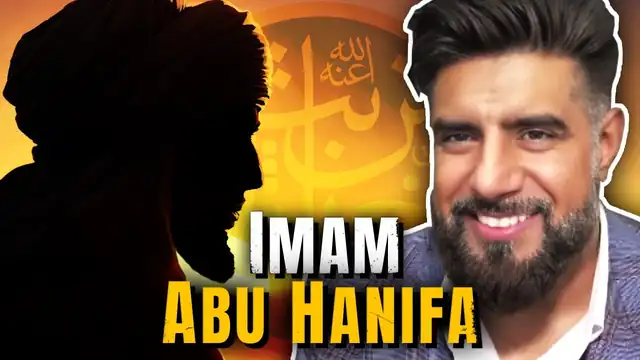 Play from 0:00
The video loads from YouTube only when you press play. Click a time in the transcript to seek.
Watch this part
Open on YouTube at 0:00The player starts at 0:00, the beginning of this part.
This segment0:00 to 6:36 · 6 min 36 sGeneral teaching
What this part covers
machinesummary, machine-writtenAbu Hanifa, a kunya that became his name, was of Persian ancestry with roots in Kabul, was born in Kufa in 80 AH and grew up as a stylish, successful cloth trader before turning to knowledge.
In more detail
Mufti Abu Layth says he wants to introduce the great imams on different occasions, beginning with Abu Hanifa, and explains that Abu Hanifa is a kunya that became his name, as with Abu Hurayra among the Companions; he gives the actual name as he recalls it, garbled in the transcript as Marzaban [?]. He says Abu Hanifa was of Persian ancestry, from a wealthy family originally from Kabul whose grandparents embraced Islam and moved towards Iraq, and that he was born in Kufa in 80 AH, among the later tabi'un or those after them. He relates a story that the grandparents served a dessert, faludhaj, to a notable figure [?] who prayed for the family, and uses it to urge viewers to gift one another a dua, which costs nothing. He says Abu Hanifa grew up in a well-to-do trading family dealing in cloth and textiles, was not initially part of the circles of knowledge, and was a successful, stylish young businessman who kept his dashing dress throughout his life as an imam, at an age when most seekers of knowledge had begun at around ten.
- Some terms in this segment are uncertain
Position stated
No position summary has been recorded for this segment.
Kind: general teachingTranscript
machine0:00 to 6:36 · click a time to seek · dotted terms open the glossary
I thought let's introduce I say introduce everybody knows the legend Imam because what it's a name that we hear so often about but simultaneously maybe some people ain't so familiar with um the great Imam and I thought maybe I could speak on different occasions about different imams and introduce them to you right so Imam Abu hanifa that's his kunya by the way some people they become more popular they like Iconia and they use that as a
name so uh Abu hanifa is a prime example like Abu hurairah from the companions these were not their their names these became their names like it's a Kunia Abu something um so you get people up or late I I use a Kunia as a name so some people the acunia is it's just it's an adopted name and Imam Abu hanifa his actual name was
yeah I believe it's marzaban yes so his ancestry was he was of Persian ancestry um he was born in 80 history so that's about 70 years after the prophet salallahu he was from the either the the the the the the lower end of the tabern or from the upper end of the tabataba and those who come after the turbine so you have the sahaba the companions of the Prophet then you have those who come after turbine so he's either from them or from the the the Tibetan who come
after them his parents and sorry his grandparents are the ones who embraced Islam I believe in the time of uh some people say in the time of um or some people say in the time of Allah but they were from a they were from a wealthy background and they embraced Islam and they were from originally from Kabul in modern day Afghanistan so I don't know whether that makes them baton maybe I don't know but or maybe more
Farsi speak but I don't know because he would have spoke he spoke Farsi so I guess but I don't know where the back then so you got to go back you see at least over 12 1300 years ago so so at that stage I don't know whether Pashto was developed or not but yeah so he was from his his ancestry was from Kabul his grandparents moved towards Iraq and so on they embraced Islam he himself is born in kufa in the year 80 history um some people say that there's a myth that his grandparents
um served a gift to and they were they were great hospitable people and they served a gift to say who made Dua for them you know this is and this is something as well look one it's something try to give gifts to people and also if you receive something nice try to make a Dua for someone and try to gift the gift of Dua to someone you see it doesn't cost you anything to make a Dua you know may Allah bless you may Allah
keep you smiling may Allah you know fill your life with happiness I mean you know it costs nothing why do we struggle to say this to someone it's because it's something in ourselves a disease and of the heart man so yeah so people say that some and there's some stories that you know like faluda there's uh I don't know whether it's the same falooda but there was an old dessert known as valuzaj and some people say he served the grandparents served that to say who in turn made to our may Allah bless
your family or something and they say that you know as a consequence of this Dua you have the legend of Imam that family but he was born in the eight year eighty history he grew up in a world-to-do family that was from a trading background his parents his father was also a Trader uh um into you usually I mean I suppose there were many different trades but they were into cloth and fabric and textiles that kind of trade didn't actually grow up
um inclined towards Islamic uh knowledge and that kind of stuff he wasn't a part of those circles so obviously he was a Muslim he I'm not saying he he I'm sure he was a great Muslim but he was just a normal Muslim he wasn't he was a businessman that he wasn't a scholar of Islam who used to go to circles and some people say he memorized the Quran as a kid but I guess in that day and age many people memorize the Quran as children but he wasn't inclined he you know he grew up he was a young man he was into business he was doing well very well in business and they say you know you'd
wear the most expensive of clothes very stylish clothes even right through his Imam ship he always maintained that style he he would often wear you know like Dapper clothing and dashing style he had and um he would he would be very Innovative with his fashion sense now they say one day he as a young man so I'm not sure what arguably in his maybe 20s which was quite yeah it was quite an age because back then people weren't you know those who got into seeking Islamic knowledge
got into it when they were just maybe from the age of 10. so this is now you've fully developed you're a grown man you know your business mind you're thriving he was walking through um in Iraq once and he walks past shabi the great turbo um and he was a great Imam has his own mother very well known Sharpie and he walks past him and shabby says to him uh he looks at Shelby and shabby looks at him and he and he says salaam and he calls him and you know who at that time he's just not a man
Paragraphs overlapping 0:00 to 6:36. Full text on the recording page.
Cite this segment
Stable id, transcript version and tier are part of the citation. Every change to a transcript is logged.Mufti Abu Layth Archive, segment 2022-12-10-S01, auto-transcribed, may contain errors. https://muftiabulayth.org/r/s-vm6mgbll8/s/1/ (accessed 1 November 2026)
- APA 7
Mufti Abu Layth. (2022, December 10). Who was Imam Abu Hanifa and where did he come from? [Video, segment 2022-12-10-S01, auto-transcribed, may contain errors]. Mufti Abu Layth Archive. Retrieved November 1, 2026, from https://muftiabulayth.org/r/s-vm6mgbll8/s/1/
- Chicago author-date
Mufti Abu Layth. 2022. "Who was Imam Abu Hanifa and where did he come from?" Video, segment 2022-12-10-S01, auto-transcribed, may contain errors. Mufti Abu Layth Archive. Recorded December 10, 2022. Accessed November 1, 2026. https://muftiabulayth.org/r/s-vm6mgbll8/s/1/
- BibTeX
@misc{abulayth-2022-12-10-S01,
  author = {Mufti Abu Layth},
  title = {{Who was Imam Abu Hanifa and where did he come from?}},
  year = {2022},
  month = {12},
  date = {2022-12-10},
  howpublished = {\url{https://muftiabulayth.org/r/s-vm6mgbll8/s/1/}},
  url = {https://muftiabulayth.org/r/s-vm6mgbll8/s/1/},
  organization = {Mufti Abu Layth Archive},
  urldate = {2026-11-01},
  note = {Segment 2022-12-10-S01, auto-transcribed, may contain errors}
}
Something wrong here?
Tell us what is wrong and it will be checked against the recording. Nothing changes until a person has reviewed it.
Sending a note needs JavaScript, which is off or unavailable in this browser. Nothing has been sent.
No name, email address or account is asked for or stored, and the inbox does not store your IP address. For rate limiting it keeps an unreadable fingerprint of your connection for 48 hours, and our database provider's own logs record connections as every website's do. Only your note, its kind, the page and the moment in the recording are kept, for review.