
Recordings › Before my Mum's Burial - Final Farewell #Duas #LoveYouMum الله يرحمك ❤️🙏🏽 · 26 May 2023 › Segment 1 of 1
What is the funeral prayer and what do you say in it?
salaah namaz salaat namaaz as-salah al-salah salawat hadeeth ahadith ahaadeeth hadis hadees ahaadith takbeer takbirat takbeerat allahu akbar janaza namaz-e-janaza janaza prayer janazah prayer koran quraan al-quran ulema ulamaa salam as-salamu alaykum assalamu alaikum assalamualaikum salaam salaams salam alaykum wa alaykum as-salam greeting duaa duas duaas supplication ikhlas ikhlaas rahmah rahmat mercyA funeral address: death as a reminder, and the janazah as a du'a
Most recent answer on Funerals and burial1 earlier answer on this topic, oldest 2020 ↓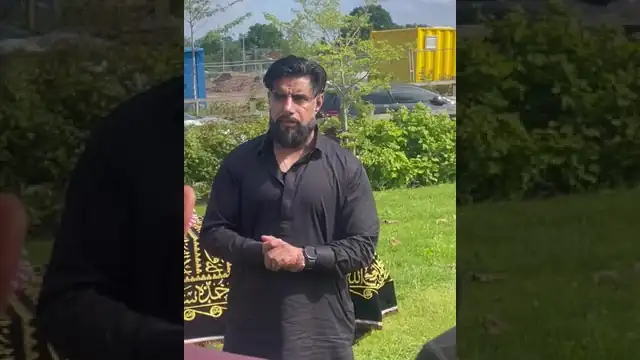 Play from 3:14
The video loads from YouTube only when you press play. Click a time in the transcript to seek.
Watch this part
Open on YouTube at 3:14The player starts at 3:14, the beginning of this part.
This segment0:01 to 4:49 · 4 min 48 sGeneral teaching
What this part covers
machinesummary, machine-writtenThe funeral prayer is in essence a sincere du'a for the deceased; many scholars allow any du'a, in any language, across its four takbirs.
In more detail
The speaker says death is the ultimate reminder, citing the verses that God created death and life to test who is best in deeds and that every soul shall taste death. He describes the deceased's nine months of illness as a lesson of strength in the face of death, quotes a classical Arabic eulogy that a person's passing was the collapse of a building, and relates a hadith that the dead seek news of their living relatives and pray for them. He explains that the janazah is in essence a du'a, citing the hadith to make the du'a sincere for the deceased, and says many ulama hold that any du'a may be said, in any language, across the four takbirs. He closes with the verses addressed to the soul at peace, which the scholars say refer to the time of death.
Position stated
Mufti Abu Layth says the janazah is in essence a du'a for the deceased.
“The janazah is really in essence a dua. The hadith of the prophet is either salatum ala al-mayyit fa akhlisu lahu dua.”
Category: teaching
Kind: general teachingTranscript
machine0:01 to 4:49 · click a time to seek · dotted terms open the glossary
Death is the ultimate reminder for us all. Allah says in the Quran that he has created death and says death first then life.
That he may see who amongst you excels in your actions. That every soul shall taste death. And that's all it is, it's a taste into another world.
Something that we will all have to do. Greatest lesson that Allah taught us in this last stage which which almost in a poetic sense mirrored the birth, it lasted for 9 months of uh illness.
With a strength was a lesson of strength facing death in the face of death and still bond is as a legacy for all of us. Some people when they go
there's a poem about a very popular person in place that says But his This was said as it was the best thing ever eulogy in Arabic ever written about someone. He said he was his his his perishing was not just the perishing of an individual, but it was the foundation of a building that dilapidated.
And I read a beautiful hadith just a few weeks before. It said that when when people pass into the next world, the malta, they continue to seek news and find out about their living relatives and they continue to make dua for them to God in the presence of God.
So in many ways the hadith said that their passing is equal to sometimes it it comes as a tragedy, but in it it has a rahma from Allah that when they're gone there they continue to pray. So May Allah make things easy for all who have passed, especially my mom. For us all. Yeah.
This The janazah is really in essence a dua. The hadith of the prophet is either salatum ala al-mayyit fa akhlisu lahu dua. That if if a person passes, really what you do is you with the most sincerity make dua for them. That is what salat al-janazah is. We're doing this once again just seeking that dua. It is with four takbirats.
Really, it's up to many ulama do say that you can read the fatiha, you can read just a dua or durood or say a dua, but really, according to many ulama, you just say a dua. Any dua, and in according to many of them you can do it in any language. It doesn't have to just be Arabic. Obviously, Arabic is there, so we do the fourth takbir out on the fourth one we do salah.
And you just make a dua that this is a There is no greater lesson than this. We're going to all uh someday be in this position. The question is what do we leave behind as a legacy for those who come after? And as to the person who's passed, then Allah says, "Ya ayyatuha an-nafs al-mutma'innah." The soul that is now at peace.
"Irji'i ila rabbiki radiyatan mardiyyah." That return to your Lord in a state of pleasedness from Allah. "Fadkhuli fi 'ibadi wadkhuli jannati." The scholars say that is at the time of death. Many of them say that Allah makes things easy for them.
Paragraphs overlapping 0:01 to 4:49. Full text on the recording page.
Cite this segment
Stable id, transcript version and tier are part of the citation. Every change to a transcript is logged.Mufti Abu Layth Archive, segment 2023-05-26-S01, auto-transcribed, may contain errors. https://muftiabulayth.org/r/y-jdmojfgnu/s/1/ (accessed 1 November 2026)
- APA 7
Mufti Abu Layth. (2023, May 26). What is the funeral prayer and what do you say in it? [Video, segment 2023-05-26-S01, auto-transcribed, may contain errors]. Mufti Abu Layth Archive. Retrieved November 1, 2026, from https://muftiabulayth.org/r/y-jdmojfgnu/s/1/
- Chicago author-date
Mufti Abu Layth. 2023. "What is the funeral prayer and what do you say in it?" Video, segment 2023-05-26-S01, auto-transcribed, may contain errors. Mufti Abu Layth Archive. Recorded May 26, 2023. Accessed November 1, 2026. https://muftiabulayth.org/r/y-jdmojfgnu/s/1/
- BibTeX
@misc{abulayth-2023-05-26-S01,
  author = {Mufti Abu Layth},
  title = {{What is the funeral prayer and what do you say in it?}},
  year = {2023},
  month = {5},
  date = {2023-05-26},
  howpublished = {\url{https://muftiabulayth.org/r/y-jdmojfgnu/s/1/}},
  url = {https://muftiabulayth.org/r/y-jdmojfgnu/s/1/},
  organization = {Mufti Abu Layth Archive},
  urldate = {2026-11-01},
  note = {Segment 2023-05-26-S01, auto-transcribed, may contain errors}
}
Something wrong here?
Tell us what is wrong and it will be checked against the recording. Nothing changes until a person has reviewed it.
Sending a note needs JavaScript, which is off or unavailable in this browser. Nothing has been sent.
No name, email address or account is asked for or stored, and the inbox does not store your IP address. For rate limiting it keeps an unreadable fingerprint of your connection for 48 hours, and our database provider's own logs record connections as every website's do. Only your note, its kind, the page and the moment in the recording are kept, for review.