
Recordings › Prof. Dr Khalil Andani | The Oral Text & the Ontology of The Quran | Mindtrap with Mufti #28 · 3 Jul 2020 › Segment 18 of 23
Viewer questions begin; the guest's connection drops
imaam imams prayer leader hambali hanbalite hanbali school muftis ilm al-kalam kalaam theology ashaira asha'irah ashariyyah ash'arite koran quraan al-quran ahl al-sunnah ahl as-sunnah ahlus sunnah ahl al-sunna sunnis ulama ulema ulamaa taqwaa muttaqi god-consciousness piety rahmah rahma rahmat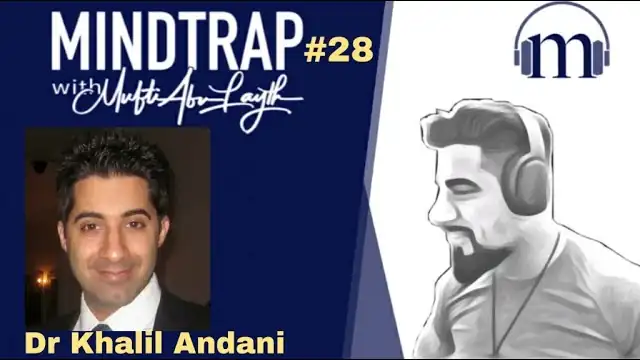 Play from 1:28:45
The video loads from YouTube only when you press play. Click a time in the transcript to seek.
Watch this part
Open on YouTube at 1:28:45The player starts at 1:28:45, the beginning of this part.
This segment1:28:45 to 1:33:10 · 4 min 25 s
What this part covers
machinesummary, machine-writtenHousekeeping: Mufti Abu Layth opens viewer questions and reconnects the guest after his connection drops.
In more detail
Mufti Abu Layth opens the floor to viewers' questions, thanks those sending super chats and, responding to a comment that non-Muslims were supporting him, says the Prophet was a mercy to everyone and one should not discriminate between Muslims and non-Muslims. He reads a comment on the Hanbali and Ash'ari views without finding a question in it. The guest's connection freezes and Mufti calls him again; once he is back, Mufti relays viewers' jokes and a comment that their approach is called liberal and modern, to which the guest says he is unclear what is being called that and Mufti says they are quoting traditional scholars.
Position stated
No position summary has been recorded for this segment.
Speakers: host and guest; guest speech is labelled and excluded from positionsTranscript
machine1:28:45 to 1:33:10 · click a time to seek · dotted terms open the glossary
A guest speaks in this segment. Guest speech is labelled and is excluded from the positions layer.
Or can we just call God Jawad, for example, because the most generous, but Jawad isn't a name given in in the texts about Allah. So this debate, I feel kind of touched up on that um are the names inherently divine or are they just means? I was I was going to say, Professor, I'd like to quite a few people had put up some questions.
I'd like to take a few questions, just engage some of our uh our beloved viewers. Uh first of all, just a uh a PI a shout out, you're doing it with the super chats. I did see Abdullah Samir was on saying, "My two favorite Muslim scholars." [laughter] Much love. Much love, Abdullah Samir. Uh somebody had said, "Oh my God, Mufti, you've got uh ex-Muslims or you've got atheists uh supporting you with super chats." [laughter] That's the love, you see?
You see, you need to spread the message of love. It does not matter whether they believe or don't believe. The prophet was not just a paragon of mercy and compassion just to Muslims. It was the al-alameen for everybody. You know, you need to smile with a person who's Muslim or non-Muslim. You can't discriminate against people. So, right. Right. So, people, if you've got any questions, feel free to put them through.
I'll um I'll start reading them out. From what I've heard, animal Oh, right. That's to do with evolution. All right. We've had such a an awesome discussion on this. So, let's if there's if there's anything around this or something specific because we've got to wrap it up as well pretty soon. So, if there are Let me just read the Facebook as well.
When the Ash'aris view Kalam as you said it's part of the divine knowledge and a meaning not physical Kalam. I like Hanbalis view, hence they don't have God as being made of created attributes or composites. We're differentiating between a concept and possible logical correlations. I I don't I'm not sure where the question was. [laughter] There was a whole comment in that, but I don't know where the question was.
So, we totally that's absolutely agree with that. All right. Imam Qazi, you're doing it. You're doing it. Much love. Right. Let's see. There's a bit of a poor connection with professor as well. Um I take it he's Professor, have we lost you? [laughter] Professor seems to have frozen.
Professor. Right. So, I see professor is frozen. Shall we disconnect and call him again? We're calling professor again, people. We seem to have lost him. Well, well.
All right. Professor, you're back. Yeah, I heard you were I heard you're taking questions, so I ran away. [snorts and laughter] Right. So, right. Let me just No problem. Look at that. It just completely It's It's your It's all your knowledge, professor. You've completely Let me just bring this up here. You've You've kind of transported yourself right over all of the screen.
Let me There you go. That's much better and I'll fix it up. People, your comments professor is back. They were like, "Where's professor gone?" Somebody said you look like Ed Miliband. Somebody had mentioned you look like Ross from Friends. Yeah, I've got that. Have you heard that before, professor? [laughter] Right. So, people, any any interesting dis- Some argue our approach is liberal modern, but we simply point out that the Quran calls itself the Mizan and Furqan.
So, professor, if people are arguing this is just a modern way of looking things and people historically didn't really look at things like this. I mean, would you feel that's an accurate claim to make? I'm not clear what is being called liberal or modern. Like what we said about the Quran is being called liberal or modern or like the Because we're quoting in essence traditional people, are we not? We're not We're not saying, "Well, today we're saying this." We're saying that well, people have been saying this and that to, you know, for the most part Sunni scholars or or these scholars or Ash'aris and Um Right.
Here's another question from PI. Did love not being a fundamental Did love not being a fundamental attribute of God play a role in historical discussions between Islam and Christianity? That's an interesting question. Love isn't actually help, even though it's mentioned as an act Allah saying in Allah youhib, you know, he loves this youhibu shakireen, youhibul those people who are taqwa or do good, but it's not an attribute of God.
Paragraphs overlapping 1:28:45 to 1:33:10. Full text on the recording page.
Cite this segment
Stable id, transcript version and tier are part of the citation. Every change to a transcript is logged.Mufti Abu Layth Archive, segment 2020-07-03-S18, auto-transcribed, may contain errors. https://muftiabulayth.org/r/xznxiyp0b5s/s/18/ (accessed 1 November 2026)
- APA 7
Mufti Abu Layth. (2020, July 3). Viewer questions begin; the guest's connection drops [Video, segment 2020-07-03-S18, auto-transcribed, may contain errors]. Mufti Abu Layth Archive. Retrieved November 1, 2026, from https://muftiabulayth.org/r/xznxiyp0b5s/s/18/
- Chicago author-date
Mufti Abu Layth. 2020. "Viewer questions begin; the guest's connection drops." Video, segment 2020-07-03-S18, auto-transcribed, may contain errors. Mufti Abu Layth Archive. Recorded July 3, 2020. Accessed November 1, 2026. https://muftiabulayth.org/r/xznxiyp0b5s/s/18/
- BibTeX
@misc{abulayth-2020-07-03-S18,
  author = {Mufti Abu Layth},
  title = {{Viewer questions begin; the guest's connection drops}},
  year = {2020},
  month = {7},
  date = {2020-07-03},
  howpublished = {\url{https://muftiabulayth.org/r/xznxiyp0b5s/s/18/}},
  url = {https://muftiabulayth.org/r/xznxiyp0b5s/s/18/},
  organization = {Mufti Abu Layth Archive},
  urldate = {2026-11-01},
  note = {Segment 2020-07-03-S18, auto-transcribed, may contain errors}
}
Something wrong here?
Tell us what is wrong and it will be checked against the recording. Nothing changes until a person has reviewed it.
Sending a note needs JavaScript, which is off or unavailable in this browser. Nothing has been sent.
No name, email address or account is asked for or stored, and the inbox does not store your IP address. For rate limiting it keeps an unreadable fingerprint of your connection for 48 hours, and our database provider's own logs record connections as every website's do. Only your note, its kind, the page and the moment in the recording are kept, for review.