
Recordings › Prof. Dr Khalil Andani | The Oral Text & the Ontology of The Quran | Mindtrap with Mufti #28 · 3 Jul 2020 › Segment 17 of 23
Where do anthropomorphic ideas of God in Islam come from?
aqidah aqeedah aqida creed aqeeda aqaid hadeeth ahadith ahaadeeth hadis hadees ahaadith malik ibn anas malik bin anas imam maalik imam malik ibn anas imaam imams prayer leader hambali hanbalite hanbali school muftis ilm al-kalam kalaam ash'ari ashaira asha'irah ashariyyah ash'arite ayah aya ayat ayaat aayah aayat sufism soofi aalim scholarAnthropomorphism, 'created in his image', and the names of God as relations
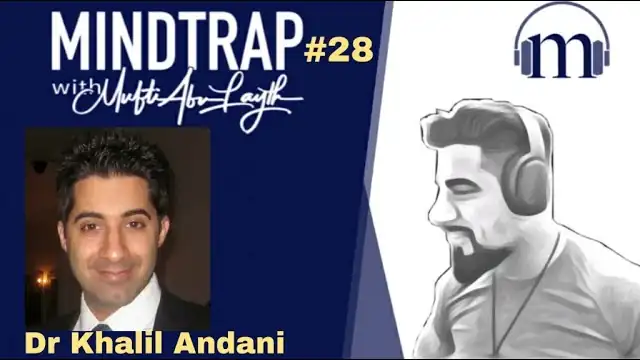 Play from 1:24:04
The video loads from YouTube only when you press play. Click a time in the transcript to seek.
Watch this part
Open on YouTube at 1:24:04The player starts at 1:24:04, the beginning of this part.
This segment1:24:04 to 1:28:45 · 4 min 41 sGeneral teaching
What this part covers
machinesummary, machine-writtenMufti Abu Layth suggests anthropomorphic texts were partly inherited from the Judeo-Christian tradition; the guest describes the Sufi, philosophical and Isma'ili view that God's names describe relations, not his essence.
In more detail
The guest says struggling with anthropomorphic ideas of God is not only a Hanbali or Muslim problem, recalling a survey in which Americans described God as a white person. Mufti Abu Layth says he feels much of the anthropomorphic textual side of the debate was perhaps inherited from the Judeo-Christian tradition, such as Genesis on man created in God's image, which is presented as a hadith although Imam Malik rejected it. The guest says Sufi, Avicennan and Isma'ili thinkers avoided the problem through negative theology: they held that the divine names are analogical at best and describe not God's essence but relationships between God and creatures, so that God's one power manifests as many powers in creation, which Mufti says makes a huge amount of sense. Mufti mentions the debate over whether the names of God are tawqifi, such as whether God may be called Jawad.
- Guest speech overlaps this segment
Position stated
Waiting for the speaker checkA guest speaks in this segment and the captions do not say who said what. The view found here is held back until the speaker-separated transcript confirms the words are his, or the channel verifies it. The transcript and recording are published in full.
Kind: general teaching Speakers: host and guest; guest speech is labelled and excluded from positionsTranscript
machine1:24:04 to 1:28:45 · click a time to seek · dotted terms open the glossary
A guest speaks in this segment. Guest speech is labelled and is excluded from the positions layer.
Obviously, that's how the mind uh operates. But yeah, so I I find uh the Hanbali almost a paradox within within Kalam, the whole and their description of God in this day and age, the 21st century, um I'm not surprised people don't struggle with it.
Yeah, I think I think it this idea of struggling with very human anthropomorphic ideas of God, I don't even think it's it's it's a exclusively Hanbali or Muslim problem. I think uh Christians all over especially in the West, um I I I recall some survey that was done among Americans asking people to describe God and and God turned out to be a a white person, you know.
Yeah. Uh so I think this this anthropo the the problem of I mean, I would actually feel that a huge part of the anthropomorphized textual uh face of of of this debate. I don't mean just the ideas, the human, but the textual side to it has perhaps been inherited from the Judeo-Christian side. Like, you know, the the famous uh Genesis verse that God created man in his own image.
This is then presented as a Hadith, even though Imam Malik rejected it, but people say in Allah, you know, khalaqa Adam ala suratihi or in al-Rahman khalaqa Adam ala suratihi. So Yeah. Mhm. No, it it's true and and that that that idea of created in the image of God, I mean, although the the exact formulation is is not there, um I think humans we we cannot help but like cast everything in our own image.
And I think this is where like the Sufi, the Avicennan, and the Isma'ili contributions to this issue of God are are quite noteworthy because these groups in their own way um totally avoided this problem. Right? Where you have like Islamic negative theology, which is very anti-anthropomorphic. Uh none of these groups um actually believe God has distinct attributes.
They also go beyond the Mu'tazilis. They'll say that actually, no, the divine names, they don't really describe God at all. They're best They're best analogical. Mhm. You know, they're analogical at best. Um At at at at worst, they even don't they don't describe God at all. They actually describe God's God's creation. Yeah. Um so for the Sufis approximation. Yeah. Yeah, cuz like what you you never have the Ash'aris say that God's names are analogical or metaphorical.
That's not there. But you do have Avicenna-type philosophers, Sufis, and Isma'ilis, they will say that the names are metaphorical or analogical. The the Sufis and the Isma'ilis would say, for example, that every divine name refers not to God's debate. Oh, sorry. Yeah. Well, I was just going to say that that the the Isma'ilis and the Sufis, they would say that um the given divine name like Rahman or Rahim or Alim, they don't refer to they don't actually describe God's essence.
At best, they describe a relationship between God and creatures. That that actually makes a huge amount of sense. Well, you have multiple relationships and none of this imposes multiplicity on God. God remains God, but creatures relate to God in different ways. So a certain creature seems to partake in certain attributes more than others. And whatever power is a creature has, ultimately those powers come from God.
So in God, there's no multiplicity. There's only this self-existent infinite necessary being, but in creatures, that one power of God, the one being of God in creatures, that manifests as multiple powers. Yeah. And this is really our journey up to God like intellectually. It's not God's journey down to us. So we are Yeah, I I just about the debate, I was going to say I think there was some debate, although I feel it may have been historically killed off.
Uh in the discussion where they say Hal asma Allah tawqifiyyah, are the names of God divine? Or can we just call him anything? So they have this debate where they say, can we say anything that's nice like God is goodness, for example? Can we say that? Uh because God hasn't called himself Khair al-Khair, for example. He's called himself Khair al-Raziqin and Khair al- this, but he hasn't just said.
Or can we just call God Jawad, for example, because the most generous, but Jawad isn't a name given in in the texts about Allah. So this debate, I feel kind of touched up on that um are the names inherently divine or are they just means? I was I was going to say, Professor, I'd like to quite a few people had put up some questions.
Paragraphs overlapping 1:24:04 to 1:28:45. Full text on the recording page.
Cite this segment
Stable id, transcript version and tier are part of the citation. Every change to a transcript is logged.Mufti Abu Layth Archive, segment 2020-07-03-S17, auto-transcribed, may contain errors. https://muftiabulayth.org/r/xznxiyp0b5s/s/17/ (accessed 1 November 2026)
- APA 7
Mufti Abu Layth. (2020, July 3). Where do anthropomorphic ideas of God in Islam come from? [Video, segment 2020-07-03-S17, auto-transcribed, may contain errors]. Mufti Abu Layth Archive. Retrieved November 1, 2026, from https://muftiabulayth.org/r/xznxiyp0b5s/s/17/
- Chicago author-date
Mufti Abu Layth. 2020. "Where do anthropomorphic ideas of God in Islam come from?" Video, segment 2020-07-03-S17, auto-transcribed, may contain errors. Mufti Abu Layth Archive. Recorded July 3, 2020. Accessed November 1, 2026. https://muftiabulayth.org/r/xznxiyp0b5s/s/17/
- BibTeX
@misc{abulayth-2020-07-03-S17,
  author = {Mufti Abu Layth},
  title = {{Where do anthropomorphic ideas of God in Islam come from?}},
  year = {2020},
  month = {7},
  date = {2020-07-03},
  howpublished = {\url{https://muftiabulayth.org/r/xznxiyp0b5s/s/17/}},
  url = {https://muftiabulayth.org/r/xznxiyp0b5s/s/17/},
  organization = {Mufti Abu Layth Archive},
  urldate = {2026-11-01},
  note = {Segment 2020-07-03-S17, auto-transcribed, may contain errors}
}
Something wrong here?
Tell us what is wrong and it will be checked against the recording. Nothing changes until a person has reviewed it.
Sending a note needs JavaScript, which is off or unavailable in this browser. Nothing has been sent.
No name, email address or account is asked for or stored, and the inbox does not store your IP address. For rate limiting it keeps an unreadable fingerprint of your connection for 48 hours, and our database provider's own logs record connections as every website's do. Only your note, its kind, the page and the moment in the recording are kept, for review.