
Recordings › Prof. Dr Khalil Andani | The Oral Text & the Ontology of The Quran | Mindtrap with Mufti #28 · 3 Jul 2020 › Segment 19 of 23
Is love one of God's attributes in Islam?
muftis ilm al-kalam kalaam theology sufism soofi taqwaa muttaqi god-consciousness piety rahmat mercyIs love an attribute of God? Sufi and Kalam traditions
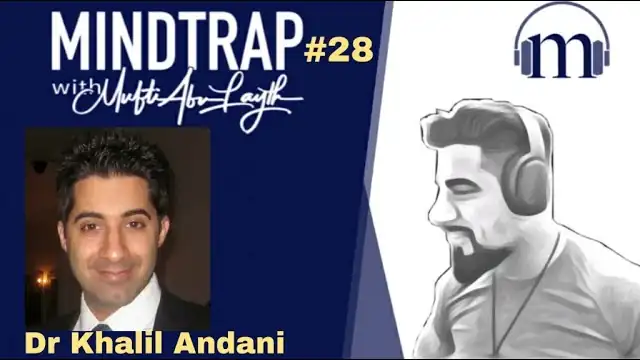 Play from 1:33:37
The video loads from YouTube only when you press play. Click a time in the transcript to seek.
Watch the answer
Open on YouTube at 1:33:37The player starts at 1:33:37, where the answer begins.
This segment1:33:10 to 1:35:02 · 1 min 52 sA view quoted in order to be discussed, not a position held
The answer in brief
machinesummary, machine-writtenThe guest says Sufi traditions understand God's mercy as love even though Kalam rarely speaks of it, and rejects the polemic that the God of Islam is not loving.
In more detail
A chat question asks whether love not being a fundamental attribute of God played a role in historical discussions between Islam and Christianity. Mufti Abu Layth notes that God is said to love certain people, but that love is not listed as an attribute. The guest says it depends on the tradition: in the Sufi tradition of Ibn Arabi, Rumi and others the meaning of Rahman is loving compassion, and some mystics said God's very essence is rahmah, whereas the Kalam tradition hardly speaks of it, which is why Sufis criticised the theologians as dry. He says he has not researched its role in Christian-Muslim relations, notes the modern Christian polemic that the God of Islam is not loving, and rejects generalised statements because there is more than one Islam.
Question as read aloud · questioner not identifiedDid love not being a fundamental attribute of God play a role in historical discussions between Islam and Christianity?
Position stated
This segment presents a view in order to discuss or respond to it. It is recorded as quoted, never as held, and no position is attributed from it.
Kind: a view quoted in order to be discussed, not a position held Speakers: host and guest; guest speech is labelled and excluded from positionsTranscript
machine1:33:10 to 1:35:02 · click a time to seek · dotted terms open the glossary
A guest speaks in this segment. Guest speech is labelled and is excluded from the positions layer.
This segment states a view in order to discuss it. It is recorded as a quoted view, not as a position held.
Here's another question from PI. Did love not being a fundamental Did love not being a fundamental attribute of God play a role in historical discussions between Islam and Christianity? That's an interesting question. Love isn't actually help, even though it's mentioned as an act Allah saying in Allah youhib, you know, he loves this youhibu shakireen, youhibul those people who are taqwa or do good, but it's not an attribute of God.
Uh Take it away, professor. What's going on here? I think it depends which which Muslim tradition truth tradition or truth discourse we're talking about. I would argue that in the Sufi tradition and the tradition of Ibn Arabi and Rumi and others, when they refer to God as Rahman, the meaning of Rahman is is love.
Loving compassion. I think there's a strong argument to be made because many of these Sufi mystics, they said God's very essence is Rahma. So, God's very substance is Rahma, which includes love. Rahma is not It doesn't just refer I mean, the translation compassion is good, but it's not very full. So, I think at least in some traditions, the esoteric mystical traditions, there certainly is an emphasis on God's love.
I would agree that in the Kalam tradition, you don't really hear about it. And that's why the Sufis criticize them with the Kalamun for being dry and sort of you know, lacking in emotion and lacking in devotion. Now, as for its role in Christian-Muslim relations, it's hard to really say. I haven't really researched that. I don't know. I know today it's a Christian polemical talking point that the God of Islam is not a loving God, but again, it depends which theological school you follow.
Paragraphs overlapping 1:33:10 to 1:35:02. Full text on the recording page.
Cite this segment
Stable id, transcript version and tier are part of the citation. Every change to a transcript is logged.Mufti Abu Layth Archive, segment 2020-07-03-S19, auto-transcribed, may contain errors. https://muftiabulayth.org/r/xznxiyp0b5s/s/19/ (accessed 1 November 2026)
- APA 7
Mufti Abu Layth. (2020, July 3). Is love one of God's attributes in Islam? [Video, segment 2020-07-03-S19, auto-transcribed, may contain errors]. Mufti Abu Layth Archive. Retrieved November 1, 2026, from https://muftiabulayth.org/r/xznxiyp0b5s/s/19/
- Chicago author-date
Mufti Abu Layth. 2020. "Is love one of God's attributes in Islam?" Video, segment 2020-07-03-S19, auto-transcribed, may contain errors. Mufti Abu Layth Archive. Recorded July 3, 2020. Accessed November 1, 2026. https://muftiabulayth.org/r/xznxiyp0b5s/s/19/
- BibTeX
@misc{abulayth-2020-07-03-S19,
  author = {Mufti Abu Layth},
  title = {{Is love one of God's attributes in Islam?}},
  year = {2020},
  month = {7},
  date = {2020-07-03},
  howpublished = {\url{https://muftiabulayth.org/r/xznxiyp0b5s/s/19/}},
  url = {https://muftiabulayth.org/r/xznxiyp0b5s/s/19/},
  organization = {Mufti Abu Layth Archive},
  urldate = {2026-11-01},
  note = {Segment 2020-07-03-S19, auto-transcribed, may contain errors}
}
Something wrong here?
Tell us what is wrong and it will be checked against the recording. Nothing changes until a person has reviewed it.
Sending a note needs JavaScript, which is off or unavailable in this browser. Nothing has been sent.
No name, email address or account is asked for or stored, and the inbox does not store your IP address. For rate limiting it keeps an unreadable fingerprint of your connection for 48 hours, and our database provider's own logs record connections as every website's do. Only your note, its kind, the page and the moment in the recording are kept, for review.