
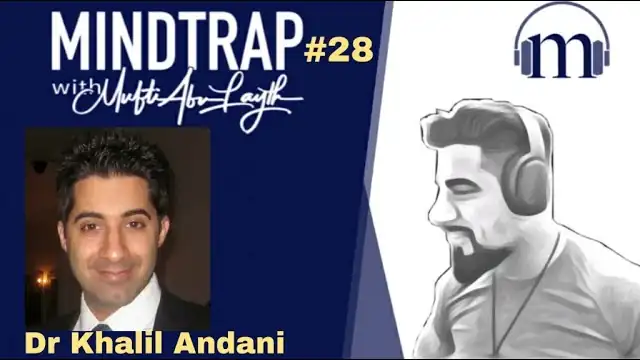
Recordings › Prof. Dr Khalil Andani | The Oral Text & the Ontology of The Quran | Mindtrap with Mufti #28 · 3 Jul 2020 › Segment 14 of 23
Were the companions allowed to change words of the Quran, and was that only a temporary concession?
hadeeth ahadith ahaadeeth hadis hadees ahaadith malik bin anas imam maalik imam malik ibn anas imaam imams prayer leader shafi shafei shafiite shafi'i school qiyas qiyaas muftis rukhas koran quraan al-quran sura soorah surat suwar soora chapter qira'ah qiraa'aat qira'aat tilawah tilawat tilaawah sahabah sahabi sahabiyyah sahabiyat ulama ulema ulamaaThe dynamic Quran: the seven ahruf, substituting words, rukhsah or default?
 Play from 1:03:43
The video loads from YouTube only when you press play. Click a time in the transcript to seek.
Watch this part
Open on YouTube at 1:03:43The player starts at 1:03:43, the beginning of this part.
This segment1:03:08 to 1:10:02 · 6 min 54 sGeneral teaching
What this part covers
machinesummary, machine-writtenThe guest argues the Prophet allowed multiple oral forms of the Quran; Mufti Abu Layth says this dynamism was the Quran's inherent nature, not a temporary concession.
In more detail
Mufti Abu Layth says seeing the Quran as a dynamic meaning makes it easier to understand that people substituted similar words. The guest says many Muslims and academics take a fixed view of the Quran, but since the recitation is only a gateway to the divine speech there is theologically no problem with the seven ahruf or with the Prophet allowing multi-form recitations and substitution of divine names; he thinks the ahruf hadith is early, sees no reason it would be forged in Malik's time, and agrees with Yasin Dutton that there is no single original text or recitation. Mufti says scholars such as Ibn Abd al-Barr report that Malik, al-Shafi'i and others held that the companions substituted words, and that some, including Abu Bakr ibn al-Arabi, called this a rukhsah that lapsed with them. He says he would rather hold that this dynamism was inherent, the actual nature of the Quran rather than a rukhsah or azimah, comparing readings to isotopes of which one stabilises and predominates, as the reading of Hafs from Asim did.
- Guest speech overlaps this segment
Position stated
Waiting for the speaker checkA guest speaks in this segment and the captions do not say who said what. The view found here is held back until the speaker-separated transcript confirms the words are his, or the channel verifies it. The transcript and recording are published in full.
Kind: general teaching Speakers: host and guest; guest speech is labelled and excluded from positionsTranscript
machine1:03:08 to 1:10:02 · click a time to seek · dotted terms open the glossary
A guest speaks in this segment. Guest speech is labelled and is excluded from the positions layer.
cave. That he was doing this this spiritual meditation in the cave and then because the bar in here, it's been argued that it's it's what they call a either bar. So, like the bar is there you you you vocalize the the bar, but in meaning it doesn't take any meaning. It's silent in the But, even if it even if it did take meaning with that, it would still fit in the sense that you know, this how you're trying to connect do it with or in the name of God.
That's an interesting I've well, I've never really thought of it like that, but that's a very fascinating kind of take. I feel that this whole thing of seeing the Quran with this kind of dynamism like let's say it is a a meaning it is and Allah is the say it is it is not a kind of Arabic This then gives much more kind of it really fleshes out the argument that the Quran when it does manifest can have a dynamic nature to it.
Like let's say when people did synonymize certain words, they substituted certain words that were very similar, but this wasn't really something it was not I mean it it isn't then all of a sudden such a difficult thing to comprehend. Do you feel this or Well, yeah, I think what has happened and I don't know whether it's just a modern phenomenon or whether there's classical roots for this, but like many many views about the Quran and this is not just Muslims, but like academics as well.
People take a very fixed and rigid view of what the Quran is and the whole dynamism is lost. Right? So, it I don't see anything inconsistent with the idea that the recitation cuz remember the recitation the Quran as recitation is the revelatory product. It's just like the end of the whole process.
The recitation according to again most theological schools, it's not identical with the the divine speech or the transcendent kitab. It's just a gateway to it. So, theologically speaking there's no problem with seven roof. There's no problem with the idea that the prophet Muhammad allowed variable or what they call multi-form recitations of the same surah.
There's no problem if the prophet said, "Okay, you can substitute certain divine names for other divine names and it's still Quran." I think it's quite likely that that this did happen. The roof Hadith is quite early and I have a hard like I don't know for what purpose in the time of Malik ibn Anas they would just forge a Hadith that undermines the fixed view of the Quran.
To me it doesn't make sense. So, I think there's some historical truth behind that roof tradition and it points to the fact that the prophet probably did allow this oral variability. And I would I agree with with Yaseen Dutton's argument that there's no actual original Quran. Okay. people are looking for the Well, there's no original Quran in the sense that there's no original text cuz the prophet didn't write it down.
And there's not even a single original recitational form. Rather, the prophet seems to have authorized a multiplicity of oral recitational formats for even the same surah and I don't even think it's a dialect issue cuz if the seven if you look at the seven Hadith if they're both like Qurayshi people who are reciting differently, it's not like someone came from another region in Arabia and had a different recitation.
So, I think it's quite likely that at the very early period the prophet either he recited it in slightly different ways. He substituted some words for others in the same surah and then people heard this. So, now you have variability or the prophet recited it in one way and then when people were reciting it differently, he authorized it and said, "Yeah, that's fine." Either way, what you're dealing with is you have multiple oral Yeah, because I would feel that the You see, so this view what Yaseen Dutton and I'm trying to arrange to kind of connect with him and I'd love to get
him on as well. But, what he I I feel I believe he calls it the multi-form. It's what I call the the dynamism or the dynamic nature of the Quran. You see, many traditional scholars like Ibn Abd al-Barr and these people discuss in Hadith and in other books that look the view of people like Imam Malik and Imam Shafi'i and they say others as well was that the Sahaba the companions were synonymizing words in the Quran.
They were kind of substituting. They don't use the word synonym. They say substituting them with other words. And maybe sometimes with certain like so they may have missed out a or replaced the wow with a fa or things like this. Now, the question here the debate the crux of the debate here is this substitution this dynamism was this a rukhsa?
Was this something or was it the azima? Was this something which they were allowed to do as a dispensation to make life easy for them? As many of the scholars did say so many I think Abu Bakr ibn al-Arabi and others Ibn Abd al-Barr I feel they said that look, this was a kind of rukhsa for them. So, they were allowed to do it. Once they died out the rukhsa had gone.
I say that you see where I would and it's difficult to ascertain what which view Imam Malik how he felt with it because obviously you know, the the dialogue wasn't that you know, delineated then. I would say that this dynamism was inherent. It was the actual nature of the Quran. It wasn't a rukhsa. It wasn't azima. It was the default position. The only difference is the Quran as it I kind of described given an analogy just as an approximation of like kind of in chemical isotopes and said that when you get some that have certain you know, they've got more
kind of different kind of compound structure to them, some will inevitably always be more stable than others. And and usually one or two will predominate by one mean or another whether it's just easier or politics or whatever. But, as it does stabilize, that becomes the version. Um So, eventually it did become the qira'at al-amma, and it became generally Hafs and Asim.
So, that is the kind of stable version that has predominated. But, the Quran in and of itself had that agility, that dynamism to and it because it was more it was always a a reflection or a statement of a description of the divine meaning. But, yeah. I mean, this this has been um um my kind of uh way of looking at it.
Paragraphs overlapping 1:03:08 to 1:10:02. Full text on the recording page.
Cite this segment
Stable id, transcript version and tier are part of the citation. Every change to a transcript is logged.Mufti Abu Layth Archive, segment 2020-07-03-S14, auto-transcribed, may contain errors. https://muftiabulayth.org/r/xznxiyp0b5s/s/14/ (accessed 1 November 2026)
- APA 7
Mufti Abu Layth. (2020, July 3). Were the companions allowed to change words of the Quran, and was that only a temporary concession? [Video, segment 2020-07-03-S14, auto-transcribed, may contain errors]. Mufti Abu Layth Archive. Retrieved November 1, 2026, from https://muftiabulayth.org/r/xznxiyp0b5s/s/14/
- Chicago author-date
Mufti Abu Layth. 2020. "Were the companions allowed to change words of the Quran, and was that only a temporary concession?" Video, segment 2020-07-03-S14, auto-transcribed, may contain errors. Mufti Abu Layth Archive. Recorded July 3, 2020. Accessed November 1, 2026. https://muftiabulayth.org/r/xznxiyp0b5s/s/14/
- BibTeX
@misc{abulayth-2020-07-03-S14,
  author = {Mufti Abu Layth},
  title = {{Were the companions allowed to change words of the Quran, and was that only a temporary concession?}},
  year = {2020},
  month = {7},
  date = {2020-07-03},
  howpublished = {\url{https://muftiabulayth.org/r/xznxiyp0b5s/s/14/}},
  url = {https://muftiabulayth.org/r/xznxiyp0b5s/s/14/},
  organization = {Mufti Abu Layth Archive},
  urldate = {2026-11-01},
  note = {Segment 2020-07-03-S14, auto-transcribed, may contain errors}
}
Something wrong here?
Tell us what is wrong and it will be checked against the recording. Nothing changes until a person has reviewed it.
Sending a note needs JavaScript, which is off or unavailable in this browser. Nothing has been sent.
No name, email address or account is asked for or stored, and the inbox does not store your IP address. For rate limiting it keeps an unreadable fingerprint of your connection for 48 hours, and our database provider's own logs record connections as every website's do. Only your note, its kind, the page and the moment in the recording are kept, for review.