
Recordings › Prof. Dr Khalil Andani | The Oral Text & the Ontology of The Quran | Mindtrap with Mufti #28 · 3 Jul 2020 › Segment 15 of 23
How did Muslim theologians reconcile God being one with his many names and attributes?
imaam imams prayer leader hambali hanbalite hanbali school muftis riba ribaa sood usury aahaad khabar al-wahid khabar wahid khabar al-ahad solitary report ilm al-kalam kalaam theology ashaira asha'irah ashariyyah ash'arite maturidiyyah maturidite mutazilite mu'tazilah koran quraan al-quran aalim scholar rahmah rahmatThe essence and attributes of God: Mu'tazili, Hanbali and Ash'ari answers
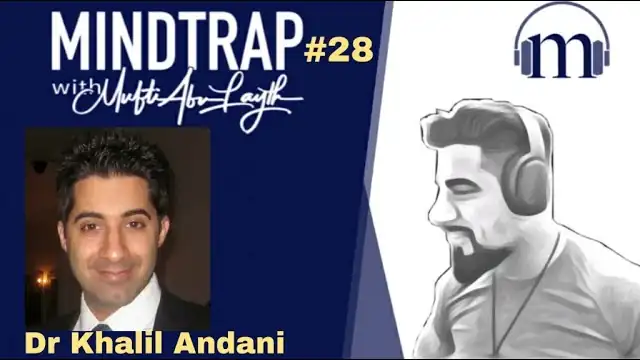 Play from 1:10:57
The video loads from YouTube only when you press play. Click a time in the transcript to seek.
Watch this part
Open on YouTube at 1:10:57The player starts at 1:10:57, the beginning of this part.
This segment1:10:02 to 1:20:44 · 10 min 42 sGeneral teaching
What this part covers
machinesummary, machine-writtenThe guest and host trace how the Mu'tazila, Hanbalis and Ash'aris reconciled God's oneness with his many names and attributes.
In more detail
Mufti Abu Layth asks about the debate, from Ahmad ibn Hanbal and the Mu'tazila to the Ash'aris, over God's essence. The guest says the Quran names God with many names while insisting he is uniquely one, so theologians had to reconcile unity and multiplicity, a problem some link to debates with Christians over the Trinity; for the Mu'tazila the names describe one essence. Mufti asks why multiple names should imply multiplicity, and the guest says the meanings differ, as knowledge and mercy do, so the Hanbalis held that the distinctions hold in God, while the Ash'aris attached multiple attributes to the one essence. Mufti says he feels the debate partly arose from problems such as how God could be sustaining before there was a creation, leading the Ash'aris to say the attributes are neither him nor other than him; the guest says the Mu'tazila treated most names as temporal acts and the Ash'aris and Maturidis took a middle path with seven essential attributes, which Mufti says they struggle to justify for sight and hearing.
- Guest speech overlaps this segment
Position stated
Waiting for the speaker checkA guest speaks in this segment and the captions do not say who said what. The view found here is held back until the speaker-separated transcript confirms the words are his, or the channel verifies it. The transcript and recording are published in full.
Kind: general teaching Speakers: host and guest; guest speech is labelled and excluded from positionsTranscript
machine1:10:02 to 1:20:44 · click a time to seek · dotted terms open the glossary
A guest speaks in this segment. Guest speech is labelled and is excluded from the positions layer.
So, that is the kind of stable version that has predominated. But, the Quran in and of itself had that agility, that dynamism to and it because it was more it was always a a reflection or a statement of a description of the divine meaning. But, yeah. I mean, this this has been um um my kind of uh way of looking at it.
You know, I'd like to ask you on this that this the Quran being the speech of God, Professor. This ties in There's an inherent There's like an a very core link here immediately with God, the speech of God linking to the essence of God. Um and then this became a huge debate in and of itself that well, you know, between the Imam Ahmad ibn Hanbal and uh the kind of Mu'tazila that what is the essence of God?
And you know, is the kalam with and later on the Ash'ari. And this has been a huge area of research and interest for you as well. Can you enlighten us uh a bit on this, the essence of God? Well, um what you have among different Muslim thinkers uh in the early period is Well, first, the Quran names God with all these names.
Right? Uh the knowing, the living, the powerful. Um it implies I mean, the Quran refers to this term kalam, right? Kalam Allah. Uh and more so kalimat Allah. So, there's speak God has speech, God has words. So, this of course people would ask, "Well, what's the nature of these divine names and acts?" Right?
[snorts] Like, how are they associated with God? Because on one hand uh the Quran is adamant that God is one, right? God is not just one entity, but he is ahad, like he's uniquely one. Yeah. So, now when you have multiple names and multiple acts, but one God, you have to sort of reconcile the unity and the multiplicity.
That's that's the theological problem. And And some would argue Some can argue that that this became seen as a theological problem because of early Muslim theological discussions with Christians, for example. Because Christians would justify the Trinity uh through the same sort of arguments, right? The Trinity is unity and three-ness together. So, you could have many responses to the question, "What is the nature of the the names of Allah, the names of God?" One response uh would be that um the names of God are simply verbal descriptions
of God himself. So, the Mu'tazili view would be that God is one essence, one self, and the different names that we give to God, the merciful, the compassionate, the wise, the knowing, these all describe the same one essence of God. That in a nutshell is the is the early Mu'tazili view. Now, they'll they'll change it a little bit, but but the gist of it is that for the Mu'tazilis, God is one singular thing.
Yeah. And there's no multiplicity associated with this singular monad, if you will. You know, this debate, right? You explain it to people today, they feel that look, to say God is ar-Rahman, God is ar-Rahim, God is al-Aziz, God is this. I mean, why is that so complicated to assume that a a signifier must have a multiplicity of signifies?
Like, why like to say God is al-Aziz, al-Qawi, al-Alim? I Nobody would really think that, you know, that that means there's 99 different people or different entities. So, what are what are these really intelligent people arguing about? Well, the the the the thing is that um it goes also goes to sort of like how truthful are the scriptural statements about God? Because if the Quran says God is uh Rahman and God is uh Alim, right?
So, he he's compassionate and he's knowing. Um if they refer to the same meaning, then something is not right here. That would be the argument. Because rahma in our understanding, ilm and rahma are not the same thing. Right? Ilm refers to knowledge. So, so at the human level, these attributes are not the same thing. These powers are not the same thing. So, the question is um do does the meaning at the human level, like that distinction, does that hold at the divine level?
Now, the Mu'tazilis would say no, but the Hanbalis would go the opposite end, and they would say absolutely it does. And the Hanbalis would say, I mean, according to the treatises attributed to Ahmad ibn Hanbal, like God gets happy and God gets angry just like we do. Yeah. But, I feel all of the attributes are literalized in a sense for for the early debate, this part, I mean, before getting into the emotions of God, but this thing of God being all wise,
all knowledgeable, all knowing, all I mean, I know they are distinct from like, let's say, God being all knowing from God being all compassionate. Are two separate understandings. We get that. But, Right. But, why would why would that why would the person feel that that necessitates two separate beings?
No, no, they're not saying it necessitates two separate beings, right? That that's not the necessary interpretation. But, at the very least, these are two separate meanings. Like, the statement God is knowing has a different meaning than the statement uh God is compassionate. Yeah. So, one would inquire, "Well, okay, why like what do the So, you have two meanings now." In other words, it seems to be saying that there it may not be separate persons, but the there must be some sort of meaning multiplicity within God.
And And to some that was a problem. To some it was not a problem. So, the Ash'ari answer was that God's essence, God's that is one. And then attached to God's essence, alongside his essence, are multiple sifat, meaning which are we call attribute, but those are meanings. It's like these multiple, you know, meanings are attached to God's essence.
So, now you can The point is that the Ash'aris can say everything that they can affirm that all the Quranic statements about God's names are true without saying, "Well, God's God's rahma is the same as God's power." Cuz the Mu'tazilis would say that, right? They would say God's knowledge is the same [snorts] as God's whatever, wisdom. But, I thought they You see, it's not that So, if imagine we cleared the level the plane, all of them believed that, for example, God was merciful, God knew, generally speaking, that he knows, you know, he has knowledge, he has like, without
using these words, these understandings, they all had them. They It's not that some of them felt uh you know, God has no knowledge. But, at this I felt that part of this debate uh stems from the understanding that things like, if you say he There's certain things if you like like you used anger.
If you say God is somebody that gets angry, uh it's an emotion that kind of appears and then disappears. Uh so, it's a temperament. So, this is a problem. The other thing is if you're saying he's doing something like an action, like he is creating or he is providing, sustaining. Yeah. But, what about when there was no creation? How could have he been sustaining then?
Um so, it kind of led to the understanding that well, God seems to have adopted certain actions, if I can say actions. Like, he started doing these things once he created creation. So, this act could not have preceded creation. It couldn't have preceded when there was nothing because God couldn't have been kind of feeding when there was nobody to feed. Uh so, I I felt these kind of problems then led the Ash'aris to say, "Well, you know what?
We'll kind of make them an attache." [laughter] Kind of like, you know, la hiya huwa la ghayruhu. You know, it's not They're not him and not other than him. So, what you what you've stated that the objection you've stated, the idea that So, the Mu'tazilis, generally speaking, the Mu'tazilis would say that all of these divine names really describe God's acts. [snorts] Not his nature.
The Mu'tazilis at most would allow for God's um life, knowledge, and power to be his nature, but everything else they would say it's God's acts. And for Mu'tazilis, um God's acts are always temporal. They can't be eternal. That was their view. So, so what you state is a Mu'tazili problem, and the Hanbalis launched the polemic against them on this point. So, what the Ash'aris do and the Maturidis do this is they come in between.
Yeah. And they to really only say that really that cuz they too really in essence they just affirm seven points, isn't Seven, right? Seven points. Actually, yeah. Yeah, seven essential attributes. Essential attributes, but what they eternal. And they say that really it's just life and knowledge and and power and and and willing, sorry.
And then it's like they say these are rational. Like we can understand these. Yeah, they make sense. And even the rest like sight and and hearing, they themselves struggle to rationalize them because you could just say, well, you know, God doesn't need sight. He could be kind of seeing without sight. He doesn't need really um you know, he doesn't need this kind of like not this, but a a sight faculty, yeah.
Yes. Yeah, well, what I would ask is like if if knowledge is already part of your attributes. Exactly. Exactly. Sight and knowledge are just input input faculties for knowledge, so why do you it cuz even the Ash'aris themselves that they when they try to justify Kalam and they try to justify Sama and they try to justify Basar, they either just choose not to rationalize them or they end up doing a horrible job.
[laughter] I mean, another issue that's lying at the core of this is that uh if you take a Hanbali view and Ash'ari view, even a Maturidi view, what you end up with is a God who has parts to be God. And the problem with that issue, which which uh both um the philosophers, the Avicennan philosophers pointed this out and the Isma'ilis attacked them for this, is that if you have a God who has parts, then that then God is actually a created being.
Paragraphs overlapping 1:10:02 to 1:20:44. Full text on the recording page.
Cite this segment
Stable id, transcript version and tier are part of the citation. Every change to a transcript is logged.Mufti Abu Layth Archive, segment 2020-07-03-S15, auto-transcribed, may contain errors. https://muftiabulayth.org/r/xznxiyp0b5s/s/15/ (accessed 1 November 2026)
- APA 7
Mufti Abu Layth. (2020, July 3). How did Muslim theologians reconcile God being one with his many names and attributes? [Video, segment 2020-07-03-S15, auto-transcribed, may contain errors]. Mufti Abu Layth Archive. Retrieved November 1, 2026, from https://muftiabulayth.org/r/xznxiyp0b5s/s/15/
- Chicago author-date
Mufti Abu Layth. 2020. "How did Muslim theologians reconcile God being one with his many names and attributes?" Video, segment 2020-07-03-S15, auto-transcribed, may contain errors. Mufti Abu Layth Archive. Recorded July 3, 2020. Accessed November 1, 2026. https://muftiabulayth.org/r/xznxiyp0b5s/s/15/
- BibTeX
@misc{abulayth-2020-07-03-S15,
  author = {Mufti Abu Layth},
  title = {{How did Muslim theologians reconcile God being one with his many names and attributes?}},
  year = {2020},
  month = {7},
  date = {2020-07-03},
  howpublished = {\url{https://muftiabulayth.org/r/xznxiyp0b5s/s/15/}},
  url = {https://muftiabulayth.org/r/xznxiyp0b5s/s/15/},
  organization = {Mufti Abu Layth Archive},
  urldate = {2026-11-01},
  note = {Segment 2020-07-03-S15, auto-transcribed, may contain errors}
}
Something wrong here?
Tell us what is wrong and it will be checked against the recording. Nothing changes until a person has reviewed it.
Sending a note needs JavaScript, which is off or unavailable in this browser. Nothing has been sent.
No name, email address or account is asked for or stored, and the inbox does not store your IP address. For rate limiting it keeps an unreadable fingerprint of your connection for 48 hours, and our database provider's own logs record connections as every website's do. Only your note, its kind, the page and the moment in the recording are kept, for review.