
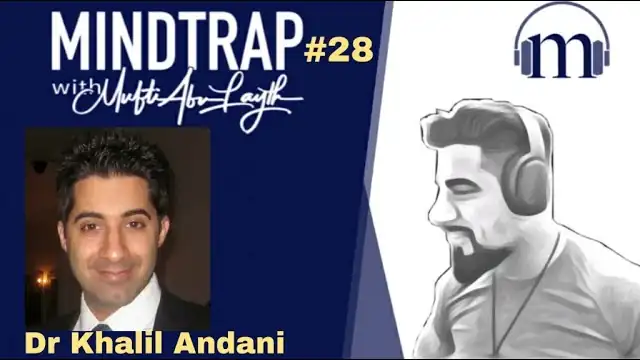
Recordings › Prof. Dr Khalil Andani | The Oral Text & the Ontology of The Quran | Mindtrap with Mufti #28 · 3 Jul 2020 › Segment 13 of 23
How reliable is the story of the first revelation in the cave?
aqidah aqeedah aqida creed aqeeda aqaid hadeeth ahadith ahaadeeth hadis hadees ahaadith muftis kalam ilm al-kalam kalaam koran quraan al-quran sura soorah surat suwar soora chapter ayah aya ayat ayaat aayah aayat wahi wahee makki and madani makki madani medinan makki surah madani surah ahl al-sunnah ahl as-sunnah ahlus sunnah ahl al-sunna sunnis sufis sufism soofi 'alim aalimThe first revelation in the cave: Waraqa, the namus and 'iqra'
 Play from 57:30
The video loads from YouTube only when you press play. Click a time in the transcript to seek.
Watch this part
Open on YouTube at 57:30The player starts at 57:30, the beginning of this part.
This segment57:30 to 1:03:08 · 5 min 38 sGeneral teaching
What this part covers
machinesummary, machine-writtenThe guest doubts the historicity of the cave story, attributing it to al-Zuhri; Mufti Abu Layth says he would take the whole description with a pinch of salt.
In more detail
Mufti Abu Layth says the idea resonates, since he has generally understood ruh as consciousness, and notes that in the popular account of the first revelation Khadijah's learned Christian relative calls what the Prophet met the namus, not Jibril. The guest says namus means law, describing the content of what happened rather than the entity, and says the whole story of the Prophet shocked in the cave comes from al-Zuhri, an Umayyad-era storyteller to whom he gives little historical weight, adding that Ibn Ishaq's version has Gabriel bring the verse written down. Mufti says he would take the whole description with a pinch of salt, but notes that the written version at least fits the reply 'I am not one who reads'; the guest mentions variants such as 'what shall I recite?'. The guest cites a reading by an Israeli scholar, captioned as Yuval Rubin [?], that the verse means 'recite the name of your Lord', a meditative practice the Prophet was already doing in the cave, which Mufti calls fascinating.
- Guest speech overlaps this segment
- Some terms in this segment are uncertain
Position stated
Waiting for the speaker checkA guest speaks in this segment and the captions do not say who said what. The view found here is held back until the speaker-separated transcript confirms the words are his, or the channel verifies it. The transcript and recording are published in full.
Kind: general teaching Speakers: host and guest; guest speech is labelled and excluded from positionsTranscript
machine57:30 to 1:03:08 · click a time to seek · dotted terms open the glossary
A guest speaks in this segment. Guest speech is labelled and is excluded from the positions layer.
It's always mentioned as something separate from the angels. So, whatever it is, we're not dealing with a literal winged creature who's transmitting verbal messages. Rather, it looks to me that the Quranic wahy and the Quranic ruh is non-verbal inspiration. And in this view anyway, um the the prophet Muhammad was responsible for verbalizing or translating wahy into Arabic.
Yeah. Uh which of course is the consequence I have to say that does resonate cuz I've generally kind of translated ruh to mean consciousness. What's also interesting on that note is uh the description the Sunni description that is popular of when revelation began. And the prophet alayhi wasallam comes back and then he tells Khadijah and she takes him to her uncle uh who is this Christian uh it's assumed like a Christian learned scribe.
Like, he's somebody very intelligent like a scholar or or a wise person. But, when he when he hears the encounter, he says, "Oh, that sounds like the namus." He uses this word, this kind of entity, this kind of experiential thing that you've encountered which is what Moses encountered and these prophets before you. But, he doesn't use the word Jibril.
It's interesting. I'm just saying that that's an interesting kind of point. So, that's that's a very interesting point. But, like I wonder how how I I guess I haven't checked, but how namus became glossed as as Gabriel because it doesn't mean that. It means law. Right? It's this like older term uh for for like divinely revealed law or divine prescription in a sense.
So, so Yeah. Yeah. I mean, whatever about Yeah. I I saw it I mean, it was all that is how they translate it as well, but I saw it more as a kind of like about the experience. Like, this kind of this spiritual kind of awakening or this in that sense a a divinely prescribed So, making that connection with with law.
Yeah. I think I think it namus describes the content of what happened. It doesn't describe the entity that, you know, spoke to Muhammad allegedly. I mean, that whole story that whole story which I've pointed out elsewhere to to some of the people who follow me. That whole story of Muhammad in the cave and being not knowing what's going on and being shocked and I mean, that's that is from from Zuhri.
Right? This Umayyad era storyteller of sorts. And I don't know I wouldn't put as much I don't put a lot of historical stock into that account. I think it reflects a certain theology of the Quran. Even Ibn Ishaq's version which is similar. The Ibn Ishaq's version in that story, he has Gabriel bring the the verse written down on something and Muhammad actually reads it physically like it's a physical text that he reads whereas In some In some ways that would at least fit that story better.
Like in the you know, like because the normal interpretation with that story is everybody's kind of stuck because they're saying, "Well, the prophet's response is I'm not one that reads." Person seem to like if a person's saying read and I'm saying, "Well, I'm not one that reads." It doesn't seem to kind of correlate. So, there seems to be a bit of they have to struggle to explain what what that actually means.
So, not that I go with this understanding that it was written or so on. This I would take it with a pinch of salt as well this whole description. But, I'm just saying at least that story fits that story better of saying it was on like it was actually written down. You see, I see it maybe there's a variant version where where he says he doesn't say I'm not There's one where he says, "What do I recite?" Okay.
Instead. There's different textual versions of the same story. So, one says like I'm not a reader. I'm not a reciter. Another one says, "Recite." He's like, "Well, what do I recite?" Mhm. You know? So, so there's there's different versions and again like we can't date it whatever it is. We can't date it That one makes a lot more sense with the with the general understanding. What do I recite? Mhm. You know? There's a There's a reading of this by by Israeli scholar Yuval Rubin who notes that um there's an argument to be made that does not mean does not mean recite or read in the name of Allah.
It simply means recite the name of your Lord. That that the prophet is being ordered So, if you discount the Hadith for a second and the meaning of this would be the prophet is being told here just like in other Meccan surahs, recite the name of your Lord. And that that the prophet is engaged in this what you could say by today's standards a very Sufi type of practice of of and and that this this whole surah at least that part of the surah is just reiterating a practice that the prophet Muhammad was was engaging in in the
cave. That he was doing this this spiritual meditation in the cave and then because the bar in here, it's been argued that it's it's what they call a either bar. So, like the bar is there you you you vocalize the the bar, but in meaning it doesn't take any meaning. It's silent in the But, even if it even if it did take meaning with that, it would still fit in the sense that you know, this how you're trying to connect do it with or in the name of God.
Paragraphs overlapping 57:30 to 1:03:08. Full text on the recording page.
Cite this segment
Stable id, transcript version and tier are part of the citation. Every change to a transcript is logged.Mufti Abu Layth Archive, segment 2020-07-03-S13, auto-transcribed, may contain errors. https://muftiabulayth.org/r/xznxiyp0b5s/s/13/ (accessed 1 November 2026)
- APA 7
Mufti Abu Layth. (2020, July 3). How reliable is the story of the first revelation in the cave? [Video, segment 2020-07-03-S13, auto-transcribed, may contain errors]. Mufti Abu Layth Archive. Retrieved November 1, 2026, from https://muftiabulayth.org/r/xznxiyp0b5s/s/13/
- Chicago author-date
Mufti Abu Layth. 2020. "How reliable is the story of the first revelation in the cave?" Video, segment 2020-07-03-S13, auto-transcribed, may contain errors. Mufti Abu Layth Archive. Recorded July 3, 2020. Accessed November 1, 2026. https://muftiabulayth.org/r/xznxiyp0b5s/s/13/
- BibTeX
@misc{abulayth-2020-07-03-S13,
  author = {Mufti Abu Layth},
  title = {{How reliable is the story of the first revelation in the cave?}},
  year = {2020},
  month = {7},
  date = {2020-07-03},
  howpublished = {\url{https://muftiabulayth.org/r/xznxiyp0b5s/s/13/}},
  url = {https://muftiabulayth.org/r/xznxiyp0b5s/s/13/},
  organization = {Mufti Abu Layth Archive},
  urldate = {2026-11-01},
  note = {Segment 2020-07-03-S13, auto-transcribed, may contain errors}
}
Something wrong here?
Tell us what is wrong and it will be checked against the recording. Nothing changes until a person has reviewed it.
Sending a note needs JavaScript, which is off or unavailable in this browser. Nothing has been sent.
No name, email address or account is asked for or stored, and the inbox does not store your IP address. For rate limiting it keeps an unreadable fingerprint of your connection for 48 hours, and our database provider's own logs record connections as every website's do. Only your note, its kind, the page and the moment in the recording are kept, for review.