
Recordings › Prof. Dr Khalil Andani | The Oral Text & the Ontology of The Quran | Mindtrap with Mufti #28 · 3 Jul 2020 › Segment 12 of 23
Was revelation words dictated by Gabriel, or inspiration the Prophet put into words?
hadith hadeeth ahaadeeth hadis hadees ahaadith muftis sunna sunnat sunan prophetic practice koran quraan al-quran sura soorah surat suwar soora chapter ayah aya ayaat aayah aayat wahi waheeWhat is wahy? Non-verbal inspiration and the ruh
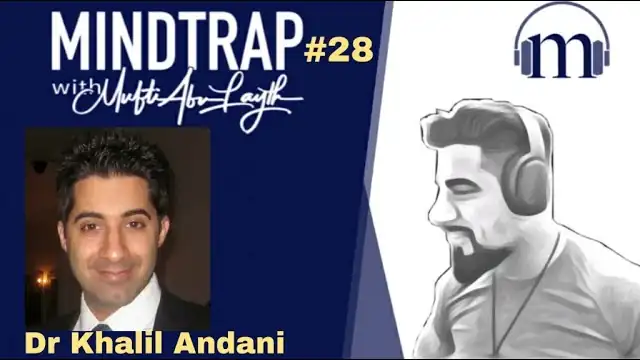 Play from 53:07
The video loads from YouTube only when you press play. Click a time in the transcript to seek.
Watch this part
Open on YouTube at 53:07The player starts at 53:07, the beginning of this part.
This segment52:33 to 57:30 · 4 min 57 sGeneral teaching
What this part covers
machinesummary, machine-writtenThe guest argues that Quranic wahy is non-verbal inspiration through the ruh which the Prophet put into Arabic; Mufti Abu Layth says he finds himself with those who hold revelation was expressed within the Prophet.
In more detail
Mufti Abu Layth cites the report that revelation came to the Prophet like a ringing sound with no mention of Gabriel, and says he finds himself in line with those who say revelation is expressed within the Prophet rather than in the mind of Gabriel. The guest says that in his scholarly view wahy in the Quran is not verbal communication but non-verbal divine inspiration, given also to bees and the heavens, and to Noah and Moses as inner guidance such as 'build the ark under our wahy'. He says the Quran associates the Prophet's wahy with the ruh, al-Ruh al-Amin, which it names Jibril only once or twice and never calls an angel, and that the later picture of Gabriel as a winged creature flying between heaven and earth is not the Quranic ruh. Citing Surah 42:51-52, he concludes that the Prophet was responsible for verbalising or translating wahy into Arabic.
- Guest speech overlaps this segment
- Some terms in this segment are uncertain
Position stated
Waiting for the speaker checkA guest speaks in this segment and the captions do not say who said what. The view found here is held back until the speaker-separated transcript confirms the words are his, or the channel verifies it. The transcript and recording are published in full.
Kind: general teaching Speakers: host and guest; guest speech is labelled and excluded from positionsTranscript
machine52:33 to 57:30 · click a time to seek · dotted terms open the glossary
A guest speaks in this segment. Guest speech is labelled and is excluded from the positions layer.
But, keeping in mind certain ahadith and Sunnah that the prophet is saying revelation comes to me like a ringing sound. And there is no mention of Jibril, you know, it's just direct like it comes to me and then I express it. I mean, I find myself in line with those people who who say that it is expressed to the prophet like he kind of sees it and expresses it. It's within him that it kind of as opposed to it's in the mind of Gabriel who Although they're all kind of views like the Right.
Well, in my estimation, again, this is from a scholarly perspective, so people can take it for what it is. But, in my view, the concept of wahy in the Quran uh is not that of a linguistic verbal communication. In my view, wahy, according to the Quran, including prophetic wahy, is a non-verbal divine inspiration.
That comes not things like this. Right. It's given to the bees. It's given to the heavens, for example. It's It's It's It's much more than I mean, it's simply not like somebody reciting Arabic or Hebrew to you. And That is amazing. That's a very I have to say a very amazing point actually to highlight that. I I mean, one one one could argue that like the the the cuz cuz you know, in according to the Quran, I mean, the Quran doesn't call it the It doesn't say laws of nature, but it says all these natural processes are are signs, are ayat.
Uh implying that like natural processes, the regularity of night and day and and all this stuff, that these are a form of revelation. And And the implication is that they happen because God is granting wahy, you know, to the whole natural world, so it behaves in this orderly way. The bee just being the cited example. So, in that sense, like wahy definitely for these non-human recipients, it's not verbal.
But, then there's a type of wahy that you hear associated with the prophets in the Quran. It says all the messengers were given wahy, but it has examples of Noah and Moses being given wahy. And the wahy they're given is not really presented as like a verbatim thing to recite. It's presented as inner guidance telling them sort of what to do in a particular situation. So, it's like to Noah, like, "Build the ark." Like, "We inspired Noah, you know, build the ark under our wahy." Yeah.
So, it's like wahy has this sense of being guided in the Quran even for the prophets. So, in my view then, the wahy that's given to Muhammad, according to the Quranic picture, was a non-verbal spiritual inspiration. And that's why the Quran associates this entity called the ruh, like Ruh al-Amin, with Muhammad and with the heart of Muhammad.
Like, it says the ruh Differentiating the the Ruh al-Amin from Jibril. Well, I think Jibril is the ruh? The kind of In In the Quranic view, the ruh is mostly called ruh and it's named Jibril one or two times. But, I I distinguish in the sense that in the post-Quranic period, Gabriel became interpreted by many as a material spatial creature who flies up and down between heaven and earth.
So, that idea of Gabriel is not the Quranic ruh. Is it more a kind of like a consciousness that you're entering? I think you could call it like a superconsciousness. I mean, in modern terms, I I would call it like a spiritual power, a spiritual intermediary. But, we read all over the Quran that God sends like it's in verse Surah 42 verse 51 and 52.
It's very clear there that God communicates to humans through wahy and that for Muhammad specifically, the wahy came in the form of ruh. That's what it says in in those two verses. And not only Muhammad, but there are verses that say God will send guidance or inspiration to any human being through the ruh. And the ruh is never called it it's never called an angel.
It's always mentioned as something separate from the angels. So, whatever it is, we're not dealing with a literal winged creature who's transmitting verbal messages. Rather, it looks to me that the Quranic wahy and the Quranic ruh is non-verbal inspiration. And in this view anyway, um the the prophet Muhammad was responsible for verbalizing or translating wahy into Arabic.
Paragraphs overlapping 52:33 to 57:30. Full text on the recording page.
Cite this segment
Stable id, transcript version and tier are part of the citation. Every change to a transcript is logged.Mufti Abu Layth Archive, segment 2020-07-03-S12, auto-transcribed, may contain errors. https://muftiabulayth.org/r/xznxiyp0b5s/s/12/ (accessed 1 November 2026)
- APA 7
Mufti Abu Layth. (2020, July 3). Was revelation words dictated by Gabriel, or inspiration the Prophet put into words? [Video, segment 2020-07-03-S12, auto-transcribed, may contain errors]. Mufti Abu Layth Archive. Retrieved November 1, 2026, from https://muftiabulayth.org/r/xznxiyp0b5s/s/12/
- Chicago author-date
Mufti Abu Layth. 2020. "Was revelation words dictated by Gabriel, or inspiration the Prophet put into words?" Video, segment 2020-07-03-S12, auto-transcribed, may contain errors. Mufti Abu Layth Archive. Recorded July 3, 2020. Accessed November 1, 2026. https://muftiabulayth.org/r/xznxiyp0b5s/s/12/
- BibTeX
@misc{abulayth-2020-07-03-S12,
  author = {Mufti Abu Layth},
  title = {{Was revelation words dictated by Gabriel, or inspiration the Prophet put into words?}},
  year = {2020},
  month = {7},
  date = {2020-07-03},
  howpublished = {\url{https://muftiabulayth.org/r/xznxiyp0b5s/s/12/}},
  url = {https://muftiabulayth.org/r/xznxiyp0b5s/s/12/},
  organization = {Mufti Abu Layth Archive},
  urldate = {2026-11-01},
  note = {Segment 2020-07-03-S12, auto-transcribed, may contain errors}
}
Something wrong here?
Tell us what is wrong and it will be checked against the recording. Nothing changes until a person has reviewed it.
Sending a note needs JavaScript, which is off or unavailable in this browser. Nothing has been sent.
No name, email address or account is asked for or stored, and the inbox does not store your IP address. For rate limiting it keeps an unreadable fingerprint of your connection for 48 hours, and our database provider's own logs record connections as every website's do. Only your note, its kind, the page and the moment in the recording are kept, for review.