
Recordings › Shaykh Omar Baloch | Cynicism, Consumerism & the Catch 22 of Riba | Mindtrap with Mufti #30 · 10 Jul 2020 › Segment 3 of 38
Who did Shaykh Omar Baloch study with?
hadith hadeeth ahadith ahaadeeth hadis ahaadith imaam imams prayer leader masjed masaajid masajid muftis koran quraan al-quran 'alim aalim sheikh shaikh sheik shuyukh shaykhs ummah umma ummatShaykh Omar Baloch's background and his teachers
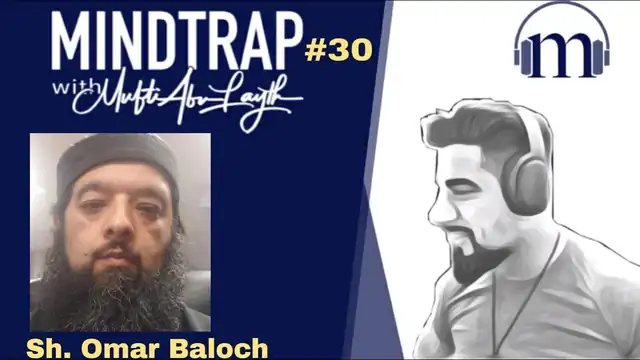 Play from 3:50
The video loads from YouTube only when you press play. Click a time in the transcript to seek.
Watch this part
Open on YouTube at 3:50The player starts at 3:50, the beginning of this part.
This segment3:50 to 9:38 · 5 min 48 sA view quoted in order to be discussed, not a position held
What this part covers
machinesummary, machine-writtenThe guest describes studying with Dr Israr Ahmed from the age of about thirteen and then with Imran Hosein in New York.
In more detail
Mufti Abu Layth asks the guest about his journey and background. The guest says he is Pakistani by heritage and was born in Chicago, studied for a while at an Arabic school in South India, and after his family moved to Pakistan began studying at about thirteen with Dr Israr Ahmed [?], sitting in on his course at the Quran Academy and later becoming one of his main students in the US; he recalls Israr Ahmed joking at a convention in Columbus, Ohio, that he had 'discovered' Omar Baloch. Asked by Mufti, the guest confirms that Israr Ahmed took bay'ah from followers. The guest then describes first meeting Imran Hosein, who had joined hands with Israr Ahmed, while the older man was vacuuming a mosque in Queens, New York, studying with him for two years, and being told by him that he was beginning to think like a scholar. Mufti asks what Imran Hosein is like as a person, saying he has never met him.
- Some terms in this segment are uncertain
Position stated
This segment presents a view in order to discuss or respond to it. It is recorded as quoted, never as held, and no position is attributed from it.
Kind: a view quoted in order to be discussed, not a position held Speakers: host and guest; guest speech is labelled and excluded from positionsTranscript
machine3:50 to 9:38 · click a time to seek · dotted terms open the glossary
A guest speaks in this segment. Guest speech is labelled and is excluded from the positions layer.
This segment states a view in order to discuss it. It is recorded as a quoted view, not as a position held.
people of right so those of you who are not too familiar with chef omar Baloch he is an imam as in he does do imam at by a scholar within islam that's what I mean by Imam but also trained within Jungian psychology he's got a he has a fascination with psychology with CBT cognitive behavioral therapy is a practitioner he's somebody who's very involved in the local community and has
and brings a plethora of experience to the table so Damas Y Caballeros let me present to you ladies and gentlemen the man the myth sure tell us a bit about your journey your journey a bit of your background you learning about Islam maybe some of the kind of tradition you're linked with just to give some of our viewers a greater horizon about you so I was well genetically in Pakistani geographically genetically hahaha yeah my mom is from the
my father is from Desmond fun I was born in Chicago stayed there for a while my dad got a job in salvia our family was in South India so there was a famous school in Arabic school called Minato - shabbiha where I studied for a while my dad had an accident our family you know a head injury we had to move we decided to move to Pakistan so he wouldn't have to work and and you know he needed some time to like in rehab kind of situation while he was there I started studying with dr.
Ahmed when I was like literally thirteen years old and so that was really where my first Islamic studies began there's a whole set of things that happened and I just liked him from the very beginning really actually I started studying with some of the jamming through Hadees did you study with when you say doctor I saw Ahmed you studied with him on a one-to-one personally or do that but what he has is he has a course called wonderfulness of okay and his students and this kid went out there was that song they were teaching this course in quran academy at that time and so I would sit in for those lectures my dad
was in that class also and then over time I became one of his like main students and here in the US for sure and you know when he would come to Chicago dr. sir I'm with you would come to our house and stay there or even one time when he had to you didn't feel like speaking he asked me to speak in his place one time he made a famous comment and it was a state convention in Columbus Ohio before the internet convention we had we had a convention with him you say you know Columbus discovered North America and in Columbus Ohio I have discovered Homer
Baloch he had many students and yeah obviously you cherish you know that type of encouragement then you know a shame around of saying had also given it that time beyond wait did he used to take bay house yes you did ah okay that's interesting yeah that's that's the whole discussion in itself obviously I'm sure but I understand had joined hands with him and that's when you know I was hearing I was in Chicago so every summer we would spend in New York taking classes either giving classes or taking classes I see uh-oh
I had heard coming from Chicago that some really famous scholar has joined hands with dr. Simon well you know I didn't know him but I went to the mustard that was the Queen's Masjid in New York and went upstairs I saw this old man vacuuming the Masjid and and then I was like oh let me go up to him because I was there a bit early so then he was vacuuming the mustard I went up to him I said you know why make this older person do this so I went up to him I said give me the back in cleaner I'll do it and he's like no no I'm gonna do it and you know he's picking things up with his hands the pieces are too big for the vacuum cleaner and I'm like what's
what's your name and he says my name is my rock you know it was right and so that's when I got to know him but what am I now where was this this was Islamabad or this was in Queens New York oh right okay Wow okay yeah and and one of my memorable moments with him because you know Islamic eschatology is one of his it's a Forte kind of integrated some of his ways of thinking into my my way of thinking from him he kind of like taught us for two years because he was appointed as the
immediate you know of the Jamaat that we were in at that time and and so one day when I was giving a lecture or as you know we were both giving lectures usually I'm listening to him but in this one year I was speaking at it is in the same to the same group of people within the Jamaat that was training and I was you know you you have ideas and you're young and you have conclusions and you're sharing that with a scholar right you know I'm sure so I used to do that with her I mean all the time but chef Mourad was a new scholar so that I
started sharing my ideas with him and then I said you know it's it's interesting how stuff and bunny is right I was talking about the truth I can say what it is but just I was talking about the relationship between Sudanese right instead of God and he said shame Aruna said he said now you're beginning to think like a scholar so before that when I was in husband didn't count how is chef Imran Hussain as a person and you know how is his dynamic and personality I've never met him I've obviously come across his kind of the
Paragraphs overlapping 3:50 to 9:38. Full text on the recording page.
Cite this segment
Stable id, transcript version and tier are part of the citation. Every change to a transcript is logged.Mufti Abu Layth Archive, segment 2020-07-10-S03, auto-transcribed, may contain errors. https://muftiabulayth.org/r/wce73zqci_i/s/3/ (accessed 1 November 2026)
- APA 7
Mufti Abu Layth. (2020, July 10). Who did Shaykh Omar Baloch study with? [Video, segment 2020-07-10-S03, auto-transcribed, may contain errors]. Mufti Abu Layth Archive. Retrieved November 1, 2026, from https://muftiabulayth.org/r/wce73zqci_i/s/3/
- Chicago author-date
Mufti Abu Layth. 2020. "Who did Shaykh Omar Baloch study with?" Video, segment 2020-07-10-S03, auto-transcribed, may contain errors. Mufti Abu Layth Archive. Recorded July 10, 2020. Accessed November 1, 2026. https://muftiabulayth.org/r/wce73zqci_i/s/3/
- BibTeX
@misc{abulayth-2020-07-10-S03,
  author = {Mufti Abu Layth},
  title = {{Who did Shaykh Omar Baloch study with?}},
  year = {2020},
  month = {7},
  date = {2020-07-10},
  howpublished = {\url{https://muftiabulayth.org/r/wce73zqci_i/s/3/}},
  url = {https://muftiabulayth.org/r/wce73zqci_i/s/3/},
  organization = {Mufti Abu Layth Archive},
  urldate = {2026-11-01},
  note = {Segment 2020-07-10-S03, auto-transcribed, may contain errors}
}
Something wrong here?
Tell us what is wrong and it will be checked against the recording. Nothing changes until a person has reviewed it.
Sending a note needs JavaScript, which is off or unavailable in this browser. Nothing has been sent.
No name, email address or account is asked for or stored, and the inbox does not store your IP address. For rate limiting it keeps an unreadable fingerprint of your connection for 48 hours, and our database provider's own logs record connections as every website's do. Only your note, its kind, the page and the moment in the recording are kept, for review.