
Recordings › Cutting-edge Perspective: Trimming the beard in Islam (pt 1)- Mufti Abu Layth · 12 Apr 2014 › Segment 3 of 3
What do the sound hadith about the beard actually say?
hadeeth ahadith ahaadeeth hadis hadees ahaadith saheeh sahih hadith saheeh hadith authentic muftis wajib waajib wajibat dalil daleel adillah adilla proof saheeh muslim imam muslim muslim ibn al-hajjaj shirk shirq mushrik polytheism ulama ulema ulamaaThe three sound hadith on the beard: moustache and beard together, and being different
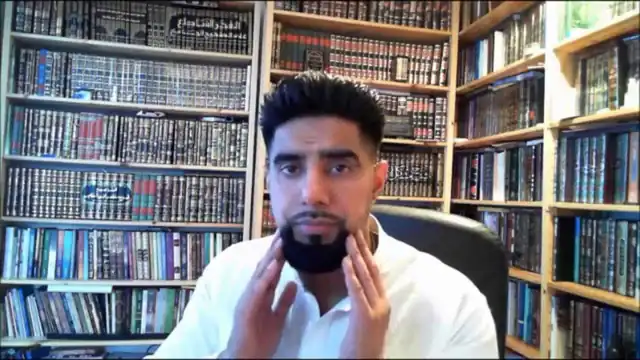 Play from 9:16
The video loads from YouTube only when you press play. Click a time in the transcript to seek.
Watch this part
Open on YouTube at 9:16The player starts at 9:16, the beginning of this part.
This segment9:16 to 13:18 · 4 min 02 sGeneral teaching
What this part covers
machinesummary, machine-writtenOnly three hadith on the beard have undisputed chains, and each pairs trimming the moustache with the beard and gives the reason of differing from the Jews and Christians, the Majus or the mushrikin. Many read this as an obligatory command, but Mufti Abu Layth says other hadith show otherwise.
In more detail
Turning to the evidence relied on by the scholars who permit trimming, and not the evidence of those who require a fistful, Mufti Abu Layth says the hadith that speak of growing the beard, though many, are reduced to three whose chains are not disputed, the others having some discussion in their chains. All three contain two commands, a word commonly interpreted as growing the beard and trimming the moustache right down. One, in Sahih Muslim, says to be different to the mushrikin [?]; the hadith of Abu Hurayra [?] in the Musnad of Ahmad says to be different to the Majus, the Zoroastrians, trimming the moustache and releasing the beard, where he notes that one linguistic meaning of the word used is actually to trim; and a third hadith [?], also in the Musnad of Ahmad, has the Prophet coming out to a gathering and, in one wording, using a word that means a goatee, telling them to leave it and be different to the others. He draws two points: in all three the moustache and the beard are combined, and each carries a stipulation to be different from the Jews and Christians, the Majus or the mushrikin. Many take this as an obligatory command, but he says other hadith show quite differently and begins to turn to them as the part ends.
- Some terms in this segment are uncertain
- Low audio confidence in the transcript
Position stated
Mufti Abu Layth holds that the sound hadith on the beard reduce to three, each pairing the moustache with the beard and giving the reason of being different from non-Muslims, and that the command need not be read as obligatory, as other hadith show.
“now many people have interpreted this to mean that it is an obligatory command a mandatory command but we see quite differently from other Hadith”
Category: method
Kind: general teachingTranscript
machine9:16 to 13:18 · click a time to seek · dotted terms open the glossary
trimmed uh have been just perhaps just a very thin layer going around or some of them have had perhaps an A goate and some of them have even been almost clean shaven this opinion very clearly has existed and continues to do so as to the evidence that these have have held and I'm not speaking about the evidence that the other UL with the other position that no you must have a fistful length beard hold I'm talking
about these because that's all I'm I'm substantiating that this view has existed for centuries and this is or these are some of the evidences that they have relied upon you will see first of all that the Hadith which speak of growing the beard generally are reduced to three many of there are many but they seem to have um some some type of calam in their chains and the type of validity has been disputed with the exception of three the Hadith
of of and and these three they all contain two commands one is that to kind of all there's a variation of wording quite commonly used to which is commonly interpreted as growing the beard and trimming right down the
must this is what is found in these three okay now we find something else in each one of these three so for example the Hadith which is in it is in Muslim that the prophet said that that be different to the that
do we see the Hadith of abuur which has been transmitted in the mus of Ahmed that the prophet Sall alaihi wasallam said that be different to the majus to the zarrian that trim the Tash right down or trim the Tash and release the beard or which is commonly and I'm saying commonly because one of the linguistic definitions of is actually to trim which may come as a surprise to many people the Hadith
of Abu Al is that the prophet Sall alaihi wasallam he comes out to uh where many people sitting and then he says to them in some of the wordings that and in fact in this Hadith which is in the ofed the word is used which is a goate and the prophet Sall Al wasallam said let that be and be different to the so first of all we've got two things here one that there is a combination between the the mustach between the Tash and the beard
okay okay so the and the in all three of these secondly we have a a type of stipulation saying be different to the Jews and the Christians or the ma or the mush now many people have interpreted this to mean that it is an obligatory command a mandatory command but we see quite differently from other Hadith so let me take you to a few other
Hadith that share or that bear a resemblance to this from the differing perspective
Paragraphs overlapping 9:16 to 13:18. Full text on the recording page.
Cite this segment
Stable id, transcript version and tier are part of the citation. Every change to a transcript is logged.Mufti Abu Layth Archive, segment 2014-04-12-S03, auto-transcribed, may contain errors. https://muftiabulayth.org/r/d95_pyj6nia/s/3/ (accessed 1 November 2026)
- APA 7
Mufti Abu Layth. (2014, April 12). What do the sound hadith about the beard actually say? [Video, segment 2014-04-12-S03, auto-transcribed, may contain errors]. Mufti Abu Layth Archive. Retrieved November 1, 2026, from https://muftiabulayth.org/r/d95_pyj6nia/s/3/
- Chicago author-date
Mufti Abu Layth. 2014. "What do the sound hadith about the beard actually say?" Video, segment 2014-04-12-S03, auto-transcribed, may contain errors. Mufti Abu Layth Archive. Recorded April 12, 2014. Accessed November 1, 2026. https://muftiabulayth.org/r/d95_pyj6nia/s/3/
- BibTeX
@misc{abulayth-2014-04-12-S03,
  author = {Mufti Abu Layth},
  title = {{What do the sound hadith about the beard actually say?}},
  year = {2014},
  month = {4},
  date = {2014-04-12},
  howpublished = {\url{https://muftiabulayth.org/r/d95_pyj6nia/s/3/}},
  url = {https://muftiabulayth.org/r/d95_pyj6nia/s/3/},
  organization = {Mufti Abu Layth Archive},
  urldate = {2026-11-01},
  note = {Segment 2014-04-12-S03, auto-transcribed, may contain errors}
}
Something wrong here?
Tell us what is wrong and it will be checked against the recording. Nothing changes until a person has reviewed it.
Sending a note needs JavaScript, which is off or unavailable in this browser. Nothing has been sent.
No name, email address or account is asked for or stored, and the inbox does not store your IP address. For rate limiting it keeps an unreadable fingerprint of your connection for 48 hours, and our database provider's own logs record connections as every website's do. Only your note, its kind, the page and the moment in the recording are kept, for review.