
Recordings › Shaykh Atabek Shukurov | Mortgages, Madhabs & Molvi-ism | MindTrap 48 | Mufti Abu Layth · 29 Jan 2021 › Segment 14 of 22
What is wijada, and why does it matter for the hadith on killing apostates?
hadeeth ahadith ahaadeeth hadis hadees ahaadith sahih saheeh sahih hadith saheeh hadith sound hadith madhhab mazhab school of law madhahib mazahib madhaahib malik ibn anas malik bin anas imam maalik imam malik ibn anas al-bukhari imam bukhari sahih al-bukhari sahih bukhari saheeh al-bukhari saheeh bukhari imam al-bukhari imaam prayer leader faqih faqeeh jurist hanafite hanafiyyah hanafi school shafi'i shafei shafiite shafi'i school ijma' ijmaa fatwah fatawa fatwaa fataawa legal opinion muftis hukm ahkam hukum hukam ahkaam haram haraam jahannam jahanam jahannum salafis salafism wahhabi wahabi wahhabism 'alim aalim ulama ulema ulamaaWijada, the apostasy hadith, and hadith as raw material for jurists
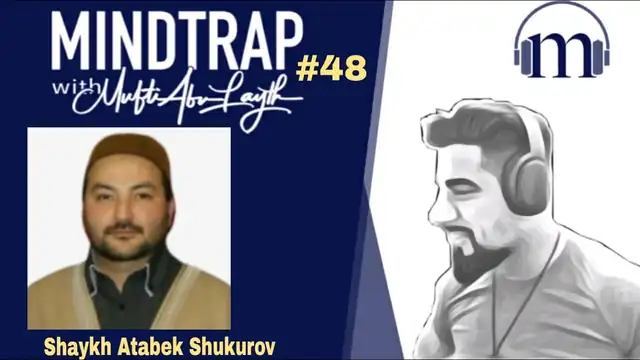 Play from 1:06:26
The video loads from YouTube only when you press play. Click a time in the transcript to seek.
Watch this part
Open on YouTube at 1:06:26The player starts at 1:06:26, the beginning of this part.
This segment1:06:26 to 1:11:04 · 4 min 38 sGeneral teaching
What this part covers
machinesummary, machine-writtenThe guest says the apostasy hadith cannot justify killing, since its own wording is not followed and it reaches us only by wijada; Mufti Abu Layth blames the Salafi call for putting raw hadith in place of the madhhabs.
In more detail
Mufti Abu Layth asks the guest to explain wijada, picking up a book of hadith rather than receiving it from a teacher. The guest says that by consensus wijada does not reach the level of a sound transmission, that strictly it requires recognising the author's handwriting, and that all hadith in our time are transmitted this way. He says he raised the point against those who kill apostates on the basis of the hadith in Bukhari: its wording would also require killing a Christian who becomes Muslim, which they never accept, and it reaches them by less than wijada. Mufti says the harm of the Salafi call was to have people drop the madhhabs and learn from Bukhari, since a ruling presented as the Prophet's words, unlike an imam's fatwa, cannot be revised for a changed age. The guest says hadith is raw material, cites Imam Malik that hadith is valid only from and for the fuqaha, and says publishing collections for the public lets anyone find the hadith on killing the apostate and become a killer.
- Guest speech overlaps this segment
Position stated
Waiting for the speaker checkA guest speaks in this segment and the captions do not say who said what. The view found here is held back until the speaker-separated transcript confirms the words are his, or the channel verifies it. The transcript and recording are published in full.
Kind: general teaching Speakers: host and guest; guest speech is labelled and excluded from positionsTranscript
machine1:06:26 to 1:11:04 · click a time to seek · dotted terms open the glossary
A guest speaks in this segment. Guest speech is labelled and is excluded from the positions layer.
However, this Shafi you can say school became widespread. Mhm. Okay. Assari style. So that's why even now say it is bkari is the most authentic but based on our school it should be one of either or by the narration of Imam Muhammad the most authentic collection of hadith. Yeah. And you also you know with Bkari you also there was the manuscript issue which I've already highlighted in my videos as well and all of that but you also raised this issue of wijada today.
Yeah. And that was an issue I didn't actually highlight or speak about much. But so for people that ain't familiar with this, what was this issue that you'd ra it is by consensus. Okay. By consensus of the scholars, wij is um does not even reach to the level of understand. So it cannot be authentic.
Okay. Um but uh so so all of the hadith in our time is by wijada. M. So just to just to ex caveat that people with the definition there that look uh wij is basically where you have not had a book of hadith or something being taught to you. You've just gone and picked it up. So like you go to your bookshop and you pick up a book. This is called wija.
Now in the past it was actually forbidden in most cases for you to just pick up a hadith book, go away and start teaching it. This was Yeah. Yeah. Exactly. Exactly. And also as you have mentioned mutis there is very specific condition of the val of the wijada. It will be wijada if you find the the copy of the book which is written by scholar and you recognize the you know the handwriting handwriting of the scholar but if you do not recognize so it's not even wijada you understand so now we are far away you know but look my main point when I have raised this
issue it was because do do you remember these people killing one another apostasy do you remember yeah of course yeah so look my main point was you guys are killing committing bloodshed without having any single basis. Oh, what about this hadith in Bkari who anyone who chances kill him? Okay. So then I say two problems. First of all, hadith necessitates that if some Christian becomes Muslim, kill him also.
You guys never accept it. So it means you are rejecting your own hadith. First problem. The second problem your hadith is wijada. Wij is not even it will be wijuada if you guys recognize the handwriting of Bkari but no one means it's not even wij so based on what you are killing the people that was my main thing you know yeah because you see what I had highlighted in my bkari gate thing when I was asked why this thing against Bkari I said you see traditionally people learned Islam from their from their madhab but what's happened in the last 1 200
years with the Salafi dwa is people are saying look well let's get rid of mabs and learn uh our from bkari now the problem with that is that one you've thrown the whole mabs away and two you are now saying you see because when you present a fatwa like if I gave you a fatwa of Imam Abu Ysef and you might say well okay fair enough MUI but today it's you know 2021 and the day and age has changed.
So Abu Ysef isn't around today. I'm going to change the fatwa. But when I say to you, oh the prophet said this, you see now that it changes the game that the landscape has changed because people are like, well, wait a minute. Are you you know, are you on the same level as the prophet. So this is this is the nasty thing that the Salafies did. Yeah. Yeah. Yeah. Yeah. And and also unfortunately um this um hadith is spreading.
Hadith is like raw material you know. Yeah. Okay. So as I im Malik who actually mentioned that hadith is not is not valid except from the fukah and it is not valid except for the fukah. Yeah. Wow that's a yeah very interesting point. Yeah. So means top he should not be interacting with the hadith you know but he should you know collect it and pass it on but he should not be interacting with it because he's not you know and is not for example who studies for example or a couple of books but I Malik was talking about the people on his
level only so you you should give the hadith for those people who can understand. Yeah. Okay. And you had that saying transmits it as well. I think Exactly. Yes. Yes. Yes. You it becomes a source of misguidance. They say but exactly but now it is just translated published and given to the public access you know so anyone open the bkari and anyone you know find the hadith of killing the apostate.
So now everyone will become that killer you know. M but this type of a hadith should not be given away to the people like that. And what's interesting is the early hanafies actually challenged that didn't they? They said that look you don't kill the apostate and imanif said you don't and and you know will write about look the women you don't kill them because you know and so on and yet today hanafi will implement by you know blasphemy laws like in Pakistan they'll have the the famous cases so I mean what the hell it's just upside down you know in terms of killing the apostle in hi school we
Paragraphs overlapping 1:06:26 to 1:11:04. Full text on the recording page.
Cite this segment
Stable id, transcript version and tier are part of the citation. Every change to a transcript is logged.Mufti Abu Layth Archive, segment 2021-01-29-S14, auto-transcribed, may contain errors. https://muftiabulayth.org/r/rtwywca2-pq/s/14/ (accessed 1 November 2026)
- APA 7
Mufti Abu Layth. (2021, January 29). What is wijada, and why does it matter for the hadith on killing apostates? [Video, segment 2021-01-29-S14, auto-transcribed, may contain errors]. Mufti Abu Layth Archive. Retrieved November 1, 2026, from https://muftiabulayth.org/r/rtwywca2-pq/s/14/
- Chicago author-date
Mufti Abu Layth. 2021. "What is wijada, and why does it matter for the hadith on killing apostates?" Video, segment 2021-01-29-S14, auto-transcribed, may contain errors. Mufti Abu Layth Archive. Recorded January 29, 2021. Accessed November 1, 2026. https://muftiabulayth.org/r/rtwywca2-pq/s/14/
- BibTeX
@misc{abulayth-2021-01-29-S14,
  author = {Mufti Abu Layth},
  title = {{What is wijada, and why does it matter for the hadith on killing apostates?}},
  year = {2021},
  month = {1},
  date = {2021-01-29},
  howpublished = {\url{https://muftiabulayth.org/r/rtwywca2-pq/s/14/}},
  url = {https://muftiabulayth.org/r/rtwywca2-pq/s/14/},
  organization = {Mufti Abu Layth Archive},
  urldate = {2026-11-01},
  note = {Segment 2021-01-29-S14, auto-transcribed, may contain errors}
}
Something wrong here?
Tell us what is wrong and it will be checked against the recording. Nothing changes until a person has reviewed it.
Sending a note needs JavaScript, which is off or unavailable in this browser. Nothing has been sent.
No name, email address or account is asked for or stored, and the inbox does not store your IP address. For rate limiting it keeps an unreadable fingerprint of your connection for 48 hours, and our database provider's own logs record connections as every website's do. Only your note, its kind, the page and the moment in the recording are kept, for review.