
Cutting-edge Perspective: Trimming the beard in Islam (pt 1)- Mufti Abu Layth
hadeeth ahadith ahaadeeth hadis hadees ahaadith tafsir tafseer exegesis tafasir tafaseer madhhab madhab mazhab madhahib mazahib madhaahib maaliki malikite malikiyyah muftis hukm ahkam hukum hukam ahkaam haraam forbidden mubah mubaah wajib waajib wajibat dalil daleel adillah adilla proof 'alim aalim alhamdulilah al-hamdu lillah alhumdulillah alhamdulillaah hamdulillahvideo · 13:21 · 37,000 views · 12 Apr 2014 · 3 segments · Open on YouTube
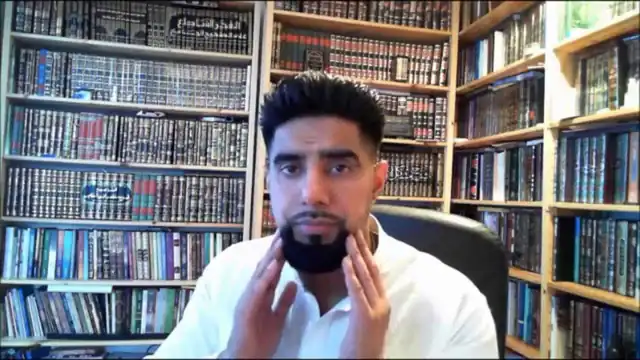 Press play to load from YouTube. Nothing loads until you do.
3 segments
machine3Each block is a segment in time order. Click to open it.All segments · in time order
Transcript
machineauto-transcribed, may contain errors · source: youtube auto · click a time to seek · dotted terms open the glossary[Music] in alhamdulillah I'd
like to deal with a question that has been posed for quite some while now and that is of the beard the what what is the ruling or is it permissible to have a beard which is trimmed from the sides or perhaps like this which may be called a goatee or an in Arabic as they called it classically or just perhaps trim your beard to quite an extent where
it's just quite small and all round in that manner is that actually permissible and I'd just like to clarify that today with you so first of all I'd like to say that this is permissible this is not Haram okay I do recognize that there is a difference of opinion amongst the I am not negating that difference I am not saying that no body is entitled to follow those other opinions you are absolutely welcome to
do so that is your choice however what I will demonstrate today is that there is a valid difference there is a valid opinion backed by many classical right up until our very day and age who have supported the other view that it is permissible to trim your beard to trim it from the sides or so on or to have it less than a fistful in length so so just to clarify so before I
proceed once again if anybody who hears this or watches this response and feels like saying yes but so and so she has said that no that is wrong and it must be uh A Fistful and here is a Hadith to prove it well I'm not saying that there is no evidence to prove that I'm not saying that there is no opinion which states that what I am proving today is that this opinion exists it has existed and continues to do so and that is all that I have to do
to show that this is within the tra tradition of our Dean it has been followed and taught by the and the F of this um so first of all when we take a look we will see that the beard which is known as a in Arabic has been described as something which grows upon the the lower jawel okay secondly many although not all but many had have definitely
agreed that it is what grows upon the chin and then there is some disagreement as to how far must it extend upon the jaw so that's as far as a definition is concerned traditionally there have been many beginning with from the Mal who clearly states in his commentary on Muslim that when he speaks about trimming the beard and he actually speaks about completely shaving the beard he says that it is simp he says it
is it is not Haram he says it is simply discouraged that discouraged according to these schools of law especially according to the Maliki School of Law or uh likewise some of the other F have adopted as well that it is something which it may be better not to do but if by doing it there is no blame upon you and clearly writes other people that it is an extension of of permissibility still Falls within that realm so it is not Haram
then like IM who describes the beard as being only that which is really with on the chin he says this the lower chin is what beard actually is so that's imashi then we have many other even from the other schools of law so for example
imami um many of these have all written very clearly that it is not Haram to trim or even shave but especially to trim right down the beard they've not considered it haram they've clearly said it is simply Mak is also transmitted from from Z these are from
the in fact goes to the extent to say it's actually it's not even to trim your beard almost right down to just you would say just above a stubble almost and you see that continuing right through to several right that have come after right up and until our very day and age so you will see many people uh whether they will be Maliki or of Other M so people like Muhammad as
his son Al you will see Kamal the great Muti of Tunisia his father Muhammad um the great of alar Muhammad Al Hussein in fact who was clean shaven himself had a small goatey as you will see you will see many like the great Maliki scholar you will see
like people like the of Ali [Music] Muhammad in our um Dr say Ahmed Al Al sh ABD alatan from Kuwait Abu zah previously uh today from the of you you hear Alani who was actually for a good while
clean shaven um his as the sh from his uh his own children Hamza Al katani and many others we see many of these right from across different schools of law up until our very day and age many of the of Al have all given fwa and have many of them have practiced actually in person that their beards have either been very
trimmed uh have been just perhaps just a very thin layer going around or some of them have had perhaps an A goate and some of them have even been almost clean shaven this opinion very clearly has existed and continues to do so as to the evidence that these have have held and I'm not speaking about the evidence that the other UL with the other position that no you must have a fistful length beard hold I'm talking
about these because that's all I'm I'm substantiating that this view has existed for centuries and this is or these are some of the evidences that they have relied upon you will see first of all that the Hadith which speak of growing the beard generally are reduced to three many of there are many but they seem to have um some some type of calam in their chains and the type of validity has been disputed with the exception of three the Hadith
of of and and these three they all contain two commands one is that to kind of all there's a variation of wording quite commonly used to which is commonly interpreted as growing the beard and trimming right down the
must this is what is found in these three okay now we find something else in each one of these three so for example the Hadith which is in it is in Muslim that the prophet said that that be different to the that
do we see the Hadith of abuur which has been transmitted in the mus of Ahmed that the prophet Sall alaihi wasallam said that be different to the majus to the zarrian that trim the Tash right down or trim the Tash and release the beard or which is commonly and I'm saying commonly because one of the linguistic definitions of is actually to trim which may come as a surprise to many people the Hadith
of Abu Al is that the prophet Sall alaihi wasallam he comes out to uh where many people sitting and then he says to them in some of the wordings that and in fact in this Hadith which is in the ofed the word is used which is a goate and the prophet Sall Al wasallam said let that be and be different to the so first of all we've got two things here one that there is a combination between the the mustach between the Tash and the beard
okay okay so the and the in all three of these secondly we have a a type of stipulation saying be different to the Jews and the Christians or the ma or the mush now many people have interpreted this to mean that it is an obligatory command a mandatory command but we see quite differently from other Hadith so let me take you to a few other
Hadith that share or that bear a resemblance to this from the differing perspective
Something wrong here?
Tell us what is wrong and it will be checked against the recording. Nothing changes until a person has reviewed it.
Sending a note needs JavaScript, which is off or unavailable in this browser. Nothing has been sent.
No name, email address or account is asked for or stored, and the inbox does not store your IP address. For rate limiting it keeps an unreadable fingerprint of your connection for 48 hours, and our database provider's own logs record connections as every website's do. Only your note, its kind, the page and the moment in the recording are kept, for review.
Cite this recording
Stable id, transcript version and tier are part of the citation. Every change to a transcript is logged.Mufti Abu Layth Archive, auto-transcribed, may contain errors. https://muftiabulayth.org/r/d95_pyj6nia/ (accessed 1 November 2026)
- APA 7
Mufti Abu Layth. (2014, April 12). Cutting-edge Perspective: Trimming the beard in Islam (pt 1)- Mufti Abu Layth [Video, auto-transcribed, may contain errors]. Mufti Abu Layth Archive. Retrieved November 1, 2026, from https://muftiabulayth.org/r/d95_pyj6nia/
- Chicago author-date
Mufti Abu Layth. 2014. "Cutting-edge Perspective: Trimming the beard in Islam (pt 1)- Mufti Abu Layth." Video, auto-transcribed, may contain errors. Mufti Abu Layth Archive. Recorded April 12, 2014. Accessed November 1, 2026. https://muftiabulayth.org/r/d95_pyj6nia/
- BibTeX
@misc{abulayth-d95-pYj6NiA,
  author = {Mufti Abu Layth},
  title = {{Cutting-edge Perspective: Trimming the beard in Islam (pt 1)- Mufti Abu Layth}},
  year = {2014},
  month = {4},
  date = {2014-04-12},
  howpublished = {\url{https://muftiabulayth.org/r/d95_pyj6nia/}},
  url = {https://muftiabulayth.org/r/d95_pyj6nia/},
  organization = {Mufti Abu Layth Archive},
  urldate = {2026-11-01},
  note = {Auto-transcribed, may contain errors}
}