
Recordings › Yasir Qadhi's reply to Jay Smith & ultracrepidarian | Mufti Abu Layth · 10 Dec 2020 › Segment 4 of 5
Was the Quran always fixed word for word, or was it flexible at first?
malik ibn anas malik bin anas imam maalik imam malik ibn anas imaam imams prayer leader faqih faqeeh fuqaha maaliki malikite malikiyyah maliki school shafi shafei shafiite shafi'i school muftis ilm al-kalam kalaam theology ash'ari ashaira asha'irah ashariyyah ash'arite al-mahdi imam mahdi mehdi koran quraan al-quran ayah aya ayat ayaat aayah aayat naskh nasikh mansukh nasikh wa mansukh wahy wahi wahee makki and madani makki madani meccan makki surah madani surah sahabah sahabi sahabiyyah sahabiyat mecca makka mekka madinah madina al-madinah madeenah ulama ulema ulamaaThe dynamic nature of the Quran: from essence to written embodiment
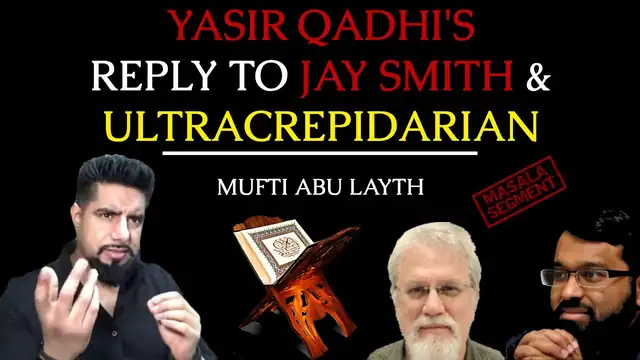 Play from 19:43
The video loads from YouTube only when you press play. Click a time in the transcript to seek.
Watch this part
Open on YouTube at 19:43The player starts at 19:43, the beginning of this part.
This segment19:43 to 28:34 · 8 min 51 sGeneral teaching
What this part covers
machinesummary, machine-writtenMufti Abu Layth holds the Quran was dynamic in the Prophet's time, with companions allowed to substitute synonyms, and that a fixed vowel-for-vowel text is a modern idea. Writing it down in a worldly script brought its own constraints.
In more detail
Answering requests for his own view, Mufti Abu Layth shares notes in which he says the Quran has always been dynamic and that the idea that it is static vowel for vowel is a nineteenth- and twentieth-century phenomenon. He sets out stages: the essence stage, the eternal speech (al-kalam al-azali) which the Ash'aris say is meaning, not words; the revelation stage, where it manifests as the Arabic Quran, citing al-Baqillani [?] and al-Bajuri, and where he sides with the view that the Arabic came into being in the mind of the Prophet, revealed to him and not invented; and the dynamic interaction stage of rulings, abrogation and companions substituting synonyms, which he says Imam Malik and al-Shafi'i allowed and which he regards as the default nature (azimah), not a dispensation. The fourth is the embodiment stage, the move from oral to written under Abu Bakr and Uthman, with the challenge of script: he says the Nabataean script, imported from al-Hira, was a worldly choice, citing Abu Sufyan, Mu'awiya and the Badr captives who could buy their freedom by teaching writing.
- Some terms in this segment are uncertain
Position stated
Mufti Abu Layth says he finds himself in line with the view that the Arabic Quran came into being in the mind of the Prophet, revealed to him and not invented by him.
“i find myself in line with that latter that is in the mind of the prophet”
Category: teaching
Kind: general teachingTranscript
machine19:43 to 28:34 · click a time to seek · dotted terms open the glossary
this is like why doesn't he answer the question i mean i don't get what the like say something for god's sake since this is your last smackdown at least share some view don't just say yeah you know war water water water i mean come on there's more to it than that so so i'm disappointed by him once again evading the question so yeah some people had asked me that mufti you know about this nature of the quran issue i have explained it before i have got a little video i did have some notes some very brief kind of written notes i shared with
some people so i thought look i'll share them here i'll share them here and just to you know if they're of any help so right now because according to me um and i this is why i'm grateful he has highlighted some diversity look it is true there is diversity in this how muslims understood revelation to me the quran has always been dynamic there is a dynamism to the nature of the quran and there are layers to this i will briefly give an overview so some people may at
least find some clarity if they choose to disagree with me that's fine there are plenty of other interpretations they can take in my understanding the scholars have never said that traditionally that the quran vowel for vowel is exactly forever static they've never said that as a whole they've addressed the quran but this thing of saying every single vowel this is a very recent 19th century 20th century phenomenon so here are some notes when i've discussed this previously with
some friends and students i've highlighted that there's different layers in which we can take this there's the ontology stage or the essence stage that the revelation in its very essence where it's a divine message which the asha ira referred to in their books as al-kalam al-azli that this is just a meaning it's not language it's not words there's the second stage and i break it down into seven stages but you could break it into how many you like really the revelation stage this is where is expressed and it's the word used for it is this is what the ashadis and the
theologians use and this is the quran arabic stage this is when it manifests in this world it manifests in the arabic language now they do disagree um now i do highlight there that look uh that this realm is it does restrict things so already there's some restriction i quote the great maliki legend there the early uh jurist and theologian barcelona who
says it reflects and is an expression of the divine message but the quran arabi belongs to this world not um that world so there is a difference now bajuri uh you can and i have discussed this in a bit more i think with the dr mahdi sergey we go over this in one of the mind traps so it's always worth uh checking that up as well i do explain here in this in this stage
the second stage there is a question that where is the arabic coming from the quran if it's been created the uh the asha era use the word mahdith they tend to avoid the word mahluk because of the controversy that went before them so they used the word mustard brought into existence as uh and the asha era claimed that the kalamu love thee is mahdith but the kalamu azli isn't nafsi that kalam which was not arabic which was not words that which was with god is divine and transcendent but what was in this world
is obviously of this world they then disagree between themselves at what stage did it become created some say in the lower some say in the sky some say in the ears some say in the mind of jibreel some say in the mind of the prophet i find myself in line with that latter that is in the mind of the prophet that it appears it is revealed to him so i don't believe the prophet is inventing it it is revealed to the prophet in his mind and it is an arabic quran that it comes and this would be the second stage the third stage would be the dynamic interaction stage this is the sub meaning the many
uh the multi-form um that it takes or the dynamism is expressed so this this life that it has to it that rulings are revealed there there are changes being made abrogations the sahaba are allowed to substitute words and synonymize them highlights that imam malik and shafa he were of that view that the sahaba could do that whatever made it easy for them they could replace these words and this was called the sabbath according to them this dynamism in my understanding was the default
nature of the quran it was not a just a dispensation it was not a roxa it was the azima okay if that makes sense to you [Music] then there is the embodiment stage now i've used the term embodiment because it's being now placed in a written body okay it moves from the four it moves from an oral to a textual tradition i have a mind trap elaborating on this with dr khalil and he's definitely worth checking out where we speak about this the challenges of something going from an oral to a written
um phase now this and the verse of the quran we say the book we reveal the scripture you make it into pages that is a verse of the quran and although there are some examples of this from the prophet's life though people are trying to write it down uh on whether it's gonna be parchments and things but really it happens after the prophet's life it happens during arguably abu bakr's time definitely by earth man's time but
this this whole thing even before the uthmani thing this writing it down has many challenges with it what some of these challenges are just in case you're wondering well first of all it was to do with what script should be used okay because uh because that's an important point what script so the nabatean script was chosen now this was something which at the time you've got was called al jazeem they would call it as opposed to the hemiari musnad script that was being chosen uh that some that the arabians used to write with so this was a more northern kingdom
script it was used in modern-day iraq it was from the nabataeans inherited by the other cultures that came after them especially in hera we know abu sufyan he imports the script through bishop and abdul malik this is why uh muawiyah radhilan was one of the first people to write the script and this is why the the prophet said to the captives in the battle of badr that if they teach the yathrib people the medinan people how to write a number of people they can buy their freedom with it because the script
this script was imported into makkah from hera so the prophet making this decision to let's use this script this script in and of itself would not have been a sacred script it was the decision that the prophet saw al-islam uh adopted as which one could then posit is part of the divine plan but this script was a very worldly script it was imported into makkah and then into medina and it naturally had its challenges so there's all of that which you have to look at um
so things like that as well so just to be clear there was uh let me just see if i missed any notes right there and this would have been the end of the pure oral expression era um i know sorry the yeah i was just seeing right that's fine then there's the fifth stage the constriction or reductionist stage i mean it's a reductionist stage but i've called it constriction and that is the rasmul ethmani in his
Paragraphs overlapping 19:43 to 28:34. Full text on the recording page.
Cite this segment
Stable id, transcript version and tier are part of the citation. Every change to a transcript is logged.Mufti Abu Layth Archive, segment 2020-12-10-S04, auto-transcribed, may contain errors. https://muftiabulayth.org/r/ttq_cxlvaso/s/4/ (accessed 1 November 2026)
- APA 7
Mufti Abu Layth. (2020, December 10). Was the Quran always fixed word for word, or was it flexible at first? [Video, segment 2020-12-10-S04, auto-transcribed, may contain errors]. Mufti Abu Layth Archive. Retrieved November 1, 2026, from https://muftiabulayth.org/r/ttq_cxlvaso/s/4/
- Chicago author-date
Mufti Abu Layth. 2020. "Was the Quran always fixed word for word, or was it flexible at first?" Video, segment 2020-12-10-S04, auto-transcribed, may contain errors. Mufti Abu Layth Archive. Recorded December 10, 2020. Accessed November 1, 2026. https://muftiabulayth.org/r/ttq_cxlvaso/s/4/
- BibTeX
@misc{abulayth-2020-12-10-S04,
  author = {Mufti Abu Layth},
  title = {{Was the Quran always fixed word for word, or was it flexible at first?}},
  year = {2020},
  month = {12},
  date = {2020-12-10},
  howpublished = {\url{https://muftiabulayth.org/r/ttq_cxlvaso/s/4/}},
  url = {https://muftiabulayth.org/r/ttq_cxlvaso/s/4/},
  organization = {Mufti Abu Layth Archive},
  urldate = {2026-11-01},
  note = {Segment 2020-12-10-S04, auto-transcribed, may contain errors}
}
Something wrong here?
Tell us what is wrong and it will be checked against the recording. Nothing changes until a person has reviewed it.
Sending a note needs JavaScript, which is off or unavailable in this browser. Nothing has been sent.
No name, email address or account is asked for or stored, and the inbox does not store your IP address. For rate limiting it keeps an unreadable fingerprint of your connection for 48 hours, and our database provider's own logs record connections as every website's do. Only your note, its kind, the page and the moment in the recording are kept, for review.