
Recordings › Yasir Qadhi's reply to Jay Smith & ultracrepidarian | Mufti Abu Layth · 10 Dec 2020 › Segment 5 of 5
Can we substitute words of the Quran today as the companions did?
malik ibn anas malik bin anas imam maalik imam malik ibn anas imaam imams prayer leader shafi shafei shafiite shafi'i school qiyas qiyaas muftis hukm ahkam hukum hukam ahkaam raawi ruwat rijal narrator koran quraan al-quran tilawah tilawat tilaawah sahabah sahaba sahabi sahabiyyah sahabiyat ulama ulema ulamaa jihad jihaadFrom the Uthmanic rasm to the canonised readings: dynamism restricted
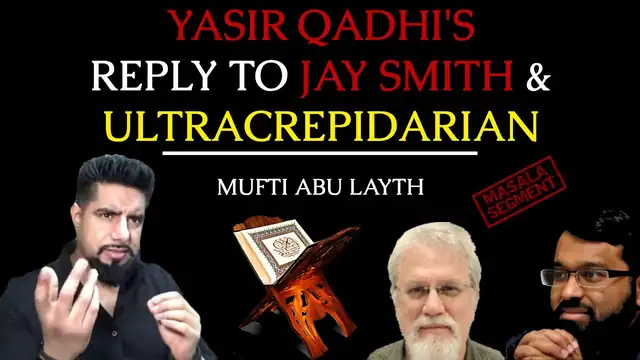 Play from 28:34
The video loads from YouTube only when you press play. Click a time in the transcript to seek.
Watch this part
Open on YouTube at 28:34The player starts at 28:34, the beginning of this part.
This segment28:34 to 34:59 · 6 min 25 sGeneral teaching
What this part covers
machinesummary, machine-writtenNo: the Quran was dynamic in the Prophet's time, but after Uthman's codex and the canonised readings it has reached us fixed, so changing it today would not be correct. He feels word substitution was the original default, not a mere dispensation.
In more detail
Mufti Abu Layth continues with the fifth stage, the constriction under Uthman, whose consonantal codex sought unity in recitation but trapped the wording so that words could no longer be substituted, ending the dynamic era. Then came the deciphering stage, when many readings emerged as people worked out vowels and diacritics, which he likens to reading abbreviated text messages, with grammar and the readings shaping each other. In the canonisation stage Ibn Mujahid chose seven readers, later scholars fixed two transmitters for each, al-Shatibi [?] restricted it to seven and Ibn al-Jazari accommodated more, and, like stable isotopes, certain readings came to dominate. He concludes that the Quran was dynamic in the Prophet's time but has come to us static, so it would not be correct to play with it today, and says that while it is unclear whether Imam Malik saw word substitution as the default or a dispensation, he himself feels it was the default.
- Some terms in this segment are uncertain
Position stated
Mufti Abu Layth says he feels that the companions' substituting of words was the default ruling for the Quran rather than merely a dispensation.
“so they may have felt the latter i feel the former that it is by default”
Category: teaching
Kind: general teachingTranscript
machine28:34 to 34:59 · click a time to seek · dotted terms open the glossary
so things like that as well so just to be clear there was uh let me just see if i missed any notes right there and this would have been the end of the pure oral expression era um i know sorry the yeah i was just seeing right that's fine then there's the fifth stage the constriction or reductionist stage i mean it's a reductionist stage but i've called it constriction and that is the rasmul ethmani in his
time uthman radiolog definitely puts together this uh codex this whole this consonantal restriction where he has certain you can't really he's trying to create some um unity amongst people wishing to recite now what the challenges that brings it traps the expression within the these continental barriers of that script which is that from hera the jesus script the nabatean script and it is the
end of the dynamic era because now once the words are trapped people can no longer substitute them okay so that has definitely come to an end i will just and you move on to the deciphering stage which is after that where several quran emerged because now although the consonantal template is the how to read it but the vowels people are still you know some people may be doing their own hd heart some people may be assuming some people so there is a lot of attempts in how should it be
best pronounced what are the inflections the endings how should they be what are the vowelings the diacritical marks is this a fur or a cough it's so the best example is like an english text message language even though it's quite straightforward sometimes you could be you know you could understand that what do they mean here if somebody was to say uh you know t h z um or ths is this these is this those like that there's a disagreement so similarly i'm just trying to give an
approximation here so a lot of are emerging there's grammatical is expanding um and it's having a a mutual impact it's impacting grammar grammar is impacting it and then there's the globalization stage in which construct constricting the embodiment so we know we already have this temp this kind of template the structure of the uthmani rasam now it's constricting it further so this has several waves to it i highlight that that is the ibn mujahid of era where he kind of chooses the seven qura only
but remember from each quran from each ari many people are transmitting it differently and you have the ibn boon uh adani it's really not ibn aderni but still i mean people have put dany in there as well the two rawi cannon that look each ari should have at least two what from him um jersey sorry shatabhi restricting it to the seven collecting these who these rawies are from them al jazeera accommodating a few more i gave the example of iso uh isoto isotopes last time
where i mentioned that look the way you have certain elements that will have certain isotopes to them now it's just the way things are that reality pans out that some elements will always be more stable and these isotopes some of them will always just be very unstable as an analogy some of these in society is a social experiment some will always preponderate okay and that's exactly what happens
naturally over time you will find a particular one for one reason or another dominating the scene and this is a quasi-end of the variation era the variant era because it's now become kind of trapped within certain readings that are then imprinted so you can't really move about and these are so these were my my notes that i shared with some people so i hope that shed some light that look in my understanding there was a dynamism that was there in the prophet's time over the stages it got restricted
we today would not be allowed because of the way we've received the tradition it is static as it's come to us but really if we were in the prophet's time it would have still had that dynamism it's just today not just today for for the most part of islam it's been then restricted okay so that has kind of left us because we don't have access to it so as to just do it today um we have had you know over for the most part really going back to uthman's time we've had this disconnect
so we you know we would not uh be allowed it would not be correct to have any play with that today although in essence the quran was dynamic so it allowed for people to to to substitute words for their ease when it was being revealed and when it was being read during the prophet's time that was the understanding of imam malik of imam shafi'i as ibn abdullah explains in although it's unclear whether imam malik believed that the them substituting words
was the default ruling or was that just a rosa just me an exception for them a rosa a dispensation to make life easy for them so they may have felt the latter i feel the former that it is by default the the the azima the ruling for people i hope that shed some light on the nature of the quran and the reason i explain that is because yes said well he's not going to explain it and it's him who's really opened this kind of worms so he really ought to do some explanation
okay cool i hope
Paragraphs overlapping 28:34 to 34:59. Full text on the recording page.
Cite this segment
Stable id, transcript version and tier are part of the citation. Every change to a transcript is logged.Mufti Abu Layth Archive, segment 2020-12-10-S05, auto-transcribed, may contain errors. https://muftiabulayth.org/r/ttq_cxlvaso/s/5/ (accessed 1 November 2026)
- APA 7
Mufti Abu Layth. (2020, December 10). Can we substitute words of the Quran today as the companions did? [Video, segment 2020-12-10-S05, auto-transcribed, may contain errors]. Mufti Abu Layth Archive. Retrieved November 1, 2026, from https://muftiabulayth.org/r/ttq_cxlvaso/s/5/
- Chicago author-date
Mufti Abu Layth. 2020. "Can we substitute words of the Quran today as the companions did?" Video, segment 2020-12-10-S05, auto-transcribed, may contain errors. Mufti Abu Layth Archive. Recorded December 10, 2020. Accessed November 1, 2026. https://muftiabulayth.org/r/ttq_cxlvaso/s/5/
- BibTeX
@misc{abulayth-2020-12-10-S05,
  author = {Mufti Abu Layth},
  title = {{Can we substitute words of the Quran today as the companions did?}},
  year = {2020},
  month = {12},
  date = {2020-12-10},
  howpublished = {\url{https://muftiabulayth.org/r/ttq_cxlvaso/s/5/}},
  url = {https://muftiabulayth.org/r/ttq_cxlvaso/s/5/},
  organization = {Mufti Abu Layth Archive},
  urldate = {2026-11-01},
  note = {Segment 2020-12-10-S05, auto-transcribed, may contain errors}
}
Something wrong here?
Tell us what is wrong and it will be checked against the recording. Nothing changes until a person has reviewed it.
Sending a note needs JavaScript, which is off or unavailable in this browser. Nothing has been sent.
No name, email address or account is asked for or stored, and the inbox does not store your IP address. For rate limiting it keeps an unreadable fingerprint of your connection for 48 hours, and our database provider's own logs record connections as every website's do. Only your note, its kind, the page and the moment in the recording are kept, for review.