
Recordings › In Depth: The Sanaʽa Manuscript -Mufti Abu Layth · 1 Mar 2019 › Segment 7 of 11
Was the Sana'a palimpsest an official copy of the Quran or someone's personal notes?
muftis dalil daleel adillah adilla proof koran quraan al-quran sura soorah suwar soora chapter bismillah ir-rahman ir-rahim bismillahir rahmanir rahim bismillahi bismillah al-rahman al-rahim tawbah tauba taubah repentanceAsma Hilali's analysis: personal notes, and 'do not say bismillah' before Surat al-Tawba
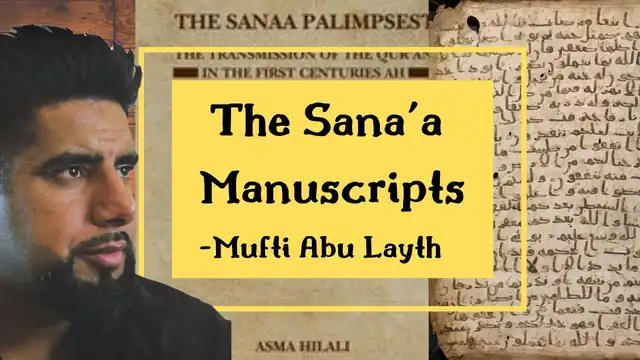 Play from 19:34
The video loads from YouTube only when you press play. Click a time in the transcript to seek.
Watch this part
Open on YouTube at 19:34The player starts at 19:34, the beginning of this part.
This segment19:34 to 22:07 · 2 min 33 sGeneral teaching
What this part covers
machinesummary, machine-writtenThe lower text contains notes such as 'do not say bismillah here' before Surat al-Tawba, which shows it was someone's personal script, as Asma Hilali argues, and not a standard copy sent out to communities. Mufti Abu Layth finds no evidence for the Puins' view that it was official.
In more detail
Mufti Abu Layth presents Asma Hilali's analysis of the manuscript, which concludes that it was most likely the personal notes of someone in a study circle, for two reasons. First, the writer sometimes wrote a letter in the middle of a word in its final form with a tail [?], which does not make sense in the usual script and suggests he wrote words down and later added to them. Second, and more fascinating to Mufti, before Surat al-Tawba, which does not begin with the basmala, the writer had written 'do not say bismillah here', which is plainly a personal note and not the Quran. Mufti says he is not sure it was a student in a study circle as Hilali suggests, but that it is definitely somebody's personal script, with notes such as 'do not say bismillah here', and that Dr Puin's [?] view that it was some kind of standard manuscript being sent out has no evidence at all behind it.
- Some terms in this segment are uncertain
Position stated
Mufti Abu Layth holds that the lower text of the Sana'a palimpsest is somebody's personal script with his own notes, not a standard manuscript, and that there is no evidence for the view that it was an official copy.
“I'm not so sure whether it was a student documenting it in a study circle like Dr Asma hilali has said but what I think is this is definitely somebody's personal script”
Category: historical claim
Kind: general teachingTranscript
machine19:34 to 22:07 · click a time to seek · dotted terms open the glossary
we're not normally speaking Arabic anyway so Arabic is only our Islamic language so it's easy to keep that in a separate mental compartment and just memorize it but for them this is how they spoke this is how they used to write you know do eloquent poetry they used to do so for them to sometimes mix up words was much more feasible some of them I'm just saying right now just to give you a um a kind of backdrop okay so with all of these things in mind okay now um I would explain that Dr Asma hilali in her analysis of these
manuscripts she has mentioned that it appears that these manuscripts were most likely personal notes that some person had taken in some study Circle this was her interpretation and the reason she says this is for two reasons she says that the person first of all when he writes letters like now uh when it's written at the end of a word it has a tale to it okay when it's written in the middle of a word it's just a round thing and Carries On so she identified that this person seems
to write the with a tail in certain words words in the middle of a word which doesn't really make sense because that's not how the C is written in the middle of a word so she so from here she assumes that this person was maybe writing it off with the c and then later adding to it like saying oh I realized that this word was like this another important thing that c thing I think is okay I think more interestingly she points out another point and this is definitely fascinating that how the person had
written before Toba uh now Surah does not begin with so the person had written do not say bismah here so now that's just a note so that's actually in this manuscript the person had written before Surah Toba now you know well that's not the Quran you know this is clearly a personal note that somebody's writing now so I would say that look with these things what we have first of
all I'd like to highlight uh what is what is this most likely so I feel that I'm not so sure whether it was a student documenting it in a study circle like Dr Asma hilali has said but what I think is this is definitely somebody's personal script if it wasn't like I know Dr Quinn seems to uh emphasize she thinks this was some kind of standard manuscript that people were sending out and there's no evidence for that at all if anything this seems to be somebody's personal uh script personal copies that they're writing and they're making some
Paragraphs overlapping 19:34 to 22:07. Full text on the recording page.
Cite this segment
Stable id, transcript version and tier are part of the citation. Every change to a transcript is logged.Mufti Abu Layth Archive, segment 2019-03-01-S07, auto-transcribed, may contain errors. https://muftiabulayth.org/r/k6faz7xw53y/s/7/ (accessed 1 November 2026)
- APA 7
Mufti Abu Layth. (2019, March 1). Was the Sana'a palimpsest an official copy of the Quran or someone's personal notes? [Video, segment 2019-03-01-S07, auto-transcribed, may contain errors]. Mufti Abu Layth Archive. Retrieved November 1, 2026, from https://muftiabulayth.org/r/k6faz7xw53y/s/7/
- Chicago author-date
Mufti Abu Layth. 2019. "Was the Sana'a palimpsest an official copy of the Quran or someone's personal notes?" Video, segment 2019-03-01-S07, auto-transcribed, may contain errors. Mufti Abu Layth Archive. Recorded March 1, 2019. Accessed November 1, 2026. https://muftiabulayth.org/r/k6faz7xw53y/s/7/
- BibTeX
@misc{abulayth-2019-03-01-S07,
  author = {Mufti Abu Layth},
  title = {{Was the Sana'a palimpsest an official copy of the Quran or someone's personal notes?}},
  year = {2019},
  month = {3},
  date = {2019-03-01},
  howpublished = {\url{https://muftiabulayth.org/r/k6faz7xw53y/s/7/}},
  url = {https://muftiabulayth.org/r/k6faz7xw53y/s/7/},
  organization = {Mufti Abu Layth Archive},
  urldate = {2026-11-01},
  note = {Segment 2019-03-01-S07, auto-transcribed, may contain errors}
}
Something wrong here?
Tell us what is wrong and it will be checked against the recording. Nothing changes until a person has reviewed it.
Sending a note needs JavaScript, which is off or unavailable in this browser. Nothing has been sent.
No name, email address or account is asked for or stored, and the inbox does not store your IP address. For rate limiting it keeps an unreadable fingerprint of your connection for 48 hours, and our database provider's own logs record connections as every website's do. Only your note, its kind, the page and the moment in the recording are kept, for review.