
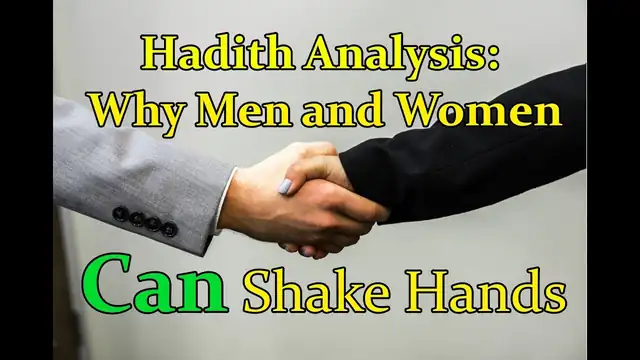
Recordings › Hadith Analysis: Why men and women CAN shake hands -Mufti Abu Layth · 4 May 2018 › Segment 3 of 4
What evidence do scholars use to allow men and women to shake hands?
haj pilgrimage hadj hadeeth ahadith ahaadeeth hadis hadees ahaadith saheeh sahih hadith saheeh hadith sound hadith authentic al-bukhari imam bukhari sahih al-bukhari sahih bukhari saheeh al-bukhari saheeh bukhari imam al-bukhari qadi ayyad qadi iyaad al-qadi iyad 'urf muftis haraam forbidden dalil daleel adillah adilla proof sahihayn sahihain saheehain saheehayn asharis ashaira asha'irah ashariyyah ash'arite quran quraan al-quran ayah aya ayat ayaat aayah aayat sahabah sahaba sahabi sahabiyyah sahabiyat ulama ulema ulamaa as-salamu alaykum assalamu alaikum assalamualaikum salaam salaams salam alaykum wa alaykum as-salam peaceFurther evidences: 'do not frighten people away', returning a greeting, Abu Musa's hair and Umm Haram
 Play from 6:33
The video loads from YouTube only when you press play. Click a time in the transcript to seek.
Watch this part
Open on YouTube at 6:33The player starts at 6:33, the beginning of this part.
This segment6:33 to 9:10 · 2 min 37 sA view quoted in order to be discussed, not a position held
What this part covers
machinesummary, machine-writtenScholars who permit it cite 'do not frighten people away', the verse on returning greetings, Abu Musa having a woman comb his hair on Hajj, and the Sahih report that Umm Haram combed the Prophet's hair and let him nap at her house. The Umm Haram report is one scholars struggled with.
In more detail
Mufti Abu Layth lists further evidences used by the scholars who permit shaking hands: the hadith 'give glad tidings and do not frighten people away', the role of custom, and the verse that when greeted one should return a better greeting or at least return it. He reports that al-Qaradawi [?] also reasons from the Bukhari report that Abu Musa al-Ash'ari, during Hajj, had a woman of his tribe comb through his hair, explaining that men then wore their hair long and in braids, as did the Prophet and many companions, so going through the hair for lice (tafliya) was a common practice. He then points to the hadith in the two Sahihs that Umm Haram bint Milhan, an aunt of Anas, did the same for the Prophet: he would rest at her house when travelling, nap there, eat food she prepared, and in one narration fell asleep with his head in her lap. He says Qadi Iyad brings many of these narrations in al-Shifa, and that the scholars really struggled with this report.
- Some terms in this segment are uncertain
Position stated
This segment presents a view in order to discuss or respond to it. It is recorded as quoted, never as held, and no position is attributed from it.
Kind: a view quoted in order to be discussed, not a position heldTranscript
machine6:33 to 9:10 · click a time to seek · dotted terms open the glossary
This segment states a view in order to discuss it. It is recorded as a quoted view, not as a position held.
hands I'm sorry that with the women did place their hands on his hand also the Haditha when you go some way bashar wallatoona do not frighten people away and if it is a custom and also the eye of the Koran were in a hurry to meet here that if you are given a greeting for hate you may ascend in Manhattan give a better greeting greeting or adieu ha or at least return it they also use the evidences that abu musa al-ashari which is in bihari they use this so useful Pablo he uses this as his reasoning as well that abu musa al-ashari during the
Hajj had a woman from from the tribe of who was a Shari from the tribe of the Achadjian to kind of fix his hair because they used to do tough Leah toughly I was because a lot of the men used to have long hair they would get sometimes either lice or sometimes some kind of they would get certain things that would come in there here so every once in a while people would go through their hair and just make sure if things clean and and a lot of the men would would have braids I keep forgetting what we call those things a bit like those I don't know whether they call them I forgot now I think but anyway they're kind of like the braids that men were but so a lot of the Companions were like
that and even the Prophet used to have braids so this tough little Rutz was a common practice done time to time when men would open up their braids so somebody would go through the hair make sure and straighten it all out and so musa al-ashari had a woman doing that whilst he was unhatched while she was mad at him and then you see what's really interesting is the hadith in sahih hain that the prophet salaallah alayhi salam o Muharram who is an aunt of Ana's she would do that with the Prophet now that's a really interesting hadith because Omaha Iran bint milhan how did the scholars the scholars really
struggled with this one so they really didn't know how to respond to it because in some hadith that because the Prophet would go the I mean the Prophet generally she was one of the aunts but the Prophet would go there sometimes when he was going somewhere he would take a rest there he was known to sometimes take a nap and he would take a nap at her house sometimes she would prepare the food for the Prophet she will do tough little rascals through he's here and there's one narration of the Prophet was really tired and he fell asleep and there's a narration that he fell asleep with his head in her lap but the general narrations do speak about the tough Leah
now all the yelled brings a lot of these narrations in the Shiva and then obviously the huge conundrum of how do we answer this so scholars have really struggled massively to answer that and what's interesting is even after Bart tried to say maybe she was like a foster sister of the Prophet through this foster relationship and later scholars like halfway the dome yachty really go out tearing that argument saying this is nonsense because how could have she been a foster sister and he goes through the
Paragraphs overlapping 6:33 to 9:10. Full text on the recording page.
Cite this segment
Stable id, transcript version and tier are part of the citation. Every change to a transcript is logged.Mufti Abu Layth Archive, segment 2018-05-04-S03, auto-transcribed, may contain errors. https://muftiabulayth.org/r/h8sxk-2-w-4/s/3/ (accessed 1 November 2026)
- APA 7
Mufti Abu Layth. (2018, May 4). What evidence do scholars use to allow men and women to shake hands? [Video, segment 2018-05-04-S03, auto-transcribed, may contain errors]. Mufti Abu Layth Archive. Retrieved November 1, 2026, from https://muftiabulayth.org/r/h8sxk-2-w-4/s/3/
- Chicago author-date
Mufti Abu Layth. 2018. "What evidence do scholars use to allow men and women to shake hands?" Video, segment 2018-05-04-S03, auto-transcribed, may contain errors. Mufti Abu Layth Archive. Recorded May 4, 2018. Accessed November 1, 2026. https://muftiabulayth.org/r/h8sxk-2-w-4/s/3/
- BibTeX
@misc{abulayth-2018-05-04-S03,
  author = {Mufti Abu Layth},
  title = {{What evidence do scholars use to allow men and women to shake hands?}},
  year = {2018},
  month = {5},
  date = {2018-05-04},
  howpublished = {\url{https://muftiabulayth.org/r/h8sxk-2-w-4/s/3/}},
  url = {https://muftiabulayth.org/r/h8sxk-2-w-4/s/3/},
  organization = {Mufti Abu Layth Archive},
  urldate = {2026-11-01},
  note = {Segment 2018-05-04-S03, auto-transcribed, may contain errors}
}
Something wrong here?
Tell us what is wrong and it will be checked against the recording. Nothing changes until a person has reviewed it.
Sending a note needs JavaScript, which is off or unavailable in this browser. Nothing has been sent.
No name, email address or account is asked for or stored, and the inbox does not store your IP address. For rate limiting it keeps an unreadable fingerprint of your connection for 48 hours, and our database provider's own logs record connections as every website's do. Only your note, its kind, the page and the moment in the recording are kept, for review.