
Recordings › Hadith Analysis: Why men and women CAN shake hands -Mufti Abu Layth · 4 May 2018 › Segment 2 of 4
Which scholars say men and women may shake hands, and what about 'I do not shake hands with women'?
wudhu wudoo wuzu ablution al-wudu wudhoo hadeeth ahadith ahaadeeth hadis hadees ahaadith sahih saheeh sahih hadith saheeh hadith sound hadith maaliki malikite malikiyyah maliki school hanafite hanafiyyah hanafi school 'urf fatwah fatawa fatwaa fataawa legal opinion muftis halal halaal lawful haraam forbidden asharis ashaira asha'irah ashariyyah ash'arite quraan al-quran ayah aya ayat ayaat aayah aayat 'alim aalim ulema ulamaa sheikh sheik shuyukh shaykhs salam as-salamu alaykum assalamu alaikum assalamualaikum salaam salaams salam alaykum wa alaykum as-salam peace'Touching women' in the schools, 'I do not shake hands with women', and the scholars who permit it
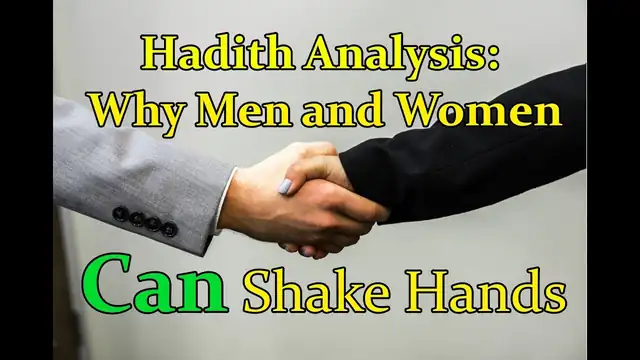 Play from 2:36
The video loads from YouTube only when you press play. Click a time in the transcript to seek.
Watch this part
Open on YouTube at 2:36The player starts at 2:36, the beginning of this part.
This segment2:36 to 6:33 · 3 min 57 sA view quoted in order to be discussed, not a position held
What this part covers
machinesummary, machine-writtenThe hadith 'I do not shake hands with women' is set against Umm Atiyya's narrations of the women's pledge, which some read as the Prophet shaking hands. Contemporary scholars including the Shaykh of al-Azhar, Bin Bayyah and the European fatwa council have ruled that shaking hands is permitted.
In more detail
Mufti Abu Layth says the Quran's phrase about touching women (lamastum al-nisa) in the verse on wudu was read by the Hanafis as meaning sex, by the Shafi'is as physical touch and by the Malikis as touch with desire. He then turns to the hadith that the Prophet said 'I do not shake hands with women', and sets against it several narrations from Umm Atiyya, transmitted in Ibn Hibban, al-Bazzar and other books and brought by al-Tabari, about the women's pledge: in some the Prophet stretched out his hand and the women stretched theirs, in others he sent Umar as deputy, and in others a cloth barrier was placed between them, so that some understood the Prophet himself to have shaken hands and others not. He lists contemporary scholars who have given the fatwa that shaking hands, not as a sexual act, is permitted: the Shaykh of al-Azhar Ahmad al-Tayyib [?], a Maliki; Shaykh Bin Bayyah, a Maliki and a teacher of Hamza Yusuf; the European fatwa council; and al-Qaradawi [?]. He recounts the Shaykh of al-Azhar shaking hands while presenting graduation awards until a female student declined, and later saying that was fine but that the matter was cultural, and the story told by Mahmud Ashur [?], a former deputy of al-Azhar, who when a Muslim woman in America refused his hand as haram asked why, if she took such reports literally, she lived in a land which other hadith would equally forbid.
- Some terms in this segment are uncertain
Position stated
This segment presents a view in order to discuss or respond to it. It is recorded as quoted, never as held, and no position is attributed from it.
Kind: a view quoted in order to be discussed, not a position heldTranscript
machine2:36 to 6:33 · click a time to seek · dotted terms open the glossary
This segment states a view in order to discuss it. It is recorded as a quoted view, not as a position held.
Arabic to touch and the word lumps can be used as touch as well but must that if you touch a woman you'd rather that there was a metal rod placed in your hand or in head and there's varying narrations now first of all these narrations are not authentic the way people would like them to be they're not but regardless even if you accept them as authentic many Oh Lama understood here this to mean this to mean this was a euphemism for sex
that when people use the word must touch they were actually speaking about having sex so that is and that is used so in the quran for example hola mr. manisa or that you've touched women that you break your voodoo so the Hanafi method was open that now this meant just sex it didn't mean having physical touch and the shafa'ah thought you meant physical touch but the male Kia said oh it meant touch with desire and not just regular touch now then there's another hadith that is taught it is society that the
Prophet said I love self upon me sir I do not shake hands with women now the issue here is that there are several narrations that come from Omo attea which are transmitted in ignite ban in Bazaar in other books like poverty even brings them as well that the Prophet sent home Arab no hotter brody lon and these varying narrations here and in some narrations he sent Omar as as a deputy and Omar took the pledge and they said for Madonna who he stretched
forward his hand on mati essays for Madonna Adrianna so we put our hand we stretched our hands now some people understood this narration to be referring to the Prophet so they said that the Prophet shook hands with them other people said no this wasn't the Prophet this was Omar then there's other narrations that say that no the Prophet placed a barrier like a cloth and then they shook hands many scholars said like today many of the scholars from al-azhar Cheryl Azhar Ahmed Rajib who is Maliki
has said that shaking hands not as a sexual act I mean it's not generally done as a sexual act but just shaking hands in general is permitted chef Ben Bayer who is a Maliki scholar has given that fatwa renowned worldwide one of the teachers of Hamza Yusuf the fatwa forum for Europe has given that fatwa Sher Khan wahwee has given that fatwa many ulama have given that fatwa and that shaking hands in fact ship Malaya it's famous about him that he was handing out the graduation awards he's the chef of a lesson and he was shaking the hands and it came to one of the the
female students and she refused to shake his hand I mean he didn't make a big deal but he was on stage and then later on it was spoken about and he said that that's fine but this isn't actually his understanding is this was more a cultural issue now there's also another story the former there's a member of the kind of Islamic Research Council in al-azhar and a former were killed as her his name is Mohammad Shaikh Mahmood are sure he speaks about on one of his travels to America he says he got there and there was a Muslim and he's speaking to Muslims and there was a Muslim woman and he tried to shake her hand and she says
I don't shake hands and he said ok and she said it's Haram and he said well if you're gonna take rulings like that in this literal way then he said can I ask why are you living in this country because there's also hadith that would say it's Haram to live in these lands but you would say oh but those hadith don't mean that so it's interesting I mean he speaks about that that's available online he also share Cheryl as her and a lot of these Michele if say that they used the evidences of one the hadith of Roma from Omar Thea that she did used to shake
hands I'm sorry that with the women did place their hands on his hand also the Haditha when you go some way bashar wallatoona do not frighten people away and if it is a custom and also the eye of the Koran were in a hurry to meet here that if you are given a greeting for hate you may ascend in Manhattan give a better greeting greeting or adieu ha or at least return it they also use the evidences that abu musa al-ashari which is in bihari they use this so useful Pablo he uses this as his reasoning as well that abu musa al-ashari during the
Paragraphs overlapping 2:36 to 6:33. Full text on the recording page.
Cite this segment
Stable id, transcript version and tier are part of the citation. Every change to a transcript is logged.Mufti Abu Layth Archive, segment 2018-05-04-S02, auto-transcribed, may contain errors. https://muftiabulayth.org/r/h8sxk-2-w-4/s/2/ (accessed 1 November 2026)
- APA 7
Mufti Abu Layth. (2018, May 4). Which scholars say men and women may shake hands, and what about 'I do not shake hands with women'? [Video, segment 2018-05-04-S02, auto-transcribed, may contain errors]. Mufti Abu Layth Archive. Retrieved November 1, 2026, from https://muftiabulayth.org/r/h8sxk-2-w-4/s/2/
- Chicago author-date
Mufti Abu Layth. 2018. "Which scholars say men and women may shake hands, and what about 'I do not shake hands with women'?" Video, segment 2018-05-04-S02, auto-transcribed, may contain errors. Mufti Abu Layth Archive. Recorded May 4, 2018. Accessed November 1, 2026. https://muftiabulayth.org/r/h8sxk-2-w-4/s/2/
- BibTeX
@misc{abulayth-2018-05-04-S02,
  author = {Mufti Abu Layth},
  title = {{Which scholars say men and women may shake hands, and what about 'I do not shake hands with women'?}},
  year = {2018},
  month = {5},
  date = {2018-05-04},
  howpublished = {\url{https://muftiabulayth.org/r/h8sxk-2-w-4/s/2/}},
  url = {https://muftiabulayth.org/r/h8sxk-2-w-4/s/2/},
  organization = {Mufti Abu Layth Archive},
  urldate = {2026-11-01},
  note = {Segment 2018-05-04-S02, auto-transcribed, may contain errors}
}
Something wrong here?
Tell us what is wrong and it will be checked against the recording. Nothing changes until a person has reviewed it.
Sending a note needs JavaScript, which is off or unavailable in this browser. Nothing has been sent.
No name, email address or account is asked for or stored, and the inbox does not store your IP address. For rate limiting it keeps an unreadable fingerprint of your connection for 48 hours, and our database provider's own logs record connections as every website's do. Only your note, its kind, the page and the moment in the recording are kept, for review.