
Recordings › Jinn Possessions: Myth and Reality in Islam by Sh. Akram Nadwi & Mufti Abu Layth · 20 Sep 2017 › Segment 11 of 25
Why did Muslim scholars of the past accept the idea of jinn possession?
sahih saheeh sahih hadith saheeh hadith sound hadith imaam imams prayer leader muftis sunna sunnat sunan prophetic practice asharis ashaira asha'irah ashariyyah ash'arite djinn jin jinnat jinni koran quraan al-quran ayah aya ayat ayaat aayah aayat ulamaa deen al-din ad-deen ad-dinWhy people traditionally accepted possession: the ulama as the explainers of everything
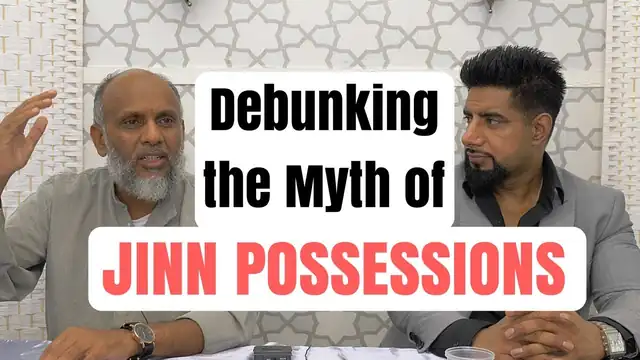 Play from 53:21
The video loads from YouTube only when you press play. Click a time in the transcript to seek.
Watch this part
Open on YouTube at 53:21The player starts at 53:21, the beginning of this part.
This segment53:21 to 58:35 · 5 min 14 sGeneral teaching
What this part covers
machinesummary, machine-writtenScholars of the past were the only learned people and were asked to explain everything, from the divisibility of atoms to where the intellect sits, so they explained strange behaviour with the best knowledge they had. That is the backdrop to the confusion over possession, not a proof of it.
In more detail
Mufti Abu Layth says that possession as people picture it does not exist, and announces that he will show where the confusion comes from in the Quran and Sunnah and then look at psychological perspectives, agreeing with the guest's point that not knowing the cause of a condition does not make it the jinn. The backdrop, he says, is human beings trying to explain their world: historically the most learned people in any society were its religious scholars, monks, Brahmins or ulama, while most people were farmers, and the ulama alone studied mathematics, philosophy, history, poetry and other religions. So the ulama were asked every question, religious or worldly: al-Baqillani [?] debated with Ash'ari and other theologians whether the atom is further divisible, and scholars argued where the aql resides, many saying the heart, citing the Quran's language of hearts that understand, while Abu Hanifa said the brain, against those who followed Greek ideas of humours governing temperament. People brought their problems to these scholars, who did their best to answer with the resources they had, and this, he says, must be kept in mind when asking why the ulama came to accept possession.
- Some terms in this segment are uncertain
Position stated
Mufti Abu Layth says the belief in possession took root because the ulama, as the most learned people in pre-modern societies, were asked to explain every worldly phenomenon and answered as best they could with the knowledge of their time.
“people were coming with normal whatever problems asking these people to explain them and they had took they were trying to come up with some answer to help these people”
Category: historical claim
Kind: general teachingTranscript
machine53:21 to 58:35 · click a time to seek · dotted terms open the glossary
that picture let's go back to the true sources the Quran the Sunnah the authentic Sunnah and and and out the sound voice of reason and let's take a look at this right gene possession demonic possessions the way people pictured this understanding that we've defined does not actually exist but I want to go into why do people where is this confusion stemming from within the Quran and Sunnah where is this coming from and then I want to take a look at
psychological kind of perspectives and also highlight some chakra had highlighted earlier on about sometimes there are medical issues which we don't know like sometimes there's a problem we don't know why that is and but just by not knowing does it mean it's the jinn this will and that's a hundred percent valid point and I will highlight as well some psychological cases that I want to share with you guys but that will be my in my second part I want to take a look at that to just show the complexity of some cases and if you go back a few decades how that could be so easily
inexplicable and you have to remember that the backdrop to all of this is coming from a single point and that is human beings trying to explain what's going on around them you see we have to remember that historically the most learned people in any society were the scholars were the religious scholars of any religion so in Christianity the monks were the people who could read and write in Hinduism the Brahmins in Islam the ulama
but in Islam there is this thing that all Muslims should read the Quran so there was literacy to that level but the most people if you think about it historically were just farmers most of society was always just farmers this worked lived on a farm their entire life then you had city small versions of cities not like today's and and people generally speaking you know they had trade and they did their things but lives were relatively simple people who learnt stuff who studied mathematics who studied trigonometry who studied philosophy history of the world poetry who studied belief who studied
other religions who study this was just the Olimar who dedicated a huge portion of their lives to learning and then usually went on to teach or become judges and things like this your normal you know in the past you wouldn't go to buy something from a shop and the guy happens to be you know for hobby he happens to be a researcher on mathematics so he happens to be somebody who's deeply read on history you this doesn't didn't happen ever it was not like I mean I don't mean as a totally somebody who was an expert and then did a job like but this was not the norm at all so let's say you had a llama
in the past speaking about atoms can an atom an atom actually linguistically means something that can't be divided any further so you had people like avocado broccolini or debating with other allama of the Asha era and other motor kala mean can and can they be a juice or ladle a the dessert can they be an atom oh is that further reducible think about it why whoa and they arguing this they're going on time after time after time you think today Olimar wouldn't do that but why would it you have detailed discussions on where
is the akhul where is the artal in the past many ala ma what is it in the demo in the brain many ala ma said no naka lain in the de ma why why are they bringing these questions to the all about who else should they take two people say you know you have a girl you have cognition we're is it people said well hmm so the ulema are using the resources to come up with answers these are not necessarily religious questions these are just worldly human questions but they so the olam are saying oh but Allah
says you know I love earth either you know we gave you heart after latter afternoon don't you think hmm the flood the heart is where Akalis in mama behind it so you get quotes from many of the self saying the heart is with uh Calise imam abu hanifa actually said the de mal is with alkyl was but many people disagreed with him back then they believed that the mark like greek philosophy just had these humans in it these kind of fluids and gases which kind of just influence your temperament why is this important to understand that
people were coming with normal whatever problems asking these people to explain them and they had took they were trying to come up with some answer to help these people right so that is because we need to keep that in mind when we're dealing with this so why are the ulama where's this confusion coming from within islam certain verses had historically been debated verses in the quran allah speaks about a very popular verse that when allah speaks about those
Paragraphs overlapping 53:21 to 58:35. Full text on the recording page.
Cite this segment
Stable id, transcript version and tier are part of the citation. Every change to a transcript is logged.Mufti Abu Layth Archive, segment 2017-09-20-S11, auto-transcribed, may contain errors. https://muftiabulayth.org/r/7z8yu8kr83y/s/11/ (accessed 1 November 2026)
- APA 7
Mufti Abu Layth. (2017, September 20). Why did Muslim scholars of the past accept the idea of jinn possession? [Video, segment 2017-09-20-S11, auto-transcribed, may contain errors]. Mufti Abu Layth Archive. Retrieved November 1, 2026, from https://muftiabulayth.org/r/7z8yu8kr83y/s/11/
- Chicago author-date
Mufti Abu Layth. 2017. "Why did Muslim scholars of the past accept the idea of jinn possession?" Video, segment 2017-09-20-S11, auto-transcribed, may contain errors. Mufti Abu Layth Archive. Recorded September 20, 2017. Accessed November 1, 2026. https://muftiabulayth.org/r/7z8yu8kr83y/s/11/
- BibTeX
@misc{abulayth-2017-09-20-S11,
  author = {Mufti Abu Layth},
  title = {{Why did Muslim scholars of the past accept the idea of jinn possession?}},
  year = {2017},
  month = {9},
  date = {2017-09-20},
  howpublished = {\url{https://muftiabulayth.org/r/7z8yu8kr83y/s/11/}},
  url = {https://muftiabulayth.org/r/7z8yu8kr83y/s/11/},
  organization = {Mufti Abu Layth Archive},
  urldate = {2026-11-01},
  note = {Segment 2017-09-20-S11, auto-transcribed, may contain errors}
}
Something wrong here?
Tell us what is wrong and it will be checked against the recording. Nothing changes until a person has reviewed it.
Sending a note needs JavaScript, which is off or unavailable in this browser. Nothing has been sent.
No name, email address or account is asked for or stored, and the inbox does not store your IP address. For rate limiting it keeps an unreadable fingerprint of your connection for 48 hours, and our database provider's own logs record connections as every website's do. Only your note, its kind, the page and the moment in the recording are kept, for review.