
Recordings › Monday Nights with Mufti #197 | Q&A Unscripted & Unrestricted! 😉 | Mufti Abu Layth · 12 Jan 2021 › Segment 28 of 43
If you deny the evil eye, why do you cite scholars who believed in it?
malik ibn anas malik bin anas imam maalik imam malik ibn anas sahih al-bukhari sahih bukhari saheeh al-bukhari saheeh bukhari imaam imams prayer leader maaliki malikite malikiyyah maliki school muftis 'ayn al-ayn nazar koran quraan al-quran ulama ulema ulamaa deen al-din ad-deen ad-dinDenying the evil eye while citing scholars who believed in it
Most recent answer on Magic, the evil eye and superstition35 earlier answers on this topic, oldest 2017 ↓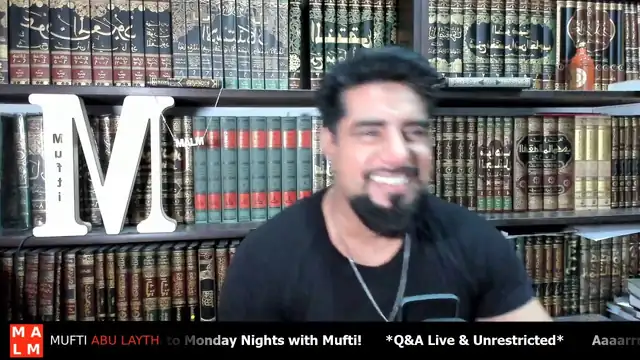 Play from 1:47:10
The video loads from YouTube only when you press play. Click a time in the transcript to seek.
Watch the answer
Open on YouTube at 1:47:10The player starts at 1:47:10, where the answer begins.
This segment1:46:32 to 1:50:22 · 3 min 50 sGeneral teaching
The answer in brief
machinesummary, machine-writtenMufti Abu Layth says scholars who believed in the evil eye were following the science of their day, and one does not take science from them.
In more detail
Mufti Abu Layth describes a message, partly polite and partly challenging, asking why he denies the evil eye yet still cites scholars such as Ibn Ashur or Imam Malik who may have accepted it. He says the evil eye was the science of the day: people believed in extramission, that the eye shoots out rays, so for them it was a matter of how biology works, not religion, and the evil eye is not mentioned anywhere in the Quran. He compares it to the common belief that the heart was the seat of thinking, saying that a quote from Imam Malik to that effect would not make it an Islamic viewpoint. He concludes that one does not take one's science from Imam al-Bukhari or Imam Malik.
Question as read aloud · questioner not identifiedWhy is it, if you deny the evil eye, that you still associate with and allude to scholars like Ibn Ashur or Imam Malik who may have accepted the evil eye?
- The question was reconstructed from Mufti Abu Layth's restatement; the questioner's own words are not in the recording
Position stated
Mufti Abu Layth says the evil eye was the science of the day, based on the belief that the eye shoots out rays, rather than a matter of religion for them.
“the evil eye was something that was the science of the day and age”
Category: teaching
Kind: general teachingTranscript
machine1:46:32 to 1:50:22 · click a time to seek · dotted terms open the glossary
not like these other people whether it's going back to kufa or going back to a different city or like some going back to [Laughter] the worst of places just a barren desert right so it's not going back this going back to the city of the prophet so that's why i'm a maliki you know i had um um i mean i i feel this is is fine to say um it's it's not in any negative light but i had um
send me a message in which was um parts of it were reasonably polite and parts of it were quite challenging in saying look you know you uh um he was saying that look on certain things i could make sense like let's say but why is it i deny the evil eye and then if that's the case and i think this is an interesting question because many people may ask this why is it if i deny the evil eye then i still associate and allude to scholars like ibn ashur or imam malik
in the past who may have accepted the evil eye so and i answered him by saying look first of all i answer this in my video but fair enough if you still you know if it didn't make sense to you there you see the evil eye was something that was the science of the day and age and you can watch my video i explain how people thought the i worked they they believed in extra mission so to them this was how biology works this was how the eye works they thought the eye shoots out rays
now actually it's only very recently we've discovered that actually the eye works through intermission or and and hence his story lie because the biology and science if we want to call it science science simply means the way the understanding of how the world works and how biology works they believed that was how eyes work so it wasn't about religion to them because the evil eye is not mentioned anywhere in the quran it was that this is how biology works this is how the eye works so now you know that's not the case so
for example many people in the past thought that you know if you went a thousand years ago or you know and even pre-islam and into early islam i'm not speaking about the prophet but scholars and just medical doctors of that day and age or philosophers believe that the heart was what you thought with that the thinking didn't happen up there it happened in the heart now that's you know that was how they thought the biology of the day and age worked some scholars back then didn't believe in that they believed that the brain was the seat of cognition but
a common perception biological perception was that the heart was the seat of of cognition so it's not about you know like one could say like if you found let's say a quote from imam malik thinking that the heart was the seat of cognition that that's where thinking took place that doesn't mean oh my god you know this is now an islamic viewpoint it's just how their understanding of biology was in that day and age this was a common understanding in the world where even if you're a non-muslim many you know you would have believed things like that so you don't take your science
from them how does the i work is extra mission information you don't need to take that from imam bukhari or imam malik or something so yeah i hope that's a you know that answers that question for many people cool let's go on aura um multiple eighth your views on influential people in history that could be prophets uh eg socrates plato buddha yeah i believe these people could have been prophets i mean not all of them but i believe like the buddha
could have been a prophet i believe socrates could have been a prophet in fact his whole thing is quite prophetic uh confucius could have been um i don't what i'm saying is that we just don't know zarathustra could have been a prophet um yeah we just don't know many hindu um you know figures could have they could have been prophets i mean we just obviously islam just doesn't mention
Paragraphs overlapping 1:46:32 to 1:50:22. Full text on the recording page.
Cite this segment
Stable id, transcript version and tier are part of the citation. Every change to a transcript is logged.Mufti Abu Layth Archive, segment 2021-01-12-S28, auto-transcribed, may contain errors. https://muftiabulayth.org/r/1zghntbmpis/s/28/ (accessed 1 November 2026)
- APA 7
Mufti Abu Layth. (2021, January 12). If you deny the evil eye, why do you cite scholars who believed in it? [Video, segment 2021-01-12-S28, auto-transcribed, may contain errors]. Mufti Abu Layth Archive. Retrieved November 1, 2026, from https://muftiabulayth.org/r/1zghntbmpis/s/28/
- Chicago author-date
Mufti Abu Layth. 2021. "If you deny the evil eye, why do you cite scholars who believed in it?" Video, segment 2021-01-12-S28, auto-transcribed, may contain errors. Mufti Abu Layth Archive. Recorded January 12, 2021. Accessed November 1, 2026. https://muftiabulayth.org/r/1zghntbmpis/s/28/
- BibTeX
@misc{abulayth-2021-01-12-S28,
  author = {Mufti Abu Layth},
  title = {{If you deny the evil eye, why do you cite scholars who believed in it?}},
  year = {2021},
  month = {1},
  date = {2021-01-12},
  howpublished = {\url{https://muftiabulayth.org/r/1zghntbmpis/s/28/}},
  url = {https://muftiabulayth.org/r/1zghntbmpis/s/28/},
  organization = {Mufti Abu Layth Archive},
  urldate = {2026-11-01},
  note = {Segment 2021-01-12-S28, auto-transcribed, may contain errors}
}
Something wrong here?
Tell us what is wrong and it will be checked against the recording. Nothing changes until a person has reviewed it.
Sending a note needs JavaScript, which is off or unavailable in this browser. Nothing has been sent.
No name, email address or account is asked for or stored, and the inbox does not store your IP address. For rate limiting it keeps an unreadable fingerprint of your connection for 48 hours, and our database provider's own logs record connections as every website's do. Only your note, its kind, the page and the moment in the recording are kept, for review.