
Recordings › Giving rulings based on minority opinions- Shaykh Akram Nadwi & Mufti Abu Layth · 6 Sep 2017 › Segment 2 of 3
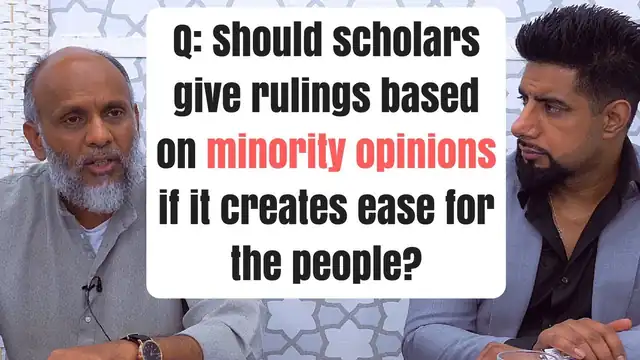
Is it wrong to choose the easier opinion in Islam?
hadeeth ahadith ahaadeeth hadis hadees ahaadith saheeh sahih hadith saheeh hadith sound hadith authentic jam jam' jam' al-salah jam bayn al-salatayn jam' al-salatayn imam bukhari saheeh al-bukhari saheeh bukhari imam al-bukhari imaam imams prayer leader faqih faqeeh jurist shafi shafei shafiite shafi'i school ijtihaad ijtehad independent reasoning muftis sunna sunnat sunan prophetic practice akhira aakhirah akhirat afterlife koran quraan al-quran sahabah sahaba sahabiyyah sahabiyat sheikh shaikh sheik shuyukh shaykhs talaq talaaq triple talaq talak deen al-din ad-deen ad-din ajr sawab thawab thawaab sawaabMufti Abu Layth: ease is the nature of Islam
 Play from 5:27
The video loads from YouTube only when you press play. Click a time in the transcript to seek.
Watch this part
Open on YouTube at 5:27The player starts at 5:27, the beginning of this part.
This segment5:27 to 8:07 · 2 min 40 sGeneral teaching
What this part covers
machinesummary, machine-writtenMufti Abu Layth says choosing what is easier is the nature of Islam, citing hadith that the Prophet always chose the easier of two options. Islam came to connect people with God, not to make secondary details the main issue.
In more detail
Mufti Abu Layth says that a person, especially a student of Islam, ought to follow the opinion they believe correct, citing Ibn al-Qayyim's I'lam al-Muwaqqi'in, and that choosing what is of ease is, in his understanding, the nature of Islam. Mufti cites a hadith in the Musnad of Ahmad that the best of your religion is the easiest of it, and a report in Sahih al-Bukhari that the Prophet was never given a choice between two things except that he chose the easier. Mufti says Islam must be relevant to people in every age and came so that people could connect with God, not over details such as combining prayers or how far a woman may travel, which are secondary but have become the key issue today. Mufti cites the companion's words that God sent them to take people from worshipping creation to worshipping the Creator and from the narrowness of this world to the vastness of the hereafter, stressing that this vastness is meant in this world, before the guest Shaykh Akram Nadwi takes up examples.
- Guest speech overlaps this segment
Position stated
Waiting for the speaker checkA guest speaks in this segment and the captions do not say who said what. The view found here is held back until the speaker-separated transcript confirms the words are his, or the channel verifies it. The transcript and recording are published in full.
Kind: general teaching Speakers: host and guest; guest speech is labelled and excluded from positionsTranscript
machine5:27 to 8:07 · click a time to seek · dotted terms open the glossary
A guest speaks in this segment. Guest speech is labelled and is excluded from the positions layer.
There is no harm in that. The people don't necessarily need to follow someone if they really can do Ijtihad properly and it can help the Believers then there is no harm in that. And we have got examples for that from the Qur'an and Sunnah. If they are right, they get double reward and if they are wrong, they still get reward. [Mufti Abu Layth] On this topic of following...
choosing an opinion and understanding that you feel is correct, I think you ought to go with. Especially if you're somebody who studies Islam, then that is what you ought to go with. Ibn Qayyim Jawziyyah has a whole section in his i`lam Muqi`in speaking about what you believe to be correct, you ought to go with but here the discussion being that choosing something that is of ease, my understanding is that is the nature of Islam.
In the Musnad of Ahmad, there is a Hadith that the Prophet said {Arabic} 3x "That the best of your Din is that which is most easiest" And in Sahih Bukhari, there is a Hadith that the Prophet was never given a choice {Arabic} that he was never given a choice between two things except he chose that of most ease.
So, this, today, Islam as in all times, ought to be relevant to people. Islam should be relevant. The main reason why Islam came was not about whether you combined prayers at this time or a woman could travel 48 miles. This is not why Islam came. Islam came so people/creation could connect with Allah. That's the reason Islam came.
And these things are all secondary, tertiary and today they've unfortunately become the key thing. And I think it's interesting, that Hadith of {Arabic} "that the Lord has sent us" the Sahabi said "to take the creation out of worshiping the creation to worshiping the Creator" but note how he ends it {Arabic} "and from the the kind of claustrophobic nature of this Dunya to the vastness of the Akhirah IN THIS WORLD" because there's no point in saying "Taking you out of this world so you're dead and in the Akhirah" because that would be meaningless.
Why would, if he said "To take you out of this world and send you to the Akhirah" that would be useless. Nobody wants that "I don't believe in your religion, so you just want to kill me?" He (the Sahabi) said "To take you from the closeness of this world, the closed nature of it, to the vastness of the vastness of the Akhirah in this world" This is the understanding that the Din is vast and full of ease. Okay. [Shaykh Akram] I'll give you examples of how the early Fuqaha' used to go for the minor opinions.
Because people think it is something new. It is not new. A few examples I'll give very clearly. Somebody said to his wife in the time of Imam Shafi`i (ra). He said to his wife "If you are not more beautiful than the moon, then you are divorced" The person (husband) went to all the jurists. Everybody said "She's divorced because how can she be more beautiful than the moon? She's divorced" He came to Imam Shafi`i and he said "No, she's not divorced because the Qu'ran says {Arabic} Human being is the best structure, much better than the Moon and the Sun. She's not divorce." He accepted the opinion of Imam Shafi`i though all the jurists said "She was divorced".
Paragraphs overlapping 5:27 to 8:07. Full text on the recording page.
Cite this segment
Stable id, transcript version and tier are part of the citation. Every change to a transcript is logged.Mufti Abu Layth Archive, segment 2017-09-06-S02, auto-transcribed, may contain errors. https://muftiabulayth.org/r/zoo6w9bfn7i/s/2/ (accessed 1 November 2026)
- APA 7
Mufti Abu Layth. (2017, September 6). Is it wrong to choose the easier opinion in Islam? [Video, segment 2017-09-06-S02, auto-transcribed, may contain errors]. Mufti Abu Layth Archive. Retrieved November 1, 2026, from https://muftiabulayth.org/r/zoo6w9bfn7i/s/2/
- Chicago author-date
Mufti Abu Layth. 2017. "Is it wrong to choose the easier opinion in Islam?" Video, segment 2017-09-06-S02, auto-transcribed, may contain errors. Mufti Abu Layth Archive. Recorded September 6, 2017. Accessed November 1, 2026. https://muftiabulayth.org/r/zoo6w9bfn7i/s/2/
- BibTeX
@misc{abulayth-2017-09-06-S02,
  author = {Mufti Abu Layth},
  title = {{Is it wrong to choose the easier opinion in Islam?}},
  year = {2017},
  month = {9},
  date = {2017-09-06},
  howpublished = {\url{https://muftiabulayth.org/r/zoo6w9bfn7i/s/2/}},
  url = {https://muftiabulayth.org/r/zoo6w9bfn7i/s/2/},
  organization = {Mufti Abu Layth Archive},
  urldate = {2026-11-01},
  note = {Segment 2017-09-06-S02, auto-transcribed, may contain errors}
}
Something wrong here?
Tell us what is wrong and it will be checked against the recording. Nothing changes until a person has reviewed it.
Sending a note needs JavaScript, which is off or unavailable in this browser. Nothing has been sent.
No name, email address or account is asked for or stored, and the inbox does not store your IP address. For rate limiting it keeps an unreadable fingerprint of your connection for 48 hours, and our database provider's own logs record connections as every website's do. Only your note, its kind, the page and the moment in the recording are kept, for review.