
Recordings › Giving rulings based on minority opinions- Shaykh Akram Nadwi & Mufti Abu Layth · 6 Sep 2017 › Segment 3 of 3
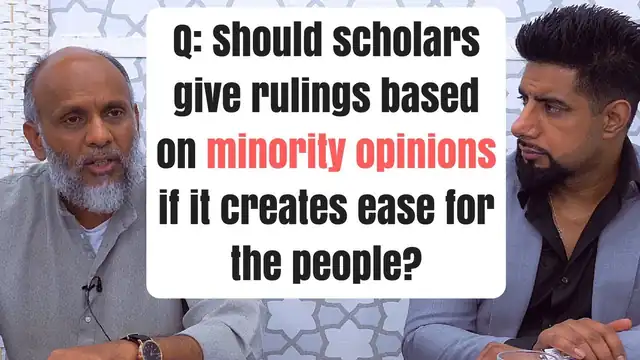
Is choosing the easier scholarly opinion just following my desires?
sawm roza siyam rozah saum malik ibn anas malik bin anas imam maalik imam malik ibn anas imaam imams prayer leader tawaaf circumambulation faqih faqeeh shafi shafei shafiite shafi'i school fatwah fatawa fatwaa fataawa legal opinion muftis koran quraan al-quran ayah aya ayat ayaat aayah aayat mecca makka mekka sheikh shaikh sheik shuyukh shaykhs talaq talaaq triple talaq talak sabr sabar ibada ibaadah ibadatShaykh Akram Nadwi: early jurists who gave the easier minority opinion
 Play from 8:07
The video loads from YouTube only when you press play. Click a time in the transcript to seek.
Watch this part
Open on YouTube at 8:07The player starts at 8:07, the beginning of this part.
This segment8:07 to 12:28 · 4 min 21 sA view quoted in order to be discussed, not a position held
What this part covers
machinesummary, machine-writtenIn this clip Shaykh Akram Nadwi gives examples of al-Shafi'i, Abu Hanifa and al-Tabari giving easier minority rulings, and says choosing among the jurists' opinions is not following one's nafs. Mufti Abu Layth only asks the question.
In more detail
The guest Shaykh Akram Nadwi gives examples to show that following easier minority opinions is not new. In his account al-Shafi'i ruled that a man who told his wife she was divorced if she was not more beautiful than the moon had not divorced her, citing the verse that the human being is created in the best stature, and Abu Hanifa freed a man from an oath to perform an act of worship alone by telling him to do tawaf alone in an emptied mataf. The guest tells of a slave in the Abbasid period trapped by his wife's clever reply to his conditional triple divorce, whom Ibn Jarir al-Tabari freed by having him repeat her words with the condition 'if I divorce you'. The guest says Abu Hanifa, al-Shafi'i and Imam Malik all gave opinions differing from the majority and that people have always taken the more convenient opinion. Mufti Abu Layth asks whether this is following one's nafs, and the guest answers that it is not, so long as one is choosing among the jurists' opinions in order to follow Islam rather than doing whatever one likes.
Position stated
This segment presents a view in order to discuss or respond to it. It is recorded as quoted, never as held, and no position is attributed from it.
Kind: a view quoted in order to be discussed, not a position held Speakers: host and guest; guest speech is labelled and excluded from positionsTranscript
machine8:07 to 12:28 · click a time to seek · dotted terms open the glossary
A guest speaks in this segment. Guest speech is labelled and is excluded from the positions layer.
This segment states a view in order to discuss it. It is recorded as a quoted view, not as a position held.
Because people think it is something new. It is not new. A few examples I'll give very clearly. Somebody said to his wife in the time of Imam Shafi`i (ra). He said to his wife "If you are not more beautiful than the moon, then you are divorced" The person (husband) went to all the jurists. Everybody said "She's divorced because how can she be more beautiful than the moon? She's divorced" He came to Imam Shafi`i and he said "No, she's not divorced because the Qu'ran says {Arabic} Human being is the best structure, much better than the Moon and the Sun. She's not divorce." He accepted the opinion of Imam Shafi`i though all the jurists said "She was divorced".
But he accepted the minor opinion because that was easy for him. That was the solution to his problem. Similarly somebody came to Imam Abu Hanifah (ra) and said "I made an oath that if I don't do an act of `Ibadah where I'm alone, then my wife is divorced. I went to all the jurists and they said "She's divorced" because whatever you do: if you fast, somebody must be fasting. If you pray, somebody must be praying.
If you read the Qur'an, somebody must be reading the Qur'an. So she is divorced. There is no solution." Imam Abu Hanifah said "No she's not divorced you go to Makkah and ask people to empty Mataf (area of Tawaf) and then you do Tawaf alone So you'd be doing something alone. Nobody shares with you. So she's not divorced." Similarly I'll give another example which shows how amazingly people can think. One person during the Abbasid period was a slave and his master was a nobleman.
And the master loved the slave very much so he brought a slave girl and married his slave with the slave girl The slave girl was very attracted and beautiful, but the slave (male) was not so handsome. So he loved her and she hated him. They both lived together. What she did was she would always annoy him so he could divorce her. All the time she'd do something so he could divorce her. But he would maintain patience because he loved her so much One day she annoyed him so much, he became angry, and he said to her
"If you say anything after this and I don't repeat the same thing, then you are divorced three times. If you say anything and I don't say the same thing to you, then you are divorced three times." She said "Anta taliqun thalathah - You're divorced three times". Now if he says this sentence, she'll be divorced. If he doesn't say it, she'll be divorced. She's so clever. She said "Anta taliqun thalathah". Now if he says it, she'll be divorced. If he doesn't say it, she'll be divorced.
And now, he went everywhere and all the jurists said "She's divorced whether you say it or don't say it". His master said to him (his slave) "Don't worry..." "...if the Fuqaha don't solve your problem, then I'll just find you another wife". He (the slave) said "No if I don't get her, I will die. I love her so much..." "...The solution is only her. Nothing else. I don't want anybody else" Then he (the master) said "Then go find a jurist (who will find you a solution). So somehow he (the slave) happened to find Ibn Jarir Tabari.
Ibn Jarir Tabari said "I can solve your problem, but don't do it again" So what Ibn Jarir Tabari said "Go and say to your wife... {Arabic} "...You are divorced three times IF I divorce you" So once you hang it, it's not a divorce. So he (the slave) said the same words and didn't divorce her. Because the condition was IF He did not accept the majority opinion. He accepted this (minority) opinion because it helped him.
So this always happened in Islam. Any opinion that helps people more conveniently, they go for it. They don't have to go for the majority opinion Everybody used to go for the more convenient opinion. That actually is Islam. Abu Hanifah didn't mind that. Imam Shafi`i didn't mind. Nobody minded. Imam Malik used to give Fatwa and opinion which sometimes differed from the people (majority). Everybody did this. In our time, I don't understand why people think it's a big thing. In Islam, it always happened like this. [Mufti Abu Layth] Is that seen as following Nafs?
[Shaykh Akram] No, its not Nafs because it's `Ibadah. You still want to follow Islam. You don't say "I don't follow your opinion. You say "I want to follow the Fuqaha' and their opinion" You don't say "I do whatever like" If you say it like that, then it is not right. But if you say "Among all of the opinions, whichever is more convenient for me, I follow that" Then there is no harm in that. Everybody should use it like that.
Paragraphs overlapping 8:07 to 12:28. Full text on the recording page.
Cite this segment
Stable id, transcript version and tier are part of the citation. Every change to a transcript is logged.Mufti Abu Layth Archive, segment 2017-09-06-S03, auto-transcribed, may contain errors. https://muftiabulayth.org/r/zoo6w9bfn7i/s/3/ (accessed 1 November 2026)
- APA 7
Mufti Abu Layth. (2017, September 6). Is choosing the easier scholarly opinion just following my desires? [Video, segment 2017-09-06-S03, auto-transcribed, may contain errors]. Mufti Abu Layth Archive. Retrieved November 1, 2026, from https://muftiabulayth.org/r/zoo6w9bfn7i/s/3/
- Chicago author-date
Mufti Abu Layth. 2017. "Is choosing the easier scholarly opinion just following my desires?" Video, segment 2017-09-06-S03, auto-transcribed, may contain errors. Mufti Abu Layth Archive. Recorded September 6, 2017. Accessed November 1, 2026. https://muftiabulayth.org/r/zoo6w9bfn7i/s/3/
- BibTeX
@misc{abulayth-2017-09-06-S03,
  author = {Mufti Abu Layth},
  title = {{Is choosing the easier scholarly opinion just following my desires?}},
  year = {2017},
  month = {9},
  date = {2017-09-06},
  howpublished = {\url{https://muftiabulayth.org/r/zoo6w9bfn7i/s/3/}},
  url = {https://muftiabulayth.org/r/zoo6w9bfn7i/s/3/},
  organization = {Mufti Abu Layth Archive},
  urldate = {2026-11-01},
  note = {Segment 2017-09-06-S03, auto-transcribed, may contain errors}
}
Something wrong here?
Tell us what is wrong and it will be checked against the recording. Nothing changes until a person has reviewed it.
Sending a note needs JavaScript, which is off or unavailable in this browser. Nothing has been sent.
No name, email address or account is asked for or stored, and the inbox does not store your IP address. For rate limiting it keeps an unreadable fingerprint of your connection for 48 hours, and our database provider's own logs record connections as every website's do. Only your note, its kind, the page and the moment in the recording are kept, for review.