
Recordings › From the Mind of a Mufti
Giving rulings based on minority opinions- Shaykh Akram Nadwi & Mufti Abu Layth
wudhu wudoo wuzu ablution al-wudu wudhoo salah salat salaah namaz salaat namaaz as-salah al-salah salawat sawm roza siyam rozah saum zakah zakaat zakah al-mal zakat al-mal obligatory charity haj pilgrimage hadj fiqah jurisprudence fikh hadeeth ahadith ahaadeeth hadis hadees ahaadith saheeh sahih hadith saheeh hadith sound hadith authentic madhab mazhab school of law madhahib mazahib madhaahib malik ibn anas malik bin anas imam maalik imam malik ibn anas al-bukhari imam bukhari sahih al-bukhari saheeh al-bukhari saheeh bukhari imam al-bukhari imaam prayer leader tawaaf circumambulation faqeeh usul al-fiqh usool usool al-fiqh usul ul-fiqh usool ul-fiqh legal theory maaliki malikite malikiyyah maliki school hanafite hanafiyyah hanafi school shafi shafei shafiite shafi'i school ijtihaad ijtehad independent reasoning mujtahideen mujtahidun mujtahidin qiyaas ijmaa fatwah fatawa fatwaa fataawa legal opinion muftis hukm ahkam hukum hukam ahkaam haraam forbidden sunna sunnat sunan prophetic practice shirq mushrik mushrikin polytheism kuffar kafir kaafir kufar kaafirun disbelief imaan eemaan eeman faith akhira aakhirah akhirat hereafter afterlife jahannam jahanam jahannum koran quraan al-quran sahabah sahaba sahabiyyah sahabiyat companions mecca makka mekka ulama ulema ulamaa sheikh shaikh sheik shuyukh shaykhs umma ummat community talaq talaaq triple talaq talak taqwaa muttaqi god-consciousness sabar deen al-din ad-deen ad-din ibada ibaadah ibadat worship ajr sawab thawab thawaab sawaabvideo · 12:29 · 15,000 views · 6 Sep 2017 · 3 segments · Open on YouTube
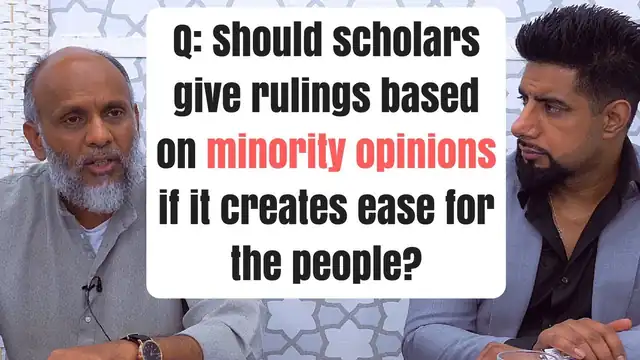 Press play to load from YouTube. Nothing loads until you do.
3 segments
machine3Each block is a segment in time order. Click to open it.All segments · in time order
Transcript
machineauto-transcribed, may contain errors · source: youtube manual · click a time to seek · dotted terms open the glossary[Shaykh Akram] You know the first thing we have to understand is how this religion is. This religion basically is Usul. Usul means fundamentals. Iman, Taqwa, piety, fear of Allah The prayer is Khushu`. {Arabic} Fear of Allah means turning to Him. These are actually the Usul of the Religion. When you pray, what actually matters is Usul and Qunut. {Arabic} He (Allah) does not say whether you should pray Hanafi Madhhab, Maliki Madhhab or Shafi`i Madhhab The Usul are the main things. All the Prophets and Messengers have been teaching the Usul.
To attend to those Usul, you need some practices that we call Furu` Kubra - major branches like the prayer, fasting, Zakat and Hajj. They are means to attain those Usul. How you get Taqwa and Sabr? By these things. Sabr & Taqwa are Usul, but fasting is from Furu` Kubra. All of these (major branches) are from Quran. Then you have minor branches.
Minor branches are like Wudu' and things similar like that. They are minor branches. Usul and major Furu` are in the Quran. For minor branches, some of them are in the Quran, some of them are in the Sunnah and some of them are known by Ijma` (by consensus). Some of them are known by Qiyas (analogy) of the Fuqaha'. This one is really very minor. It is so minor that the Prophet (saw) has said that when a Hakim (judge) or a Mujtahid makes an effort to find a ruling, if he's right, he gets double reward. If he's wrong, he still gets one reward. This is so insignificant that even if you're wrong you get reward. Same for those who follow them, if they're right,
they get double reward. If they're not right, they still get one reward. But for the major branches, for Usul, if you do mistake it can be Shirk or Kufr. It is harmful. But for minor branches they are so insignificant, if you're right, you get double reward. If you're wrong, you still get reward. There is no significance. This is where the Fuqaha' differ. When the Fuqaha' make rulings about these matters, their rulings are different types. Some rulings are right because of their understanding of the Quran & Sunnah.
Some rulings will just be temporary solutions to problems of that time. If the time changes, if the context, changes then they themselves will change. Sometimes Abu Hanifah changes his opinion because of time. Sometimes Imam Shafi`i changes his opinion because of space. When he moves from Baghdad to Egypt, he changes himself. These things keep changing. So similarly, in our time, it could be possible that people have a problem and generally the Fuqaha's opinion of their own time, it does not help people so much. But we find that a Fatwa from somebody who's opinion is more helpful for the people/society. So there is no harm in that Imam Sufayan Thawri used to say "Fiqh is not to say "It is Haram". Fiqh is to find solutions for the Believers"
So any opinion which can make something easier, that actually is one of the valid things in Islam. When people give Fatwa, there are two ways to look at an issue. One is from the argument. If something has a stronger argument, you go for that. But the other way for the Fuqaha' has been what is more easier for the people. Easy thing in the Furud is very important. And the Prophet himself has encouraged and the Fuqaha' call it Umum Balwah and things like that to make it easier. In our time, I'll give an example Like in Hanafi Madhhab it is generally understood that you do not wipe over cotton socks.
But there are Fuqaha, who have allowed wiping over cotton socks. Actually from Abu Hanifah, there is a narration from him and some other people have been doing it too. Now I see in Oxford, I've been seeing really that the places (restrooms) are not meant for washing your feet. If you give fatwa for the people that they can wipe over the socks, so that they put on the socks in the morning, after bath or after Wudu` and then they come to the office or the class room and when they need to do Wudu`, they wash everything and for the feet they just wipe. It makes life so easy for them.
So even if this opinion has been a minor opinion but it is so helpful now that you give a Fatwa for that. Like combining between two prayers for traveling, it makes life so easy for many people. So you give Fatwa. So in these minor issues, there is no harm in finding an opinion Which can be easier, which can help the Believers make their life easier Actually if they're not even minor opinions, somebody does his Ijtihad and differs from the rest of the Ummah.
It is still fine. He did make an effort. If he is right, he'll get double reward and if he's wrong, he still gets a reward. He doesn't necessarily need to follow one of the previous Imams. Like Imam Abu Hanifah and Imam Malik, sometimes they have opinion that would differ from everybody because their opinion was a better solution. In our time, it still can be the same for some issues where a Faqih can think that "No, in this matter, the opinion that was held in the past is not helpful so I can find another opinion which will be more helpful for the Believers and I have a better argument for that.
There is no harm in that. The people don't necessarily need to follow someone if they really can do Ijtihad properly and it can help the Believers then there is no harm in that. And we have got examples for that from the Qur'an and Sunnah. If they are right, they get double reward and if they are wrong, they still get reward. [Mufti Abu Layth] On this topic of following...
choosing an opinion and understanding that you feel is correct, I think you ought to go with. Especially if you're somebody who studies Islam, then that is what you ought to go with. Ibn Qayyim Jawziyyah has a whole section in his i`lam Muqi`in speaking about what you believe to be correct, you ought to go with but here the discussion being that choosing something that is of ease, my understanding is that is the nature of Islam.
In the Musnad of Ahmad, there is a Hadith that the Prophet said {Arabic} 3x "That the best of your Din is that which is most easiest" And in Sahih Bukhari, there is a Hadith that the Prophet was never given a choice {Arabic} that he was never given a choice between two things except he chose that of most ease.
So, this, today, Islam as in all times, ought to be relevant to people. Islam should be relevant. The main reason why Islam came was not about whether you combined prayers at this time or a woman could travel 48 miles. This is not why Islam came. Islam came so people/creation could connect with Allah. That's the reason Islam came.
And these things are all secondary, tertiary and today they've unfortunately become the key thing. And I think it's interesting, that Hadith of {Arabic} "that the Lord has sent us" the Sahabi said "to take the creation out of worshiping the creation to worshiping the Creator" but note how he ends it {Arabic} "and from the the kind of claustrophobic nature of this Dunya to the vastness of the Akhirah IN THIS WORLD" because there's no point in saying "Taking you out of this world so you're dead and in the Akhirah" because that would be meaningless.
Why would, if he said "To take you out of this world and send you to the Akhirah" that would be useless. Nobody wants that "I don't believe in your religion, so you just want to kill me?" He (the Sahabi) said "To take you from the closeness of this world, the closed nature of it, to the vastness of the vastness of the Akhirah in this world" This is the understanding that the Din is vast and full of ease. Okay. [Shaykh Akram] I'll give you examples of how the early Fuqaha' used to go for the minor opinions.
Because people think it is something new. It is not new. A few examples I'll give very clearly. Somebody said to his wife in the time of Imam Shafi`i (ra). He said to his wife "If you are not more beautiful than the moon, then you are divorced" The person (husband) went to all the jurists. Everybody said "She's divorced because how can she be more beautiful than the moon? She's divorced" He came to Imam Shafi`i and he said "No, she's not divorced because the Qu'ran says {Arabic} Human being is the best structure, much better than the Moon and the Sun. She's not divorce." He accepted the opinion of Imam Shafi`i though all the jurists said "She was divorced".
But he accepted the minor opinion because that was easy for him. That was the solution to his problem. Similarly somebody came to Imam Abu Hanifah (ra) and said "I made an oath that if I don't do an act of `Ibadah where I'm alone, then my wife is divorced. I went to all the jurists and they said "She's divorced" because whatever you do: if you fast, somebody must be fasting. If you pray, somebody must be praying.
If you read the Qur'an, somebody must be reading the Qur'an. So she is divorced. There is no solution." Imam Abu Hanifah said "No she's not divorced you go to Makkah and ask people to empty Mataf (area of Tawaf) and then you do Tawaf alone So you'd be doing something alone. Nobody shares with you. So she's not divorced." Similarly I'll give another example which shows how amazingly people can think. One person during the Abbasid period was a slave and his master was a nobleman.
And the master loved the slave very much so he brought a slave girl and married his slave with the slave girl The slave girl was very attracted and beautiful, but the slave (male) was not so handsome. So he loved her and she hated him. They both lived together. What she did was she would always annoy him so he could divorce her. All the time she'd do something so he could divorce her. But he would maintain patience because he loved her so much One day she annoyed him so much, he became angry, and he said to her
"If you say anything after this and I don't repeat the same thing, then you are divorced three times. If you say anything and I don't say the same thing to you, then you are divorced three times." She said "Anta taliqun thalathah - You're divorced three times". Now if he says this sentence, she'll be divorced. If he doesn't say it, she'll be divorced. She's so clever. She said "Anta taliqun thalathah". Now if he says it, she'll be divorced. If he doesn't say it, she'll be divorced.
And now, he went everywhere and all the jurists said "She's divorced whether you say it or don't say it". His master said to him (his slave) "Don't worry..." "...if the Fuqaha don't solve your problem, then I'll just find you another wife". He (the slave) said "No if I don't get her, I will die. I love her so much..." "...The solution is only her. Nothing else. I don't want anybody else" Then he (the master) said "Then go find a jurist (who will find you a solution). So somehow he (the slave) happened to find Ibn Jarir Tabari.
Ibn Jarir Tabari said "I can solve your problem, but don't do it again" So what Ibn Jarir Tabari said "Go and say to your wife... {Arabic} "...You are divorced three times IF I divorce you" So once you hang it, it's not a divorce. So he (the slave) said the same words and didn't divorce her. Because the condition was IF He did not accept the majority opinion. He accepted this (minority) opinion because it helped him.
So this always happened in Islam. Any opinion that helps people more conveniently, they go for it. They don't have to go for the majority opinion Everybody used to go for the more convenient opinion. That actually is Islam. Abu Hanifah didn't mind that. Imam Shafi`i didn't mind. Nobody minded. Imam Malik used to give Fatwa and opinion which sometimes differed from the people (majority). Everybody did this. In our time, I don't understand why people think it's a big thing. In Islam, it always happened like this. [Mufti Abu Layth] Is that seen as following Nafs?
[Shaykh Akram] No, its not Nafs because it's `Ibadah. You still want to follow Islam. You don't say "I don't follow your opinion. You say "I want to follow the Fuqaha' and their opinion" You don't say "I do whatever like" If you say it like that, then it is not right. But if you say "Among all of the opinions, whichever is more convenient for me, I follow that" Then there is no harm in that. Everybody should use it like that.
Something wrong here?
Tell us what is wrong and it will be checked against the recording. Nothing changes until a person has reviewed it.
Sending a note needs JavaScript, which is off or unavailable in this browser. Nothing has been sent.
No name, email address or account is asked for or stored, and the inbox does not store your IP address. For rate limiting it keeps an unreadable fingerprint of your connection for 48 hours, and our database provider's own logs record connections as every website's do. Only your note, its kind, the page and the moment in the recording are kept, for review.
Cite this recording
Stable id, transcript version and tier are part of the citation. Every change to a transcript is logged.Mufti Abu Layth Archive, auto-transcribed, may contain errors. https://muftiabulayth.org/r/zoo6w9bfn7i/ (accessed 1 November 2026)
- APA 7
Mufti Abu Layth. (2017, September 6). Giving rulings based on minority opinions- Shaykh Akram Nadwi & Mufti Abu Layth [Video, auto-transcribed, may contain errors]. Mufti Abu Layth Archive. Retrieved November 1, 2026, from https://muftiabulayth.org/r/zoo6w9bfn7i/
- Chicago author-date
Mufti Abu Layth. 2017. "Giving rulings based on minority opinions- Shaykh Akram Nadwi & Mufti Abu Layth." Video, auto-transcribed, may contain errors. Mufti Abu Layth Archive. Recorded September 6, 2017. Accessed November 1, 2026. https://muftiabulayth.org/r/zoo6w9bfn7i/
- BibTeX
@misc{abulayth-ZOo6W9bfn7I,
  author = {Mufti Abu Layth},
  title = {{Giving rulings based on minority opinions- Shaykh Akram Nadwi \& Mufti Abu Layth}},
  year = {2017},
  month = {9},
  date = {2017-09-06},
  howpublished = {\url{https://muftiabulayth.org/r/zoo6w9bfn7i/}},
  url = {https://muftiabulayth.org/r/zoo6w9bfn7i/},
  organization = {Mufti Abu Layth Archive},
  urldate = {2026-11-01},
  note = {Auto-transcribed, may contain errors}
}