
Recordings › Discussion on Miracles: A fallacy against God | Mufti Abu Layth · 13 Oct 2020 › Segment 13 of 14
If human reason is limited, why rely on it in religion?
muftis dalil daleel adillah adilla proof iman imaan eemaan eeman akhirah akhira aakhirah akhirat hereafter jahannam jahanam jahannum koran quraan al-quran deen al-din ad-deen ad-dinIntrospection, the limits of reason, and a God who calls to faith through reason
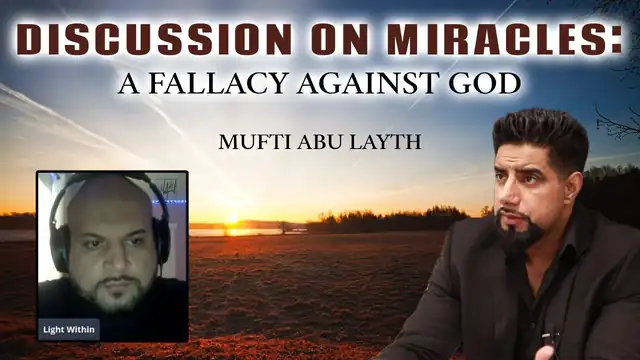 Play from 57:31
The video loads from YouTube only when you press play. Click a time in the transcript to seek.
Watch this part
Open on YouTube at 57:31The player starts at 57:31, the beginning of this part.
This segment57:31 to 1:04:33 · 7 min 02 sGeneral teaching
What this part covers
machinesummary, machine-writtenReason has limits, but it is the best tool humans have for any shared dialogue, and a God who calls people through reason would not then demand belief in the irrational.
In more detail
Mufti Abu Layth says people who critique the voice of reason should introspect on what stops them accepting it, often culture, sectarianism or inherited dogma. He says he invites people to reflect and would like them to believe what he believes, but is not instructing them, since replacing dogma with dogma would be counterproductive. Asked whether reason is limited, he says everyone recognises reason has limits but it is the best human beings have for any intersubjective dialogue, giving the example of proving that a tree or a can is not God. He says unseen matters like the afterlife are not counter to reason, only unproven, but a God who calls people to Him through reason would not then tell them to believe irrational things, likening it to a human rights group that asks new members to murder.
Position stated
Mufti Abu Layth says reason has its limitations but is the best that human beings have for any intersubjective dialogue.
“everybody with any reason recognizes that reason two has its limitations but it is the best that we as human beings have for in any uh inter-subjective dialogue”
Category: method
Kind: general teachingTranscript
machine57:31 to 1:04:33 · click a time to seek · dotted terms open the glossary
it created bridges it says you people of scripture come to a middle ground between us meaning we will give up some things like we're being accommodating you be somewhat accommodating the thing that they weren't islam didn't accommodate on was the trinity but it kind of allowed them to entertain these other beliefs it didn't have a huge issue it said you know if you want to believe in the virgin birth we're not going to the quran did not affirm it but it gave them the space to infer it because it allowed that middle ground
now this was actually what i was going to answer when we when you began by saying well why did islam not clearly criticize them but look i get the fact that you know many people will struggle with these kind of things i feel that the reason they have you know like people say to me i need to introspect and i do and i do reflect and i do think well why do i believe this i think people need to introspect as well you know people that critique these like let's say the voice of reason and they need to think well what is it that's actually stopping them from accepting reason
like what is it that's actually stopping them and often it will just be culture sectarian or dogma that has already been set out and and and the often i'm not maybe not always but often it will just be that because they were brought up in a particular way upon certain dogma they just struggled to part ways from that but i mean i i do want to put in the disclaimer again that look i'm not telling people it would be ironic of me to tell people to believe what i believe because that would be dogma but the thing is
as a as a public speaker you know we have responsibility if i wear a white coat and i tell uh no no no no let me let me correct myself let me sorry let me just add the i am of course i'm inviting them to reflect and i would like them to believe what i believe of course but i'm not instructing them so there's a difference because that would just be dogmatic it would be counterproductive for me to replace dogma with dogma i'm trying to replace it with the with the the nur of kind of enlightenment of reason but do you believe do you also do you believe that we are limited with our reasoning do you believe humans have limitations
yeah we do we do we do so is it possible that some things that logically reason reasonably doesn't make any sense but that's because of our limitations do you believe in that or yeah but it's the yeah but hopeful that everything has to make sense to you no right so the laws of this dunya so just to be clear i everybody with any reason recognizes that reason two has its limitations but it is the best that we as human beings have
for in any uh inter-subjective dialogue we don't have anything beyond reason because it is the best thing to allow there to be any inter-subjective dialogue because without reason then when i ask you how do you know that that tree over there isn't god how do you know that well you're going to start giving me reasons or sorry a rationale based on reason you're going to start saying well uh but but then i could say well but your reason has limitations maybe that tree in my back garden is actually god but it's just done it in a way that's
outside the capacity of your reason correct i mean that's not saying so with the reason there are certain things that we take it as so do you not believe do you not believe that belief in god is not based on reason no it is but not every not so much no but so is so do you even your belief in god can you but argue a belief in god without reason i mean would you would that because then it's just a free-for-all isn't it like this can over here is god it is how do you know well just because you don't know it doesn't mean it's not god you see
it you can only argue that now based on reason so yes your reason to argue that this can is not god is still going to be your reason anybody's reason is reason is limited at some point but it's the best we've got no no i'm not i'm not saying that we shouldn't reason the existence of god i'm not saying what does it make so does it follow a god that invites you to believe in him based on reason based on reason then tells you to believe in things that go against reason
does that follow well our reasons is different on human rights now wait a minute so the god that invited i don't mean reasons but reason with a capital r that god that invites you to believe in him based on reason would then the moment you accept him start telling you to believe things that go against reason when that was the very tool he told you to use to believe that he's the truth no i i was under assumption that even in the quran there are verses that says that there are certain things that we're not we don't know and we're not supposed to know until the end of time
but they're not counter reason ever you're talking i'm not talking about the rabiat i'm not talking about things like is there going to be an afterlife like that now look it's not counter reason that there's going to be a continuity of life it's not counter reason we just don't have evidence for it okay fine that's not these things that the rabiat are not irrational beliefs right they just they just beliefs that we can't substantiate which is fine that's not that's not the issue the issue is would god who calls you to believe in him on reason the moment you accept him starts telling you to do things which are uh starts telling you to accept things which are now
from a rational perspective absurd so uh they don't make sense they're not they're irrational all of a sudden so i would say and i accept that you can accept that but to me i can't accept that because a god that calls you to believe in him on reason to me can that's like if an organization asks me to join them based on their uh you know championing human rights and the moment you join them they ask you to murder someone right now you you'll be like what the hell are these guys about this is pure hypocrisy double standards now to me that would stand true
if a god invited us to him based on reason the moment we accepted he told us oh you know that tool i told you to uh you know use to recognize me i want you to kind of like throw that away now and start believing weird stuff so this i think but this is not obviously we're not going to be able to get to the end of this here tonight yeah sure because we have gone on quite a bit but i think it's been very fruitful so i do really appreciate that you did come on and we discussed my last question uh i guess is the idea of color like if i have a gun and i go and i kill someone
Paragraphs overlapping 57:31 to 1:04:33. Full text on the recording page.
Cite this segment
Stable id, transcript version and tier are part of the citation. Every change to a transcript is logged.Mufti Abu Layth Archive, segment 2020-10-13-S13, auto-transcribed, may contain errors. https://muftiabulayth.org/r/hiu1gjszg1e/s/13/ (accessed 1 November 2026)
- APA 7
Mufti Abu Layth. (2020, October 13). If human reason is limited, why rely on it in religion? [Video, segment 2020-10-13-S13, auto-transcribed, may contain errors]. Mufti Abu Layth Archive. Retrieved November 1, 2026, from https://muftiabulayth.org/r/hiu1gjszg1e/s/13/
- Chicago author-date
Mufti Abu Layth. 2020. "If human reason is limited, why rely on it in religion?" Video, segment 2020-10-13-S13, auto-transcribed, may contain errors. Mufti Abu Layth Archive. Recorded October 13, 2020. Accessed November 1, 2026. https://muftiabulayth.org/r/hiu1gjszg1e/s/13/
- BibTeX
@misc{abulayth-2020-10-13-S13,
  author = {Mufti Abu Layth},
  title = {{If human reason is limited, why rely on it in religion?}},
  year = {2020},
  month = {10},
  date = {2020-10-13},
  howpublished = {\url{https://muftiabulayth.org/r/hiu1gjszg1e/s/13/}},
  url = {https://muftiabulayth.org/r/hiu1gjszg1e/s/13/},
  organization = {Mufti Abu Layth Archive},
  urldate = {2026-11-01},
  note = {Segment 2020-10-13-S13, auto-transcribed, may contain errors}
}
Something wrong here?
Tell us what is wrong and it will be checked against the recording. Nothing changes until a person has reviewed it.
Sending a note needs JavaScript, which is off or unavailable in this browser. Nothing has been sent.
No name, email address or account is asked for or stored, and the inbox does not store your IP address. For rate limiting it keeps an unreadable fingerprint of your connection for 48 hours, and our database provider's own logs record connections as every website's do. Only your note, its kind, the page and the moment in the recording are kept, for review.