
Recordings › Discussion on Miracles: A fallacy against God | Mufti Abu Layth · 13 Oct 2020 › Segment 14 of 14
If I commit a crime, was it my free will or my destiny?
qiyas qiyaas muftis qadr taqdir taqdeer qada wa qadar al-qada wa al-qadar divine decreeFree will and destiny: the video game analogy, and civil disagreement
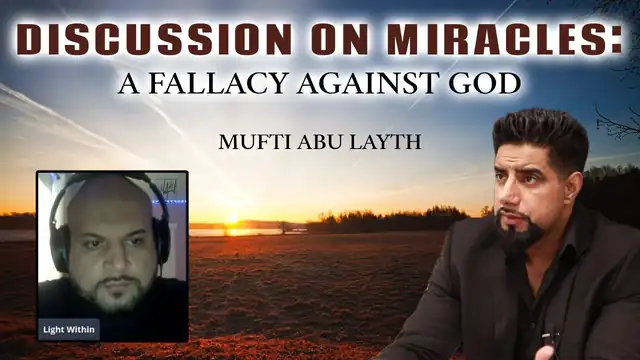 Play from 1:04:33
The video loads from YouTube only when you press play. Click a time in the transcript to seek.
Watch the answer
Open on YouTube at 1:04:33The player starts at 1:04:33, where the answer begins.
This segment1:04:33 to 1:07:38 · 3 min 05 sGeneral teaching
The answer in brief
machinesummary, machine-writtenHumans have real free will: as in a video game, every outcome was designed, but where you go and what you do is your own doing.
In more detail
The caller's last question asks whether, if he takes a gun and kills someone, that is his free will or qadar. Mufti Abu Layth says human beings do have free will, likening it to a video game whose designer created every possible outcome while where the player gets and what he does along the way is up to him. He adds a professor of quantum physics' comparison with the Heisenberg principle, that one can speak of free will or of destiny but our thinking cannot hold both at once, and says he accepts that to a degree. He thanks the caller, saying the discussion shows people can disagree and still be civil.
Question as read aloud · questioner not identifiedIf I have a gun and I go and kill someone, was that my free will or was that qadar?
Position stated
Mufti Abu Layth says human beings do have free will, likening it to a video game whose outcomes were all designed but whose course is up to the player.
“free will is human beings do have free will and i kind of in uh have given an analogy or made it analogous to somewhat of a computer game”
Category: teaching
Kind: general teachingTranscript
machine1:04:33 to 1:07:38 · click a time to seek · dotted terms open the glossary
if a god invited us to him based on reason the moment we accepted he told us oh you know that tool i told you to uh you know use to recognize me i want you to kind of like throw that away now and start believing weird stuff so this i think but this is not obviously we're not going to be able to get to the end of this here tonight yeah sure because we have gone on quite a bit but i think it's been very fruitful so i do really appreciate that you did come on and we discussed my last question uh i guess is the idea of color like if i have a gun and i go and i kill someone
yeah was that my free will or was that yes i i would i have said in my understanding of free will that free will is human beings do have free will and i kind of in uh have given an analogy or made it analogous to somewhat of a computer game so i've said if you have a video game then somebody has designed all possible outcomes now for you to be able to conduct any outcome it must have been designed however where you get in the game and what you do along the way
is entirely up to you as the player so but somebody must have designed it it is true so in somewhat of a poor approximation i give that example uh i do explain that look it is it is diff it's a very difficult in fact when discussing with the uh the uh professor of quantum physics uh doctor faisal mead uh we you he used the example i liked it very much giving the analogy of um what is the the heisenberg principle in quantum physics saying that look basically when we're speaking about human beings and speaking of free will it you cannot speak about destiny in that thing it's used up
the capacity like it can only like in a sentence you can either be talking about free will or you can be talking about destiny like predestination um when you use them both it it just doesn't our thinking just does not capacitate completely for that uh and in somewhat of a way i accept that so what what what does the law of nature say about that the law
according to you when it comes to free will how do you answer because you like to use reason and love so that is so based on reason i have given the example of the video game and that is a something based on reason i'm giving an example of how free will would work so you as the you would have agency but yes there has been design in where the character obviously wherever the character whether you got to stage four or level five or level 99 in the game is your doing but the game was designed all right yeah cool abdul malik i'll leave you with it it's been an absolute pleasure
take very good care of yourself no no not at all and i want to actually say before you go that this is actually a very i'm very glad that we had this discussion but it's also demonstrative of look people can disagree and we can still have a very civil conversation because sometimes people have said to me that oh you know that oh that they wouldn't you know i wouldn't engage people's discussions if they disagreed with me of course i would and and i'm really glad that you did ask that abdul malik so much love take very good care of yourself
Paragraphs overlapping 1:04:33 to 1:07:38. Full text on the recording page.
Cite this segment
Stable id, transcript version and tier are part of the citation. Every change to a transcript is logged.Mufti Abu Layth Archive, segment 2020-10-13-S14, auto-transcribed, may contain errors. https://muftiabulayth.org/r/hiu1gjszg1e/s/14/ (accessed 1 November 2026)
- APA 7
Mufti Abu Layth. (2020, October 13). If I commit a crime, was it my free will or my destiny? [Video, segment 2020-10-13-S14, auto-transcribed, may contain errors]. Mufti Abu Layth Archive. Retrieved November 1, 2026, from https://muftiabulayth.org/r/hiu1gjszg1e/s/14/
- Chicago author-date
Mufti Abu Layth. 2020. "If I commit a crime, was it my free will or my destiny?" Video, segment 2020-10-13-S14, auto-transcribed, may contain errors. Mufti Abu Layth Archive. Recorded October 13, 2020. Accessed November 1, 2026. https://muftiabulayth.org/r/hiu1gjszg1e/s/14/
- BibTeX
@misc{abulayth-2020-10-13-S14,
  author = {Mufti Abu Layth},
  title = {{If I commit a crime, was it my free will or my destiny?}},
  year = {2020},
  month = {10},
  date = {2020-10-13},
  howpublished = {\url{https://muftiabulayth.org/r/hiu1gjszg1e/s/14/}},
  url = {https://muftiabulayth.org/r/hiu1gjszg1e/s/14/},
  organization = {Mufti Abu Layth Archive},
  urldate = {2026-11-01},
  note = {Segment 2020-10-13-S14, auto-transcribed, may contain errors}
}
Something wrong here?
Tell us what is wrong and it will be checked against the recording. Nothing changes until a person has reviewed it.
Sending a note needs JavaScript, which is off or unavailable in this browser. Nothing has been sent.
No name, email address or account is asked for or stored, and the inbox does not store your IP address. For rate limiting it keeps an unreadable fingerprint of your connection for 48 hours, and our database provider's own logs record connections as every website's do. Only your note, its kind, the page and the moment in the recording are kept, for review.