
Recordings › How to Pray Salah According to the Maliki Madhhab- Mufti Abu Layth · 2 Apr 2017 › Segment 2 of 13
Demonstration of the Maliki salah from takbir to salam
salat salaah namaz salaat namaaz as-salah al-salah salawat hadeeth ahadith ahaadeeth hadis hadees ahaadith malik ibn anas malik bin anas imam maalik imam malik ibn anas rakat raka'at rakaah prayer unit rukoo bowing sajdah sajda sujood prostration tashahud tashahhudh takbeer takbirat takbeerat allahu akbar imaam prayer leader maaliki malikite malikiyyah muftis mubah mubaah fard farz faraid fard ayn fard kifayah fardh sunna sunnat sunan prophetic practice jinn djinn jinnat jinni koran quraan al-quran sura soorah surat suwar soora chapter ayah aya ayaat aayah aayat tilawah tilawat tilaawah sahaba sahabi sahabiyyah sahabiyat companions madinah al-madinah madeenah yathrib bismillah ir-rahman ir-rahim bismillahir rahmanir rahim bismillahi bismillah al-rahman al-rahim as-salamu alaykum assalamu alaikum assalamualaikum salaam salaams salam alaykum wa alaykum as-salam peace greeting niyyah niyah niyat niyya niyyat duaa duaas supplication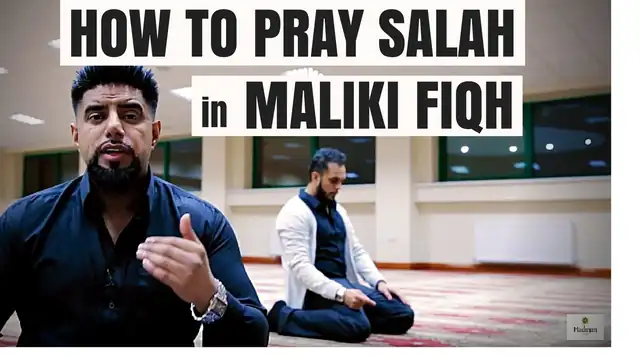 Play from 2:51
The video loads from YouTube only when you press play. Click a time in the transcript to seek.
Watch this part
Open on YouTube at 2:51The player starts at 2:51, the beginning of this part.
This segment2:51 to 15:36 · 12 min 45 sGeneral teaching
What this part covers
machinesummary, machine-writtenThe Maliki prayer is performed with the arms hanging, no opening dua or basmala, silent al-Fatiha, tasbih and personal dua without a set number, and a single salam. Tranquility in every posture is an obligation.
In more detail
Mufti Abu Layth walks through a prayer performed by a demonstrator. He says the intention is simply awareness, with nothing to verbalise; the opening takbir with hands raised to the shoulders is followed by letting the arms hang (sadl), which he says is from the Sunnah and the position of many imams, with folding the arms [?] also practised by many Malikis. One looks ahead or at the place of sujud. There is no opening dua and no basmala: one begins straight with al-Fatiha, read silently, then a short surah or some verses, again without the basmala, then ruku' with takbir, generally without raising the hands though that is an option. He describes the tasbih in ruku' and sujud with no set number, rising with the words of praise, and sujud as a place of dua in any language, citing reports that a person is closest to Allah in sujud and that dua there is more deserving of acceptance. He shows the sitting between the two sujud, the hands being the last to leave the ground when rising, the second rak'ah repeated in the same way, the two sitting positions in tashahhud, the moving index finger, the tashahhud and salutation that Imam Malik chose from several valid transmissions, a dua with no set wording, and a single salam to the right, with two salams an option. He says every posture must be done with tranquility, which the Malikis count as an obligation. Finally he says that behind an imam one does not recite in an audible prayer, as the Quran says to listen when it is recited [?], and one rises from ruku' with the words of praise rather than repeating the imam's words.
- Segment boundaries not yet verified against the transcript
- Some terms in this segment are uncertain
Position stated
No position summary has been recorded for this segment.
Kind: general teachingTranscript
machine2:51 to 15:36 · click a time to seek · dotted terms open the glossary
right throughout this video and generally whilst you will be praying your Salah is that with the school of Medina are there is a huge emphasis on keeping a naturalness right throughout the prayer now you'll see what I mean as we go through this video but just keep that in mind okay a naturalness folks right so let's move on to the Salah in order to perform and enact for us yep that's not a Jin just in case you're wondering that's a Jin in the background it's not that shaan who's
kindly offered to perform this Salah for us so we can get a clear example allahar Okay so you're ready to pray you're going to face the once you're doing that you've got an intention now what does this mean all this is is having an awareness okay you want to know what it is that you're doing that's what this is about no need to verbalize anything no need to say anything once you're ready you're looking ahead you say the which is allahar that is necessary to begin the Salah
that's accompanied by raising the hands to the shoulders okay you let them drop and go back to their resting place which is by the side according to the school of Medina now no need to freak out this is called SLE this is which means a hanging this is from the Sunnah as explained by many like who said the this was also the position of many of the imams of this tradition including people
like IIM and others so it is a well-known position within sunah and within the Maliki School you also have the option of folding your arms which is referred to as this is equally applied and practiced by many Malik here as well okay so right so you've got that another question somebody may ask okay where should I be looking where should I be looking now you do have generally two options either to just look straight ahead as in the Quran we're we're reminded by the verse
that face the another option is to look at the place of suud if that helps with concentration ation once you've got that what do we do there is no Dua to begin there is no which means there isn't even which is once again this is from the Sunnah this was the practice of the people of Madina that Imam Malik found himself upon and this is what he taught so there's no need to freak out once again
you begin immediately with the recitation which is ald so that's how you begin straight after tbar you've gone into recitation which is read alhamd is generally said silently now at this stage you follow
this with either a short Surah of the Quran or a few verses of few ayat can be read also so and this is begun once again without the B so you just go straight into the Surah now you're ready to go into this is done by saying Allah and you go into R now generally this is done without but that is also an option
within the school of Medina practiced by many people to do ra before going into Ru and coming out of it when you're in Ru this is a place of T of glorifying Allah so a popular sub this is said without any set number you can do this there is no limit once you've done that you will rise from ru to okay now all these postures by the way you should ensure that they're done
correctly and outright whether it's r or standing now once you stand you will stand with the word and follow that with now you're ready to go into so what do you do this is a place of of and Dua so you're in you can recite subh once again without any set number it's not it's not determined once you've
once you're done you can also make Dua Dua can be any Dua according to the school of Medina anything bothering you this is the time to reach out to Allah the Hadith says the that the closest a person is to Allah is when he's in and in a in a Hadith that the prophet said make Dua when you in and that it is well it is more deserving to be accepted and you can do this and this
is the the awesome or very interesting part this can be done in any language according to the school of Medina once you've done that you rise from sujud with allahar hands just resting on the thighs and then you're ready to go back into sujud this is just done with another and the same thing again it is a place of sub without any set number and you can make Dua a personal Dua it can be about anything about passing exams about work it can be about any problems it can
be about anything Allah is listening and in any language once you're done you're ready to rise you do that by saying Tak once again as you're Rising your hands will be the last to leave the ground as you stand up now this will be your second ra which will be repeated in the same manner that we've done the first okay so you can see that you will stand for recitation you will go through the F the once you've done that you'll go into Ru similarly once again you do your T
you'll rise from r with and we've highlighted that before and then you'll be ready to go into sujud one thing to keep in mind as you go into sujud ensure that the hands do preed you into suud that is generally as is taught and understood by the school of Medina now once again two sujud once you rise from suud you are now in the position of T so what are the sitting positions now you're going to find more than one generally uh you have one called which involves
leaning in on the left hip lowering that to the ground and having the left foot come from beneath and under the right foot and leg as you can see if you find that uncomfortable or quite inconveniencing and difficult you can it is valid and permissible to sit in the position with which involves resting on the left foot okay so these are all transmissions which have come from different sahabah and the whole point of Salah is to connect you with Allah and
not to kind of bring about discomfort and pain in this position as you are about to begin the you will generally your hands will be resting on your thighs your right hand will we folded with the index finger pointing out as you can see you'll have your thumb resting on the middle finger as you can see and the index finger moving sideways now this continues to move right throughout the T position till the end of
Salah so let's get back to the T you will recite here now this there are multiple ways to read this multiple Transmissions from different sahab IM Malik chose the one by but they are all permissible and valid which is as follows
right now this is followed by which is read and once again there's there are varying narrations a popular one uh can be read muhamad
now at this stage you recite a Dua now there is no set Dua within the Maliki many people popularly read duas like The quranic Dua or
now once you've done that you're ready to finish the prayer to conclude and this is done with a single Salam now that's quite popular within the school of Imam Malik that it's just one Salam although there is the option for those who want to do two that that is an option as well and this is done simply with the wordsum no more than that and that is done by turning the head just slightly to the right as you say that and with that you've concluded your prayer some things to just keep in mind that during the Salah all of the postures all of the
positions ought to be done and they really must be done with a sense of Tranquility okay calmness to them in a correct manner there's no need to rush okay and this is what the refer to as within the Salah an an obligation within the Salah to perform it in a tranquil manner one more question that a lot of people do ask is that how is this any different if I was praying behind an Imam now it's not two different besides things that you'd already know one key difference is that according to the
school of Madina if the Imam is reciting in an audible in a loud prayer you do not recite behind the Imam as the Quran states that once the Quran is being recited be silent and listen to it so that is a key difference um and once the IM is rising from he says there's no need for you to say that you would rise with him following with the words these are really just some subtle key differences to keep in mind if you're praying behind the Imam other
than that the rest is generally pretty much the same across the board Bismillah folks I'd like to share something very important related to Salah something that touches at the heart of being human human all to human and that's forgetfulness in Arabic there's a saying that we get our name insan from actually being forgetful so what if we forget something in Salah that's where you have something
Paragraphs overlapping 2:51 to 15:36. Full text on the recording page.
Cite this segment
Stable id, transcript version and tier are part of the citation. Every change to a transcript is logged.Mufti Abu Layth Archive, segment 2017-04-02-S02, auto-transcribed, may contain errors. https://muftiabulayth.org/r/bin9uqpopma/s/2/ (accessed 1 November 2026)
- APA 7
Mufti Abu Layth. (2017, April 2). Demonstration of the Maliki salah from takbir to salam [Video, segment 2017-04-02-S02, auto-transcribed, may contain errors]. Mufti Abu Layth Archive. Retrieved November 1, 2026, from https://muftiabulayth.org/r/bin9uqpopma/s/2/
- Chicago author-date
Mufti Abu Layth. 2017. "Demonstration of the Maliki salah from takbir to salam." Video, segment 2017-04-02-S02, auto-transcribed, may contain errors. Mufti Abu Layth Archive. Recorded April 2, 2017. Accessed November 1, 2026. https://muftiabulayth.org/r/bin9uqpopma/s/2/
- BibTeX
@misc{abulayth-2017-04-02-S02,
  author = {Mufti Abu Layth},
  title = {{Demonstration of the Maliki salah from takbir to salam}},
  year = {2017},
  month = {4},
  date = {2017-04-02},
  howpublished = {\url{https://muftiabulayth.org/r/bin9uqpopma/s/2/}},
  url = {https://muftiabulayth.org/r/bin9uqpopma/s/2/},
  organization = {Mufti Abu Layth Archive},
  urldate = {2026-11-01},
  note = {Segment 2017-04-02-S02, auto-transcribed, may contain errors}
}
Something wrong here?
Tell us what is wrong and it will be checked against the recording. Nothing changes until a person has reviewed it.
Sending a note needs JavaScript, which is off or unavailable in this browser. Nothing has been sent.
No name, email address or account is asked for or stored, and the inbox does not store your IP address. For rate limiting it keeps an unreadable fingerprint of your connection for 48 hours, and our database provider's own logs record connections as every website's do. Only your note, its kind, the page and the moment in the recording are kept, for review.