
Recordings › A Reply to Sheikh Yasir Qadhi - Mufti Abu Layth · 20 Oct 2018 › Segment 4 of 15
What is Yasir Qadhi's background, and where does the Salafi movement come from?
haj pilgrimage hadj hadith hadeeth ahadith ahaadeeth hadis ahaadith ka'bah ka'ba kaabah masjid masjed masaajid masajid hambali hanbalite hanbali school muftis halal halaal lawful mubah mubaah tawheed tauheed touheed oneness of god shirq mushrik mushrikin polytheism kufr kuffar kaafir kufar kaafirun disbelief atharis atharism athariyyah jahannam jahanam jahannum al-mahdi imam mahdi mehdi makka mekka madina al-madinah madeenah yathrib salafism wahabi 'alim aalim ulama ulema ulamaa shaykh shaikh sheik shuyukh shaykhsBackdrop: Qadhi's Salafi formation, Ibn Abd al-Wahhab, and the roots of the Salafi movement
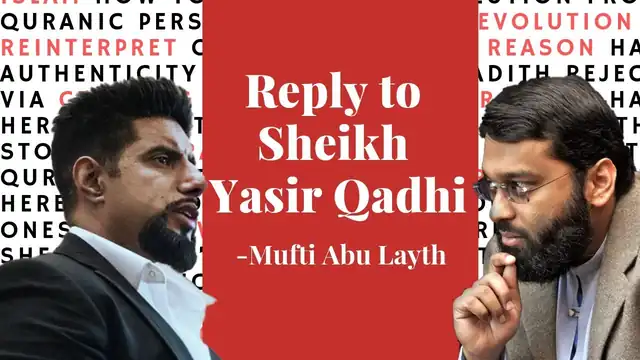 Play from 14:22
The video loads from YouTube only when you press play. Click a time in the transcript to seek.
Watch this part
Open on YouTube at 14:22The player starts at 14:22, the beginning of this part.
This segment14:22 to 24:51 · 10 min 29 sGeneral teaching
What this part covers
machinesummary, machine-writtenQadhi's arguments stem from a hard-line Salafi formation, and Wahhabism in Mufti Abu Layth's account is a doctrine of literalism hostile to reason founded by Muhammad ibn Abd al-Wahhab, whom he calls a deviant for permitting the killing and enslavement of Muslims. He traces the Salafi scholars of the 1970s to the movement behind the 1979 seizure of Mecca.
In more detail
To understand the arguments, Mufti Abu Layth says, one must understand the person making them. He says his respect for Yasir Qadhi was rising a few years ago as Qadhi became critical and enlightened, but that in the last year or two he has made a U-turn. He describes Qadhi as having risen as a hard-line Salafi of Wahhabi background, which he says is a fact rather than an insult, noting that Wahhabis form a spectrum from ISIS at one extreme to a small minority inclined to reason, such as the subcontinent scholar Abdul Karim Athari [?], and that Qadhi wrote a book on the four principles of shirk of Muhammad ibn Abd al-Wahhab and relied on Salafi scholars of the age. He argues that Wahhabism is in essence a doctrine of literalism and dogmatism built on Ibn Abd al-Wahhab's hostility to reason, and describes Ibn Abd al-Wahhab as a Hanbali literalist, a scholar but not an exceptional one, whom he categorically calls a deviant because he permitted killing Muslims he deemed disbelievers, enslaving their wives and taking their wealth, including pilgrims on Hajj; he says ISIS gives out Ibn Abd al-Wahhab's Kitab al-Tawhid as a core text and that Qadhi still has a book in print praising him. He calls the Salafi scholars of Saudi Arabia Bedouin scholars given prestige by oil wealth, and recounts that in the early 1970s figures such as Ibn Baz, al-Albani, Bakr Abu Zayd and Muqbil [?] were part of al-Jama'a al-Salafiyya al-Muhtasiba, which he calls a prototype Taliban that beat people for not praying, was investigated and shut down by the Saudi authorities, and whose lower ranks under Juhayman seized the sanctuary in Mecca in 1979, declaring a Mahdi; he accepts that the senior figures had left the movement but says they founded it. He concludes that Qadhi studied at the Islamic University of Madinah, drew inspiration from these people, built his fame on that movement and later departed from it.
- Some terms in this segment are uncertain
Position stated
Mufti Abu Layth says Muhammad ibn Abd al-Wahhab was a deviant because he held it permissible to kill Muslims he deemed disbelievers, enslave their wives and take their wealth, including pilgrims on Hajj, and that Wahhabism is in essence a doctrine of literalism and dogmatism hostile to reason.
“he was definitely I mean I would categorically say he was a deviant”
Category: historical claim
Kind: general teachingTranscript
machine14:22 to 24:51 · click a time to seek · dotted terms open the glossary
beliefs we must be very literal and we can't have new radical new interpretations they must be the old interpretations of the people before ok so right so this is important so that's what I would like to take a look at in order to take a look at that I want to say a few words in a few minutes about share yourself Adi now I think it's important to highlight these now share here sort of Adi we've got to understand these arguments are stemming from some way ok now in order to understand the argument you have to
understand or at least get a glimpse into the person that is making the arguments ok now I have respect for Shari Arsenal kabhi I used to my respect well a few years ago was definitely on the rise massively for chef Yasir Qadhi because he was really evolving and developing into some into somebody quite enlightened quite critical and he was becoming a beacon of hope and reason for people but then in the last these are my thought
on Cheryl called the in the last maybe two years or so he seems to have for some reason I don't know why I don't know what's going on I don't know whether it's personal I don't know whether it's he's just been advised to do so but he seems to have done a kind of u-turn and really gone because you see share sort of godly just a bit about him he rose as a as a hard-line Salafi a hardcore Wahhabi I mean that's his background I know I'll mention a bit about that this is just so we understand the person and I'm not saying this as a
diss but he is Sheikh assir God it still is a Wahhabi of the Salafi background that is somebody who he is that's unquestionable I mean that's not I'm not saying this as a dis to him he is of the Wahhabi kind of denomination and well hobbies are not all equal there's different types it's like a spectrum you have so for example you're gonna have some nutcase kind of wahhabis extreme like I suppose Isis and all of them were also wahhabis and part of the Hobby kind of thing but they that doesn't mean were hobbies are like that so you get different ends of
them and you get some at the very kind of you get some very inclined towards reason but they are an absolute minority like people like you will get some of the indian sub-continent all kind of raha BL the Sela fear of the past like Maulana Abdul Karim Allah 30 was a selfie and yet he's an amazing beacon of reason in his tough seer orbital with God but Cheryl kadhi he kind of I think in his early days was more entrenched so he has he has a his book he has in share here so Hadees book one of his books is
on the four principles of shirk of Muhammad ibn Abdul wahap and he relies on the that he works by the Salafi you know the salafiyyah the wahhabis of the age like chef Jeanine Ignat you bring in chefs Allah and all of these people and and the reason I'm giving this backdrop is to have an understanding into this in order to understand why share here suck are these saying these things we need to understand the person the person is okay our hobby and the reason I'm saying that and I'm not saying this to offend people I'm just just calling a spade a spade
now why why is that important is to understand that well were happy ISM is generally in essence based on literalism it is a doctrine of literal thought of dogmatism it is something that really the whole belief rose on the back from muhammad abdul wahhab hated reason he was somebody against reason altogether and his whole movement rose to kind of to regain territory what is today modern-day Saudi Arabia to regain
control of that from the Ottomans and in doing so he was a humbly from a very kind of a literal reading of the humbly school and he I'm not saying he was dumb he wasn't dumb he was learning to some extent he was definitely a scholar it's not that he wasn't a scholar but he he wasn't like an exceptional genius scholar by any standard and he was definitely I mean I would categorically say he was a deviant you need to and the reason because he knows somebody who believed it was permissible to shed blood in the name of God he killed many Muslims who he thought because he deemed
them to be non-muslims he said it was permissible to kill them he said it was permissible to enslave and rape their wives he said it was permissible to rob their wealth and including many of those who are coming on Hajj so he attacked the Hajis he said that they weren't true Muslims they were go far pretending to be Muslims because they've lost because they do and therefore you can rake their wives I mean take their wives as slaves and you can kill the men and you can rob their walls and these were people coming on Hajj and other Arabs that lived in Arabia at the time he did the same to them as well so he was a deviant there's no understanding no misunderstanding about
that and it is no joke that his true truly his works have been an inspiration for people like modern-day Isis they so for example Isis one of the key mandatory books that they give out to teach is kata Bhutto he'd of Muhammad ibn Abdul Wahab that's one of the books that they give to everybody to learn because it's very hardcore in how what declares Muslims as non-muslims so when they do this which Shelke their kafir they do this they're a cafe and it's all about dehumanizing the other so chef Yasir Qadhi is a huge fan of people like
muhammad abdul wahhab although i don't know to what extent if his views have changed from but he has a book which is still in print about praising mohammed IBN abdul wahab and glorifying him and his works he's is very inspired by a lot of the Salafis of today the Wahabis like chef Jeanine and what they mean and bimba's and all of these people who I'm not saying are evil people they're not evil people but it's important to know that they where he's coming from because these are people who are really in all essence just Bedouin scholars these are scholars who really have just
lived their lives in deserts and because Saudi Arabia has become rich in the last few decades they've kind of been given a certain amount of prestige not to forget the fact that many of these selfies these wahhabis in the early 70s were part of a new can google these were part of the Jamaat and salafiyyah to Mata Seba the movement that began in the early 70s began with figures like bin baz alberni bakr abu zaid all of these people were part of that movement chef bill all these people that later gave that they were doing they were the
prototype version of the Taliban they would go around trying to beat people if they weren't going to the mosque and doing stuff like these and then they got cracked down on after being investigated by the Saudi authorities for a few years and then they were shut down now they claimed to have disappeared from the movement and the lower ranks that were they wanted a worthy like obeyed what's his name sorry and but there were a few of them that were from the lower ranks these were the leaders the pioneers of that movement Jamar Tomatis about to salafiyyah or the JMS now the lower ranks they
claimed took over as they left the lower ranks produced the likes of Joe Hammond and the other people who then took over the siege of Mecca in 1979 and claimed to be the Mahdi and they smuggled weapons into the Kaaba and they killed people and they you know declared to have taken over and they declared he was the Mahdi and you can see that on on YouTube now Joe Haman was part of the movement this is why Albanian dog chef MOC bill and all these people were exported from Saudi Arabia they and they were never allowed to be in Saudi Arabia that but they claimed and maybe rightfully so I accept they claim that
they claim that they left that movement when the police crack down on it and this group took it underground and a few years later emerged as the MIDI and but they in essence laid the seeds to that movement they were that movement in its early days they founded it they were the pioneers of it they were the ones going around beating people up if they weren't praying and doing things now they disciples so to speak did go on to become major extremists and do stuff now these people distance themselves from that I accept that but this is to give you the backdrop into these people because this is the history now I know
today the Salafi acclaim that we are the least violent and we are the least to do this but you know lest we forget that only a few decades ago all of these same salafiyyah were the people that founded that movement Jamaat on matters about the salafiyyah and it's only because the Saudi government bashed and beat the hell out of some of them in the last few decades that they became so terrified that now they speak about glorifying the king of Saudi Arabia but prior to only in this seventies they founded these movements so it's not even that long ago and it is
on YouTube and it's on you can buy the book a siege of Makkah so any so this is the backdrop to these figure heads or or an inspiration to share yourself adi share here sort of gauzy studied in medina university and drew great inspiration from these kind of people in his early days he my understanding is he was a hard cool Salafi and this is why the salafiyyah loved him back then that's where he grew his his kind of his claim to fame on the back of that movement later on he departed from that movement to be fair to him he started to kind of discover his own path and go about
Paragraphs overlapping 14:22 to 24:51. Full text on the recording page.
Cite this segment
Stable id, transcript version and tier are part of the citation. Every change to a transcript is logged.Mufti Abu Layth Archive, segment 2018-10-20-S04, auto-transcribed, may contain errors. https://muftiabulayth.org/r/7cylt19gx5k/s/4/ (accessed 1 November 2026)
- APA 7
Mufti Abu Layth. (2018, October 20). What is Yasir Qadhi's background, and where does the Salafi movement come from? [Video, segment 2018-10-20-S04, auto-transcribed, may contain errors]. Mufti Abu Layth Archive. Retrieved November 1, 2026, from https://muftiabulayth.org/r/7cylt19gx5k/s/4/
- Chicago author-date
Mufti Abu Layth. 2018. "What is Yasir Qadhi's background, and where does the Salafi movement come from?" Video, segment 2018-10-20-S04, auto-transcribed, may contain errors. Mufti Abu Layth Archive. Recorded October 20, 2018. Accessed November 1, 2026. https://muftiabulayth.org/r/7cylt19gx5k/s/4/
- BibTeX
@misc{abulayth-2018-10-20-S04,
  author = {Mufti Abu Layth},
  title = {{What is Yasir Qadhi's background, and where does the Salafi movement come from?}},
  year = {2018},
  month = {10},
  date = {2018-10-20},
  howpublished = {\url{https://muftiabulayth.org/r/7cylt19gx5k/s/4/}},
  url = {https://muftiabulayth.org/r/7cylt19gx5k/s/4/},
  organization = {Mufti Abu Layth Archive},
  urldate = {2026-11-01},
  note = {Segment 2018-10-20-S04, auto-transcribed, may contain errors}
}
Something wrong here?
Tell us what is wrong and it will be checked against the recording. Nothing changes until a person has reviewed it.
Sending a note needs JavaScript, which is off or unavailable in this browser. Nothing has been sent.
No name, email address or account is asked for or stored, and the inbox does not store your IP address. For rate limiting it keeps an unreadable fingerprint of your connection for 48 hours, and our database provider's own logs record connections as every website's do. Only your note, its kind, the page and the moment in the recording are kept, for review.