
Recordings › A Reply to Sheikh Yasir Qadhi - Mufti Abu Layth · 20 Oct 2018 › Segment 3 of 15
Is Yasir Qadhi's case for reading the Quran literally consistent?
khutba khutbas sermon shari'ah shariat sharee'ah muftis koran quraan al-quran rahmah rahma rahmatContradictions in the khutbah: new meanings, literal reading and the hand of God
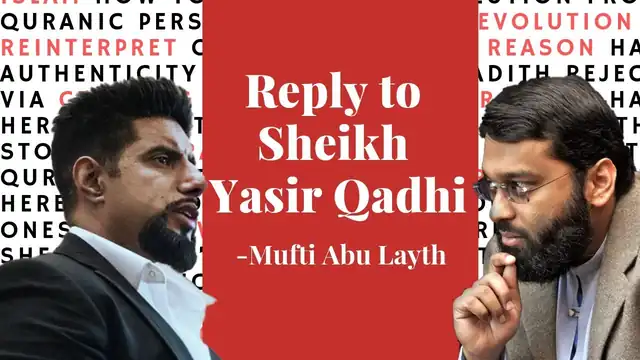 Play from 10:26
The video loads from YouTube only when you press play. Click a time in the transcript to seek.
Watch this part
Open on YouTube at 10:26The player starts at 10:26, the beginning of this part.
This segment10:26 to 14:22 · 3 min 56 sGeneral teaching
What this part covers
machinesummary, machine-writtenThe khutbah is internally inconsistent: it allows the Quran to unlock new meanings while condemning new interpretations, and it demands literal reading while itself reading 'the hand of God' non-literally as God's mercy.
In more detail
Mufti Abu Layth points to what he sees as contradictions in the same talk. Qadhi accepts that the Quran will continue to unlock new meanings for people throughout time; Mufti says a new meaning can only be a new interpretation, so by Qadhi's own third point anyone who finds one would be a new prophet, and he does not know how the two are reconciled. He sums up the whole khutbah as a sustained argument for a literal reading of the Quran and a condemnation of any non-literal reading: anyone who says the stories of the Quran can be metaphors or symbols is called a deviant, and Qadhi repeats that if Allah wanted to tell a story he would tell a story and that Islam is not about stories. Mufti notes the irony that when Qadhi argues for orthodoxy with the words 'the hand of Allah is with the congregation' he translates the hand of God as the mercy of God, itself a non-literal reading, and that Qadhi stresses that in beliefs especially one must be literal and keep to the interpretations of earlier people. He says this is what he wants to examine, and that first he will say a few words about Yasir Qadhi himself.
Position stated
Not yet double-checkedA summary of the view expressed is published here only after a second, independent review has found the sentence in the transcript where he says it. Until then, the transcript and the recording speak for themselves.
Kind: general teachingTranscript
machine10:26 to 14:22 · click a time to seek · dotted terms open the glossary
yourself I love called the has stated now there are countless contradictions in what he said as well and I'll go through some of these by the way those of you just tuning in I can see a few people are tuning in if you if you do like and share this so we can get I'd like as many people as possible this message to reach them about this video of Chef Yasir Qadhi and the response and the response to his objections and criticisms so chef yes sir does go on to say in in the same
talk that by the way I do accept the Quran will always continue to unlock and unravel new meanings for people throughout time which I didn't get by the way because that kind of contradicted his first point because if the Quran unravels a new meaning for you then surely it's not going to come up with a new word or something because enough you know the Quran is words already expressed so that means it's gonna be if anything in interpretation so if your interpretation is is new and
unprecedented as he says that it will continue to unravel and unlock new meanings for people throughout time then that means you've come up with something radically different which means you are a new prophet according to Sharia socata himself in the same video so I don't know how he reconciled those two points together right so I'm I'm thinking so these are some some issues right now also one could sum up before getting and
this is the kind of intro to his before getting into his actual points you can sum up what right throughout his 30-minute hotma he is arguing very much for the the literal reading of the Quran and arguing against a non literal reading of the Quran so he highlights time and time again that anybody who says that the metaphor in the Quran that the symbolism in the Quran the stories can represent metaphors or symbols is is a deviant is a heretic these are radical
new interpretations if Allah wanted to mention a story could mention a story he goes on to say that Quran Islam is not about stories he repeats that message on a few occasion and he condemns this thing of metaphor I mean the whole hook bar is pretty much sums up the fact that is very strongly arguing for a literal reading of the Quran and arguing against in fact condemning a non literal reading of the Quran right ironically by the way
he himself at one point when he's arguing his third point about why you need to stick with what is the orthodoxy he goes on to say that yet allahi wa l-jamaa add that the hand of God is with and he translates this as by the way this means the mercy of God which is a non literal reading which kind of contradicts his earlier point about you can't have non-literal readings of the Quranic must be literal readings and then especially he stresses the point about beliefs he says that regarding
beliefs we must be very literal and we can't have new radical new interpretations they must be the old interpretations of the people before ok so right so this is important so that's what I would like to take a look at in order to take a look at that I want to say a few words in a few minutes about share yourself Adi now I think it's important to highlight these now share here sort of Adi we've got to understand these arguments are stemming from some way ok now in order to understand the argument you have to
Paragraphs overlapping 10:26 to 14:22. Full text on the recording page.
Cite this segment
Stable id, transcript version and tier are part of the citation. Every change to a transcript is logged.Mufti Abu Layth Archive, segment 2018-10-20-S03, auto-transcribed, may contain errors. https://muftiabulayth.org/r/7cylt19gx5k/s/3/ (accessed 1 November 2026)
- APA 7
Mufti Abu Layth. (2018, October 20). Is Yasir Qadhi's case for reading the Quran literally consistent? [Video, segment 2018-10-20-S03, auto-transcribed, may contain errors]. Mufti Abu Layth Archive. Retrieved November 1, 2026, from https://muftiabulayth.org/r/7cylt19gx5k/s/3/
- Chicago author-date
Mufti Abu Layth. 2018. "Is Yasir Qadhi's case for reading the Quran literally consistent?" Video, segment 2018-10-20-S03, auto-transcribed, may contain errors. Mufti Abu Layth Archive. Recorded October 20, 2018. Accessed November 1, 2026. https://muftiabulayth.org/r/7cylt19gx5k/s/3/
- BibTeX
@misc{abulayth-2018-10-20-S03,
  author = {Mufti Abu Layth},
  title = {{Is Yasir Qadhi's case for reading the Quran literally consistent?}},
  year = {2018},
  month = {10},
  date = {2018-10-20},
  howpublished = {\url{https://muftiabulayth.org/r/7cylt19gx5k/s/3/}},
  url = {https://muftiabulayth.org/r/7cylt19gx5k/s/3/},
  organization = {Mufti Abu Layth Archive},
  urldate = {2026-11-01},
  note = {Segment 2018-10-20-S03, auto-transcribed, may contain errors}
}
Something wrong here?
Tell us what is wrong and it will be checked against the recording. Nothing changes until a person has reviewed it.
Sending a note needs JavaScript, which is off or unavailable in this browser. Nothing has been sent.
No name, email address or account is asked for or stored, and the inbox does not store your IP address. For rate limiting it keeps an unreadable fingerprint of your connection for 48 hours, and our database provider's own logs record connections as every website's do. Only your note, its kind, the page and the moment in the recording are kept, for review.