
Recordings › Dr Javad T. Hashmi | Axis of Morality & Archetypal Myths in the Quran | MindTrap 46 |Mufti Abu Layth · 11 Dec 2020 › Segment 5 of 36
Why don't madrasas teach the Islamic philosophers and the Mu'tazila?
averroes ibn rushd al-hafid hambali hanbalite hanbali school muftis riba ribaa sood usury ashaira asha'irah ashariyyah ash'arite mutazilite mu'tazilah ahl al-sunnah ahl as-sunnah ahlus sunnah ahl al-sunna sunnis shiah shiite shi'i twelver ithna ashari sufi sufism soofi madrasah madrassa madaris madrassah religious school deen al-din ad-deen ad-dinIslamic intellectual history: the philosophers, the Qadariyya and the Mu'tazila
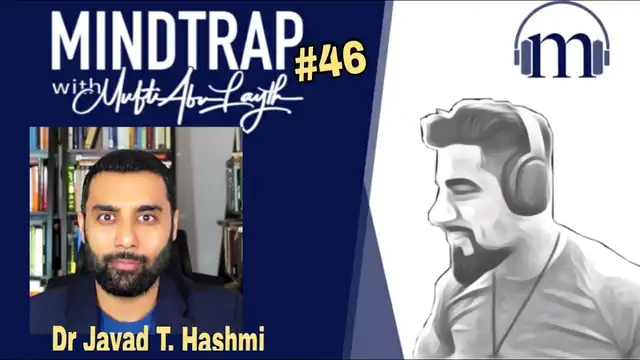 Play from 15:30
The video loads from YouTube only when you press play. Click a time in the transcript to seek.
Watch this part
Open on YouTube at 15:30The player starts at 15:30, the beginning of this part.
This segment15:30 to 19:28 · 3 min 58 sA view quoted in order to be discussed, not a position held
What this part covers
machinesummary, machine-writtenThe guest says traditionalists value only a narrow sliver of Islam's diverse intellectual heritage, ignoring the philosophers, the early Qadariyya and Mu'tazila, Shia thinkers and modernists, and that he found answers on religion and science in Ibn Rushd.
In more detail
Asked about his interest in Islamic intellectual history, the guest says he taught a series on it and that traditionalists are gaslighting Muslims by calling themselves traditional while valuing only a narrow sliver of the tradition. He says madrasas teach nothing about the great philosophers such as Ibn Rushd, Ibn Sina and Ibn Tufayl, nor that the Qadariyya were the first theological group and the Mu'tazila the first orthodoxy, with the Ash'ari and Hanbali systems coming much later, and that non-Sunni groups such as the Isma'ilis also had great philosophers. He says he found the answers to questions of religion and science not in the Ash'aris or Hanbalis but in Ibn Rushd, and that he also wants to take Islamic modernism seriously, along with non-orthodox Sufis and groups such as the Ahmadis, to widen what is thought of as Muslim. Mufti Abu Layth puts to him the usual response that such figures are not taught because they are misguided and would lead people astray.
Position stated
This segment presents a view in order to discuss or respond to it. It is recorded as quoted, never as held, and no position is attributed from it.
Kind: a view quoted in order to be discussed, not a position held Speakers: host and guest; guest speech is labelled and excluded from positionsTranscript
machine15:30 to 19:28 · click a time to seek · dotted terms open the glossary
A guest speaks in this segment. Guest speech is labelled and is excluded from the positions layer.
This segment states a view in order to discuss it. It is recorded as a quoted view, not as a position held.
you know you've uh in invested a lot in learning and promoting this. Tell us a bit about a bit about this and your interest in it. Uh do yeah so I haven't really put anything out publicly much yet other than I did teach a series on Islamic intellectual history which maybe some people would uh uh know of me from that. Um, but that is one of my interests is Islamic intellectual history. And it's precisely because, and this is a problem with the Madrasa traditional Islamic learning system, is that I think they're gaslighting us.
Um, they are they call themselves traditionalists, but in reality, they only value a small part of the tradition, a very narrow understanding of what tradition is. So what I tried to do in the course that I taught is to expand our minds to see the great diversity of the true Islamic tradition so that we can value it and know what we have back in it. Um so for example they don't teach anything about the great Islamic philosophers.
We're talking about Iben Rush Iban Cena Aarois Avisa um Ibn Tufel. They don't teach us about you know they don't tell us about these people at all. uh we don't know anything other than very negative stereotypical things about the we don't know anything about them uh we don't know about the early theological groups the kadis for example the kadrites were the first theological group and from them came the mutazlies they were the orthodoxy back then they were the first orthodoxy of Islam so we but they don't tell you that they don't tell you that the usher system came much later even the hanbali system came later
much later and that we had this great diversity of thought and why do we constrain ourselves to one sliver of the tradition. So, and even why do we not look at non-Sni groups as well? So, look at different Shia groups, the ismileies. Um, they had some great philosophers as well. We should look at this entire tradition and value it. Um, and so that's what I tried to um promote in the course that I taught.
So, that's available on YouTube. uh and I thank the Gandhi center for uh letting me teach that course. Um so that's my interest in Islamic intellectual history and I also think that um in order to solve the problems of today we like for example issues like religion and science I didn't find the answers in the the two groups of Islamic orthodoxy today which is the usher and the hanbal instead I found the answer in ibush that's where I found the answer so I think uh you relying on all of these resources will help us deal with modernity in a much better fashion.
And then on my last point, I would say I also wanted to teach on um Islamic modernism which I think is a much maligned group. Um and so I wanted to say let's take these thinkers seriously as well in the modern period. So in the past I'm looking at these other groups like the Islamic philosophers and then all and even non-orthodox Sufis and then and non-sni groups and then in the present I'm looking at Islamic modernists and other groups even the Ahmedis etc.
So I'm trying to expand our mind and expand what we think of as a Muslim and not view just to towards orthodoxy. You see, but people would say um the reason uh we're not teaching um who I often speak about and promote or we're not speaking about uh whether it's going to be ki or farabi or we're not going to speak about these people or whatever is because these people are they are misgu guided and upon dalala
upon misguidance and if um if we start promoting them people will become misguided this is the the kind of response given when you I mean what what do you what do you think of that what do you make of that because that's the response usually given isn't it yeah well I would say sarcastically and ironically I would say I would want people then to be misguided if [laughter] if if if being on guidance is following what the traditionalists and quote unquote orthodoxy is doing today.
Paragraphs overlapping 15:30 to 19:28. Full text on the recording page.
Cite this segment
Stable id, transcript version and tier are part of the citation. Every change to a transcript is logged.Mufti Abu Layth Archive, segment 2020-12-11b-S05, auto-transcribed, may contain errors. https://muftiabulayth.org/r/zasz48lx_wi/s/5/ (accessed 1 November 2026)
- APA 7
Mufti Abu Layth. (2020, December 11). Why don't madrasas teach the Islamic philosophers and the Mu'tazila? [Video, segment 2020-12-11b-S05, auto-transcribed, may contain errors]. Mufti Abu Layth Archive. Retrieved November 1, 2026, from https://muftiabulayth.org/r/zasz48lx_wi/s/5/
- Chicago author-date
Mufti Abu Layth. 2020. "Why don't madrasas teach the Islamic philosophers and the Mu'tazila?" Video, segment 2020-12-11b-S05, auto-transcribed, may contain errors. Mufti Abu Layth Archive. Recorded December 11, 2020. Accessed November 1, 2026. https://muftiabulayth.org/r/zasz48lx_wi/s/5/
- BibTeX
@misc{abulayth-2020-12-11b-S05,
  author = {Mufti Abu Layth},
  title = {{Why don't madrasas teach the Islamic philosophers and the Mu'tazila?}},
  year = {2020},
  month = {12},
  date = {2020-12-11},
  howpublished = {\url{https://muftiabulayth.org/r/zasz48lx_wi/s/5/}},
  url = {https://muftiabulayth.org/r/zasz48lx_wi/s/5/},
  organization = {Mufti Abu Layth Archive},
  urldate = {2026-11-01},
  note = {Segment 2020-12-11b-S05, auto-transcribed, may contain errors}
}
Something wrong here?
Tell us what is wrong and it will be checked against the recording. Nothing changes until a person has reviewed it.
Sending a note needs JavaScript, which is off or unavailable in this browser. Nothing has been sent.
No name, email address or account is asked for or stored, and the inbox does not store your IP address. For rate limiting it keeps an unreadable fingerprint of your connection for 48 hours, and our database provider's own logs record connections as every website's do. Only your note, its kind, the page and the moment in the recording are kept, for review.