
Recordings › Dr Javad T. Hashmi | Axis of Morality & Archetypal Myths in the Quran | MindTrap 46 |Mufti Abu Layth · 11 Dec 2020 › Segment 6 of 36
Does traditional orthodoxy lead to extremism?
hadeeth ahadith ahaadeeth hadis hadees ahaadith muftis mutazilite mu'tazilah salafis salafism wahhabi wahabi wahhabism deobandis deoband barelwi barelvis brelvi barelwisBetter misguided? Orthodoxy, extremism and an alternative vision
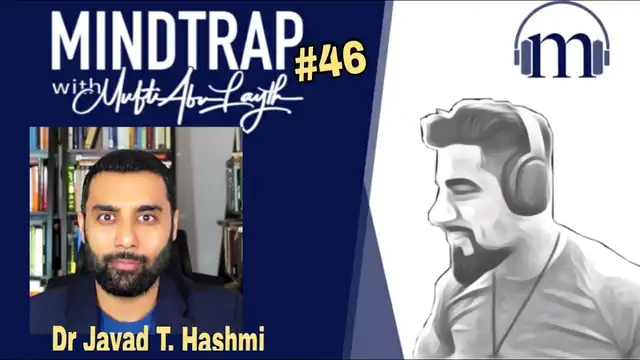 Play from 19:28
The video loads from YouTube only when you press play. Click a time in the transcript to seek.
Watch this part
Open on YouTube at 19:28The player starts at 19:28, the beginning of this part.
This segment19:28 to 22:39 · 3 min 11 sGeneral teaching
What this part covers
machinesummary, machine-writtenThe guest says today's orthodoxy promotes reactionary conservatism that can mutate into groups like the Taliban and ISIS, and proposes reviving the philosophers, Mu'tazila and modernists; Mufti Abu Layth agrees some non-violent groups create a springboard for extremism.
In more detail
The guest answers, ironically, that if being guided means following what today's traditionalists teach, he would rather be misguided, since what they promote is reactionary conservatism and fundamentalism. He says that while they are not the same as terrorists, it is not a coincidence that, by his account, most terrorist groups in South Asia are Deobandi-inspired or Salafi, with a minority Barelvi, and asks what is being taught that mutates so easily into the Taliban or ISIS. He respects some reformed traditionalists but calls reformed traditionalism a failed project, and says he wants to channel the Islamic philosophers, the Mu'tazila and the modernists, a vision that has struggled because in Muslim countries its proponents are killed or exiled, which cannot happen to him in the United States. Mufti Abu Layth agrees that certain groups which are not themselves violent create an atmosphere that can be a springboard to extremism, mentioning Salafi thought, and the segment ends in microphone trouble.
- Guest speech overlaps this segment
Position stated
Waiting for the speaker checkA guest speaks in this segment and the captions do not say who said what. The view found here is held back until the speaker-separated transcript confirms the words are his, or the channel verifies it. The transcript and recording are published in full.
Kind: general teaching Speakers: host and guest; guest speech is labelled and excluded from positionsTranscript
machine19:28 to 22:39 · click a time to seek · dotted terms open the glossary
A guest speaks in this segment. Guest speech is labelled and is excluded from the positions layer.
upon misguidance and if um if we start promoting them people will become misguided this is the the kind of response given when you I mean what what do you what do you think of that what do you make of that because that's the response usually given isn't it yeah well I would say sarcastically and ironically I would say I would want people then to be misguided if [laughter] if if if being on guidance is following what the traditionalists and quote unquote orthodoxy is doing today.
If that's guidance, then I want to be misguided because what they are promoting today is reactionary conservatism and ext fundamentalism and extremism. And I'm not saying that they're the same as the extremists who go and blow themselves up, but there's a it's not a coincidence. For example, so for example, I come from I'm I'm from a South Asian background. the the traditional the traditionalist ama of South Asia the quintessential ones are the Diabundies.
Now if you look and you go through the different terrorist groups uh the majority of them are Dioi or Diabundi inspired or the other group of orthodoxy the Salafies the hadith they are the other group or not if not those two then a minority will also be BVI which is another shade of orthodoxy. So my question is what are these people teaching that it's so easy to mutate into the Taliban?
So easy to mutate into ISIS. So I'm not saying they're the same. There's a huge difference and there's even some reformed traditionalists who I respect and think they're pushing back against it. Ultimately I think reformed traditionalism is a failed project. But I myself am trying to promote an alternative vision which is I want to channel the spirit of the Islamic philosophers and the multazles uh as well as uh the Islamic modernists.
And I think we need another alternative. And I think the only reason why it hasn't had success is because they kill you or they run you out of the country. But sad for them, they can't do that in the United States. So I can teach my course and there's nothing they can do. Um, so I understand why in Muslim countries it's difficult to um be more radical in your way of thinking, but now so can't sorry your mic kind of thing just bounced a bit there and I and I totally agree that this whole thing of you get certain groups who they they may not themselves
be uh kind of they they're not terrorists or promoting terrorism or extreme extremism, violent extremism. However, they create an atmosphere that can be a springboard to that. Um, like you're mentioning that some I'm not saying all these for example are like that, but yes, the atmosphere can serve as a springboard into that uh as well as Salifi kind of thought kind of.
So, my audio keeps cutting out. Um, it's the gym. It's the gin that I see. I'm hearing my voice back there. I took off my head to see if that will help. No, I think No, that won't help. Let me try. [snorts] Try [laughter] medical. Just do the doctor's advice. If it doesn't work, just take it out and put it back in. [laughter] Okay.
Paragraphs overlapping 19:28 to 22:39. Full text on the recording page.
Cite this segment
Stable id, transcript version and tier are part of the citation. Every change to a transcript is logged.Mufti Abu Layth Archive, segment 2020-12-11b-S06, auto-transcribed, may contain errors. https://muftiabulayth.org/r/zasz48lx_wi/s/6/ (accessed 1 November 2026)
- APA 7
Mufti Abu Layth. (2020, December 11). Does traditional orthodoxy lead to extremism? [Video, segment 2020-12-11b-S06, auto-transcribed, may contain errors]. Mufti Abu Layth Archive. Retrieved November 1, 2026, from https://muftiabulayth.org/r/zasz48lx_wi/s/6/
- Chicago author-date
Mufti Abu Layth. 2020. "Does traditional orthodoxy lead to extremism?" Video, segment 2020-12-11b-S06, auto-transcribed, may contain errors. Mufti Abu Layth Archive. Recorded December 11, 2020. Accessed November 1, 2026. https://muftiabulayth.org/r/zasz48lx_wi/s/6/
- BibTeX
@misc{abulayth-2020-12-11b-S06,
  author = {Mufti Abu Layth},
  title = {{Does traditional orthodoxy lead to extremism?}},
  year = {2020},
  month = {12},
  date = {2020-12-11},
  howpublished = {\url{https://muftiabulayth.org/r/zasz48lx_wi/s/6/}},
  url = {https://muftiabulayth.org/r/zasz48lx_wi/s/6/},
  organization = {Mufti Abu Layth Archive},
  urldate = {2026-11-01},
  note = {Segment 2020-12-11b-S06, auto-transcribed, may contain errors}
}
Something wrong here?
Tell us what is wrong and it will be checked against the recording. Nothing changes until a person has reviewed it.
Sending a note needs JavaScript, which is off or unavailable in this browser. Nothing has been sent.
No name, email address or account is asked for or stored, and the inbox does not store your IP address. For rate limiting it keeps an unreadable fingerprint of your connection for 48 hours, and our database provider's own logs record connections as every website's do. Only your note, its kind, the page and the moment in the recording are kept, for review.