
Recordings › Dr Javad T. Hashmi | Axis of Morality & Archetypal Myths in the Quran | MindTrap 46 |Mufti Abu Layth · 11 Dec 2020 › Segment 27 of 36
Does the Quran treat every human life as sacred, even in war?
fiqah jurisprudence fikh muftis dalil daleel adillah adilla evidence koran quraan al-quran ulama ulema ulamaa jihaad mujahid barakah baraka barakat barkat baraqah deen al-din ad-deen ad-dinEvery soul sacred: jihad, the exegetes, and moving from fiqh to ethics
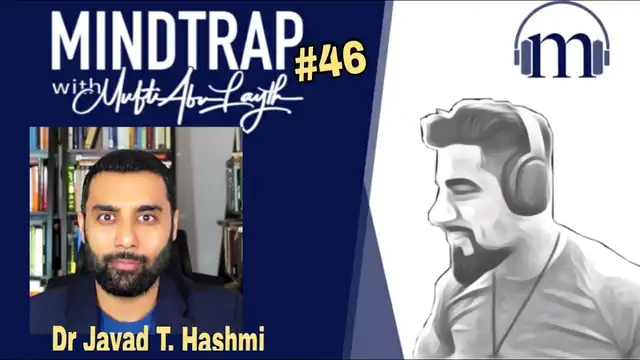 Play from 1:52:45
The video loads from YouTube only when you press play. Click a time in the transcript to seek.
Watch this part
Open on YouTube at 1:52:45The player starts at 1:52:45, the beginning of this part.
This segment1:52:45 to 1:56:12 · 3 min 27 sGeneral teaching
What this part covers
machinesummary, machine-writtenThe guest says the Quran holds every human soul sacred, which classical exegetes on jihad missed; Mufti Abu Layth says Muslim scholarship must shift from outdated fiqh to ethics.
In more detail
The guest says that in his work on jihad he finds the classical exegetes did not recognise the Quran's teaching that all human souls are sacred, believing instead that only Muslims, dhimmis and those with treaties were inviolable while others in the abode of war were fair game, apart from limits such as not targeting women and children. He says the Quran's default is that every human being is sacrosanct, which is the basis of human rights and of the Enlightenment idea that all are created equal, and that reading the creation story as literal history misses this. Mufti Abu Layth agrees and says Muslim scholarship needs to shift from its traditional orientation to ethics, since the fiqh books, though recently printed, are a couple of hundred years out of date, which may be a blessing in disguise. The guest adds that the Quran takes an anti-clerical stance, affirming Jesus' criticism of clerics who bastardised religion through legalism.
- Guest speech overlaps this segment
Position stated
Waiting for the speaker checkA guest speaks in this segment and the captions do not say who said what. The view found here is held back until the speaker-separated transcript confirms the words are his, or the channel verifies it. The transcript and recording are published in full.
Kind: general teaching Speakers: host and guest; guest speech is labelled and excluded from positionsTranscript
machine1:52:45 to 1:56:12 · click a time to seek · dotted terms open the glossary
A guest speaks in this segment. Guest speech is labelled and is excluded from the positions layer.
It go and it instills us in this human egalitarianism. That is what the Quranic story is doing above the biblical story. So once we understand what the Quran is doing and stop taking it in a literal scientific manner, we actually are able to understand what the Quran is doing. And then lastly, and I know I'm going on, [laughter] but it's all part of the story. It's all part of the story.
So like, so like if you look at the classical exites, I work on jihad in the Quran. That's my dissertation topic. They did not recognize that the Quran actually says that all human souls are sacred, are sanctified. They actually believe that only some souls are san sacrosan and other souls are not. And so they believe that in warfare you can uh the people who are Muslims or dimmis and people who have contractual agreements those are now off limits but everyone else in har they're free they're free game now you can't target women and children there's certain but the re from
a onlogical standpoint people don't start out the the default position for all human beings according to the Quran is sacrosanct you are sacred as a human being and that's the basis of our human rights culture. We are all created equal. We were all created equal. What does that mean? Created by who? By God. That's the basis of our western enlightenment values of of human rights.
And that's what the Quranic creation story is doing. And that's how we should understand it. And if we don't understand if we understand it as literal history, we're going to misread uh the Quran. That that so that's my kind of No, I get that. And I As far as this point is, I totally agree that uh and I feel that the way in history Muslim scholars the they were dominated and geared towards there needs to be a shift where the scholars move away from that kind of uh uh theme to one of ethics.
Absolutely. So the the current one should be a preoccupation with ethics and I feel in some way our disconnect with because most of is now out of sync. So if you read the fick books they are like a couple of hundred years old like as in the even though they're modern books but the the fick in them is out of date. So the and maybe that's actually a blessing in disguise that it can kind of allow us or force strong armors to jump genres and move more towards ethics and focus on ethics.
That's just a side point, you know, latching on to what you're saying. You're you're absolutely right. And I would even go one step further and say that um we miss out the part of the Quran that is affirmed. It affirms this of the Bible that uh the Quran takes a very anti-clerical view. So it actually affirms the view of Jesus where Jesus is saying that you clerics, you've misunderstood, you've bastardized the religion.
this legal this legalistic way bastardized the this this this myopic uh way of legalistically viewing the religion is missing the entire point of religion and it is bastardizing the religion and so I think we should actually take hint of that in the Quran itself that the Quran is affirming the anti-clerical stance so this whole um that's a very good point it definitely is that's the nature of the Quran you know these stories um this thing.
So just right cuz this is how I I understand I I understand this and I've explained it that the stories in the Quran first of all the miracles that you've uh mentioned I've obviously said on almost all of these it's never actually said it's just understood like people kind of read between the lines and so for example the story of the table descending for Jesus the Quran never said that it was actually sent down it just said they asked for it and then they were threatened that are you sure you really want this because it's you know if you really want categorical proof then it's game over if you don't uh and then mus it doesn't say anymore
Paragraphs overlapping 1:52:45 to 1:56:12. Full text on the recording page.
Cite this segment
Stable id, transcript version and tier are part of the citation. Every change to a transcript is logged.Mufti Abu Layth Archive, segment 2020-12-11b-S27, auto-transcribed, may contain errors. https://muftiabulayth.org/r/zasz48lx_wi/s/27/ (accessed 1 November 2026)
- APA 7
Mufti Abu Layth. (2020, December 11). Does the Quran treat every human life as sacred, even in war? [Video, segment 2020-12-11b-S27, auto-transcribed, may contain errors]. Mufti Abu Layth Archive. Retrieved November 1, 2026, from https://muftiabulayth.org/r/zasz48lx_wi/s/27/
- Chicago author-date
Mufti Abu Layth. 2020. "Does the Quran treat every human life as sacred, even in war?" Video, segment 2020-12-11b-S27, auto-transcribed, may contain errors. Mufti Abu Layth Archive. Recorded December 11, 2020. Accessed November 1, 2026. https://muftiabulayth.org/r/zasz48lx_wi/s/27/
- BibTeX
@misc{abulayth-2020-12-11b-S27,
  author = {Mufti Abu Layth},
  title = {{Does the Quran treat every human life as sacred, even in war?}},
  year = {2020},
  month = {12},
  date = {2020-12-11},
  howpublished = {\url{https://muftiabulayth.org/r/zasz48lx_wi/s/27/}},
  url = {https://muftiabulayth.org/r/zasz48lx_wi/s/27/},
  organization = {Mufti Abu Layth Archive},
  urldate = {2026-11-01},
  note = {Segment 2020-12-11b-S27, auto-transcribed, may contain errors}
}
Something wrong here?
Tell us what is wrong and it will be checked against the recording. Nothing changes until a person has reviewed it.
Sending a note needs JavaScript, which is off or unavailable in this browser. Nothing has been sent.
No name, email address or account is asked for or stored, and the inbox does not store your IP address. For rate limiting it keeps an unreadable fingerprint of your connection for 48 hours, and our database provider's own logs record connections as every website's do. Only your note, its kind, the page and the moment in the recording are kept, for review.