
Recordings › Dr Javad T. Hashmi | Axis of Morality & Archetypal Myths in the Quran | MindTrap 46 |Mufti Abu Layth · 11 Dec 2020 › Segment 26 of 36
Is the story of Adam in the Quran a myth?
muftis koran quraan al-quranThe Adam story as sacred myth: beyond literalism and scientism
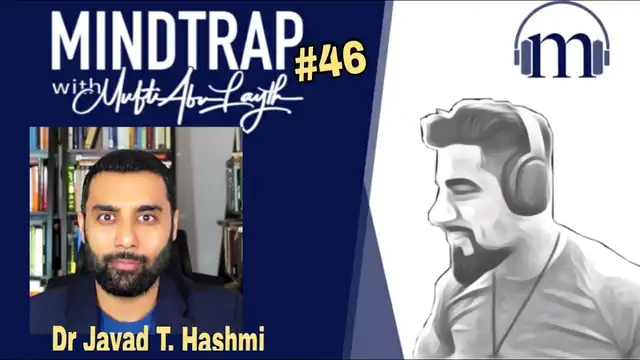 Play from 1:45:37
The video loads from YouTube only when you press play. Click a time in the transcript to seek.
Watch this part
Open on YouTube at 1:45:37The player starts at 1:45:37, the beginning of this part.
This segment1:45:37 to 1:52:45 · 7 min 08 sGeneral teaching
What this part covers
machinesummary, machine-writtenThe guest reads the Adam story as sacred myth whose point is human dignity, improving on the Babylonian and biblical accounts by removing original sin and blame of the woman; Mufti Abu Layth holds the figures and events were real but told to appeal to listeners.
In more detail
The guest says he takes the Adam creation story neither literally nor scientistically, and that Mufti Abu Layth does what he does seventy percent of the time but offers scientistic explanations the other thirty, which he says belittles the Quranic story out of an inferiority complex towards Western science, noting that Muhammad Iqbal said similar things; he says the scientific story of humanity, in which he believes, leaves us morally bankrupt. He defines the stories of past prophets as sacred legends, possibly based on real figures and events and dramatised to give meaning and universality. Mufti agrees only to the extent that these were real people and events portrayed in ways that appeal to listeners. The guest says the Adam story is academically a myth, a story of origins, whose point is God's spirit breathed into the first human, raising all humans above creation; he traces the Babylonian Enuma Elish, in which humans are lowly servants of warring gods, the biblical story that elevated them, and the Quran's improvement on it, which removes original sin and the blaming of the woman and grounds human egalitarianism.
- Guest speech overlaps this segment
Position stated
Waiting for the speaker checkA guest speaks in this segment and the captions do not say who said what. The view found here is held back until the speaker-separated transcript confirms the words are his, or the channel verifies it. The transcript and recording are published in full.
Kind: general teaching Speakers: host and guest; guest speech is labelled and excluded from positionsTranscript
machine1:45:37 to 1:52:45 · click a time to seek · dotted terms open the glossary
A guest speaks in this segment. Guest speech is labelled and is excluded from the positions layer.
[clears throat] So that the Adamic creation story I definitely do not take literally and nor do I move toward a scientistic understanding of it. Now I think from what I see is that 70% of the time you are doing what I'm doing and then 30% of the time this is where I I want to move in that direction. I think 30% of the time you're doing the scientistic explanation which is that this actually means this and this is no no I'm taking the story literally but as literature as a story as a story.
So, and I'm not the first to say this, of course, Muhammad Muhammadbal said it, who's a great Islamic modernist, um, and, uh, this author that we're reading is saying the same thing. And what the Quran is doing when we try to, and here's my criticism of the 30%. We're actually belittling the Quranic story because we have an inferiority complex. We are actually so impressed by Western science and Darwinian evolution.
So even though I'm the one who believes in Darwinian evolution but somebody like that guy Darwin delusions guy you know he doesn't believe in it. Um in fact they are so these traditionalists are so impressed by western science that they have to uh you know reconcile thing they're so busy in doing this that because they're so impressed by science. Now what I will tell you is the actual scientific story of humanity leaves us morally um bankrupt.
If we and that's what I said about evolution. I believe in human evolution but if we leave it at that that's a very um empty story. We have no reason to say that human beings are uh endowed with um sanctity of life for example. The Quranic story meanwhile and that's where I agree with what you said about stories is what makes us human beings and that's the most meaningful and the Quran itself describes the story doesn't describe these as history by the way.
If that's the case then you see couldn't these stories like let's say they are for the most part all fictitious if that that's the argu no I'm not saying that they're fictitious I'm saying that I I'm saying that um okay so let's define terms okay so I I I am saying that stories of past prophets uh are generally sacred legends okay legends means that they can not always but they can be based on a true historical figure.
Okay. But the and and possibly a true event which is dramatized. Okay. In order and why is it dramatized? It's dramatized to give it meaning and to universalize it. No, I mean that part I don't that part I would agree with to the extent that uh I mean not exactly. I I would agree in the sense that I feel that these were people and these were the events but in the relaying of a story you're obviously going to portray in a way that has the appeal of people listening.
So naturally yeah and that's actually the more important part Mhm. is that narrative redescription of it. The why the Quran the Quran offiscates it. The reason why Quran doesn't tell you the historic though the reason why the Quran doesn't tell you that where the uh people of the cave where that was the reason is that's what's least important that's important it in fact uh that's why I'm saying that our modern uh like these traditionalist viewpoints that are the fundamentalism this is why we're missing the essence of
the Quran instead of focusing on uh the meaning of these stories, the moral meaning of these stories. We're focusing on the historical factuality and literalness. So I'll give you an example when it comes to the Adamic creation story. Mhm. Which technically by an academic standpoint is considered under the category of myth. Now the Quran has myth in it. There's from an academic standpoint, not from so No, sure.
It's No, of course. Just for viewers, I want to clarify. I know that you know this, but academically whether you're a even if you're the most traditionalist Muslim, you have to acknowledge that myth exists in the Quran from an academic standpoint. Myth is merely a uh his is a story that describes um cosmology and like uh beginnings whether it actually happened or not it would still come under the category of myth.
So, so um my point here was that traditionalist fundamentalists are missing the point because they're so busy talking about human evolution and Darwinianism. They actually miss the point that the Quran, the whole purpose of the Quranic Adamic creation story, which is like literally the most beautiful story. It's about God's spirit being breathed into the first human being which from which we all come in a [snorts] literary manner.
Maybe not it's questionable whether that's a literal reality but it's a deeper metaphorical reality. So thereby the Quran is all of a sudden raising the status of all human beings above that of all other creation. That is the theological heavy work that the Quranic story is doing. And we know that the biblical creation story, we know the origins of the biblical like what it was responding to.
We know the Mesopotamian and Babylonian creation stories, the what's it called the Enuma Elish story. We know that the that's when the biblical creation story hap was created. And what was it doing? It was rearticulating because the Mesopotamian and Babylonian one was actually saying that human beings were created as um lowly scum of the earth.
They were guilty of uh being beaten by this mongering uh god like deity who was waring against other gods. And then the human beings were created in order to be uh like the noer the servants not like we believe the servants of Allah but as like you know lowly like we serve like on a platter we serve gods that's what we do.
So then the biblical creation story came and it elevated the status of human beings on this deeper metaphorical then the Quranic creation story came and it rearticulated the biblical story and said and it improved it. Why? because it actually said stuff like for example the the bib the Quranic story says more optimistic about human beings. It goes away original sin. It goes away from blaming the woman.
It go and it instills us in this human egalitarianism. That is what the Quranic story is doing above the biblical story. So once we understand what the Quran is doing and stop taking it in a literal scientific manner, we actually are able to understand what the Quran is doing. And then lastly, and I know I'm going on, [laughter] but it's all part of the story. It's all part of the story.
Paragraphs overlapping 1:45:37 to 1:52:45. Full text on the recording page.
Cite this segment
Stable id, transcript version and tier are part of the citation. Every change to a transcript is logged.Mufti Abu Layth Archive, segment 2020-12-11b-S26, auto-transcribed, may contain errors. https://muftiabulayth.org/r/zasz48lx_wi/s/26/ (accessed 1 November 2026)
- APA 7
Mufti Abu Layth. (2020, December 11). Is the story of Adam in the Quran a myth? [Video, segment 2020-12-11b-S26, auto-transcribed, may contain errors]. Mufti Abu Layth Archive. Retrieved November 1, 2026, from https://muftiabulayth.org/r/zasz48lx_wi/s/26/
- Chicago author-date
Mufti Abu Layth. 2020. "Is the story of Adam in the Quran a myth?" Video, segment 2020-12-11b-S26, auto-transcribed, may contain errors. Mufti Abu Layth Archive. Recorded December 11, 2020. Accessed November 1, 2026. https://muftiabulayth.org/r/zasz48lx_wi/s/26/
- BibTeX
@misc{abulayth-2020-12-11b-S26,
  author = {Mufti Abu Layth},
  title = {{Is the story of Adam in the Quran a myth?}},
  year = {2020},
  month = {12},
  date = {2020-12-11},
  howpublished = {\url{https://muftiabulayth.org/r/zasz48lx_wi/s/26/}},
  url = {https://muftiabulayth.org/r/zasz48lx_wi/s/26/},
  organization = {Mufti Abu Layth Archive},
  urldate = {2026-11-01},
  note = {Segment 2020-12-11b-S26, auto-transcribed, may contain errors}
}
Something wrong here?
Tell us what is wrong and it will be checked against the recording. Nothing changes until a person has reviewed it.
Sending a note needs JavaScript, which is off or unavailable in this browser. Nothing has been sent.
No name, email address or account is asked for or stored, and the inbox does not store your IP address. For rate limiting it keeps an unreadable fingerprint of your connection for 48 hours, and our database provider's own logs record connections as every website's do. Only your note, its kind, the page and the moment in the recording are kept, for review.