
Recordings › Dr Javad T. Hashmi | Axis of Morality & Archetypal Myths in the Quran | MindTrap 46 |Mufti Abu Layth · 11 Dec 2020 › Segment 22 of 36
Did the Prophet Muhammad perform miracles?
aqidah aqeedah aqida creed aqeeda aqaid hadeeth ahadith ahaadeeth hadis hadees ahaadith muftis wajib waajib wajibat kalam ilm al-kalam kalaam koran quraan al-quranDid the Prophet perform miracles? The Quran's answer to demands for signs
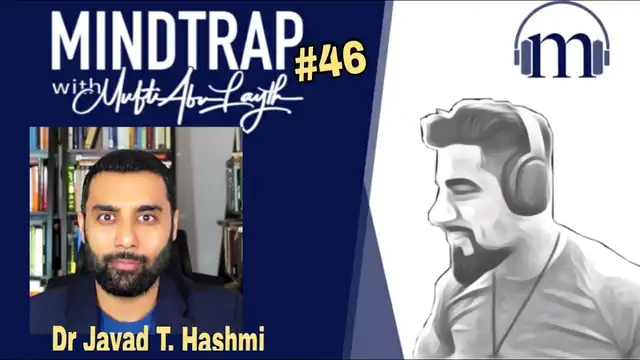 Play from 1:30:29
The video loads from YouTube only when you press play. Click a time in the transcript to seek.
Watch this part
Open on YouTube at 1:30:29The player starts at 1:30:29, the beginning of this part.
This segment1:30:29 to 1:34:56 · 4 min 27 sA view quoted in order to be discussed, not a position held
What this part covers
machinesummary, machine-writtenThe guest argues that the Quran implies the Prophet performed no miracles and ties signs to compulsion, so traditionalists read miracles in from hadith; both speakers appear to reject the view that every prophet needs a miracle.
In more detail
The guest says traditionalists hold that a miracle must confirm every claim to prophethood, and one of the two, apparently Mufti Abu Layth, interjects that they both consider that view wrong. The guest argues that the Quran in several places implies the Prophet performed no miracles: when the pagans demanded that he climb a ladder to the sky or bring down an angel, the Quran answers that if it did so the matter would be decided, linking miracles to compulsion, since a visible angel would end the time for belief. He says traditionalists therefore read miracles into the Quran, such as the splitting of the moon, and draw on hadith reports of plants shading the Prophet and his having no shadow, and asks why, had these happened, his enemies did not believe and the Quran kept answering demands for signs. He says Christian missionaries such as Jay Smith are right that the Quran shows the Prophet did no miracles, and cites Fazlur Rahman that miracles seem out of fashion in the Quran.
- Guest speech overlaps this segment
Position stated
This segment presents a view in order to discuss or respond to it. It is recorded as quoted, never as held, and no position is attributed from it.
Kind: a view quoted in order to be discussed, not a position held Speakers: host and guest; guest speech is labelled and excluded from positionsTranscript
machine1:30:29 to 1:34:56 · click a time to seek · dotted terms open the glossary
A guest speaks in this segment. Guest speech is labelled and is excluded from the positions layer.
This segment states a view in order to discuss it. It is recorded as a quoted view, not as a position held.
I'm gonna get you 100%. Right. So, so that's arrogant of me to say. [laughter] Okay. So, let me let me narrow this down. Um, let's talk about miracles first because these past stories are about miracles. So, we have to talk about miracles. Now, the traditionalist view, do you feel the past stories are actually the central theme is miracles?
Okay. So, let me get to that please. So, Um, sorry. I didn't mean to be rude. Was I? No. No. No. It's not rude. Of course not. [laughter] That's not rude. You should see how people interact with me normally. Okay. Okay. So, so, uh, traditionalists argue that miracles are obligatory to be sent to prove the prophethood of a prophet.
That is the purpose of miracles. Okay? Theologically, that's the purpose. In order to be a prophet, you have to make a claim of prophecy. And it has to be confirmed with a miracle. That is the traditionalist view. Yeah. Now, if you read Okay, let's take that view. If you Yeah. I mean, we don't I mean, we're in agreement that view is crazy, but Yeah. Yeah. But we're going to hypothetically take that. Sure. Sure. Sure. Sure. Explain it. Yeah. Yeah.
Now, you take a look at the Quran. The Quran itself seems in multiple places to imply clearly that the prophet did not carry out any miracles. And they have to in fact it says that the infidel pagans they said bring us from make a ladder to the sky to the heavens and bring us a miracle down. And and the Quran says that you know what pe it it goes it gives all sorts of rhetorical arguments saying that even if we did that first of all the first theological claim of the Quran is if we did that the matter would
be done. Yeah. then there's no purpose of belief after that and God does not compel people to believe. So it links miracle to compulsion. So if God brought down an angel and a he that would be compel and and we know that if for example uh angel Gabriel came down to me right now if me and you are talking right now and all of a sudden angel Gabriel came down here and said and and we both saw him and he had wings 70 wings and all this stuff then I would be like oh I'm totally wrong on my view right like there would be [laughter] I'd be like damn those mushrooms kicked in quick
They kicked in before I even took them. [laughter] The point the point is that the debate would be done. Correct? The time for belief would be done. So God says is making a theological claim that you are asking for miracles. We're warning you of the punishments and if we bring you those what you're asking for, the time is done for you. Now this is the theological argument that the Quran is making. What the traditionalists have to do is they have to use textual ac acrobatics to read in miracles in the Quran for the prophet Muhammad.
What they do is they say the splitting of the moon and then they use their hadith literature and in the hadith literature there's tons of miracles. You have the prophet walking and the plants are turning to shading him and there's he has no shadow. Think common sense. If the prophet actually did any of those things, don't you think his infidel pagan uh enemies would say, "Oh, yeah, that guy is a prophet." Yeah.
And and why would then if that if those things actually happened, why would the Quran have all this dialogue about they're asking you for miracles and tell them that if there's no point of sending you a miracle, right? So yeah, the point is we can say that the traditionalists with their theology have created a big problem. And by the way, Jay Smith and all of these Christian uh missionaries, they actually used this to hit us over the head with they say that Prophet Muhammad didn't do any miracles and we can prove it from the Quran.
And they're right. They're right about that. So instead of insisting on this silly theological belief, we should actually try to understand what the Quran is doing. So what the Quran is doing, what Fazer Rahman said, Professor Fazman, in the Quran, it seems as if miracles are out of fashion in the Quran. Okay. So now I still haven't answered your question about past prophets.
I'm getting there. I'm really getting [laughter] this this is the the straightforward response. Wait till we get to the other the complex response. [laughter] So, I'm going to say one more point. No, go for it. Go for it. Go for it. The only miracle that we could actually think about when it comes to the prophet that's mentioned in the Quran is the idea of the angels coming down on the battlefield of Badr.
Paragraphs overlapping 1:30:29 to 1:34:56. Full text on the recording page.
Cite this segment
Stable id, transcript version and tier are part of the citation. Every change to a transcript is logged.Mufti Abu Layth Archive, segment 2020-12-11b-S22, auto-transcribed, may contain errors. https://muftiabulayth.org/r/zasz48lx_wi/s/22/ (accessed 1 November 2026)
- APA 7
Mufti Abu Layth. (2020, December 11). Did the Prophet Muhammad perform miracles? [Video, segment 2020-12-11b-S22, auto-transcribed, may contain errors]. Mufti Abu Layth Archive. Retrieved November 1, 2026, from https://muftiabulayth.org/r/zasz48lx_wi/s/22/
- Chicago author-date
Mufti Abu Layth. 2020. "Did the Prophet Muhammad perform miracles?" Video, segment 2020-12-11b-S22, auto-transcribed, may contain errors. Mufti Abu Layth Archive. Recorded December 11, 2020. Accessed November 1, 2026. https://muftiabulayth.org/r/zasz48lx_wi/s/22/
- BibTeX
@misc{abulayth-2020-12-11b-S22,
  author = {Mufti Abu Layth},
  title = {{Did the Prophet Muhammad perform miracles?}},
  year = {2020},
  month = {12},
  date = {2020-12-11},
  howpublished = {\url{https://muftiabulayth.org/r/zasz48lx_wi/s/22/}},
  url = {https://muftiabulayth.org/r/zasz48lx_wi/s/22/},
  organization = {Mufti Abu Layth Archive},
  urldate = {2026-11-01},
  note = {Segment 2020-12-11b-S22, auto-transcribed, may contain errors}
}
Something wrong here?
Tell us what is wrong and it will be checked against the recording. Nothing changes until a person has reviewed it.
Sending a note needs JavaScript, which is off or unavailable in this browser. Nothing has been sent.
No name, email address or account is asked for or stored, and the inbox does not store your IP address. For rate limiting it keeps an unreadable fingerprint of your connection for 48 hours, and our database provider's own logs record connections as every website's do. Only your note, its kind, the page and the moment in the recording are kept, for review.