
Recordings › Dr Javad T. Hashmi | Axis of Morality & Archetypal Myths in the Quran | MindTrap 46 |Mufti Abu Layth · 11 Dec 2020 › Segment 21 of 36
Did Jesus really speak in the cradle, and did the earlier prophets exist?
aqidah aqeedah aqida creed aqeeda aqaid muftis dalil daleel adillah adilla proof kalam ilm al-kalam kalaam koran quraan al-quran ayah aya ayat ayaat aayah aayat ulama ulema ulamaa deen al-din ad-deen ad-dinDid the prophets exist? The historical Jesus and speaking in the cradle
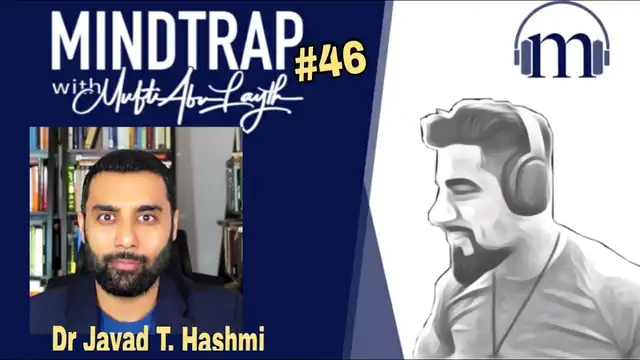 Play from 1:24:52
The video loads from YouTube only when you press play. Click a time in the transcript to seek.
Watch this part
Open on YouTube at 1:24:52The player starts at 1:24:52, the beginning of this part.
This segment1:24:52 to 1:30:29 · 5 min 37 sGeneral teaching
What this part covers
machinesummary, machine-writtenThe guest says historians can be confident that Muhammad and Jesus existed but less so of earlier figures, and that the Quran's Jesus stories, such as speaking in the cradle, are dramatised; Mufti Abu Layth says no clear verse says Jesus spoke in the cradle.
In more detail
Pressed by Mufti Abu Layth on whether the Israelites and their stories are fictitious, the guest says he once scandalised his wife with his views, and that as an academic he knows the Prophet Muhammad existed and believes that Jesus existed and was crucified, while the further back one goes the less sure historians can be, because of the fog of history before written records. He says the Quran's stories of Jesus are dramatised and told in a literary way, citing Khalafallah's argument that the Christians, who exaggerate Jesus' miracles, do not relate that he spoke in the cradle, and arguing that had he done so people would have believed in him. Mufti says that no clear verse of the Quran states that Jesus spoke in the cradle, and that this is inferred by reading between the lines; the guest calls such readings textual acrobatics and jokes that Mufti is seventy percent of the way to his view. He then turns to miracles.
- Guest speech overlaps this segment
Position stated
Waiting for the speaker checkA guest speaks in this segment and the captions do not say who said what. The view found here is held back until the speaker-separated transcript confirms the words are his, or the channel verifies it. The transcript and recording are published in full.
Kind: general teaching Speakers: host and guest; guest speech is labelled and excluded from positionsTranscript
machine1:24:52 to 1:30:29 · click a time to seek · dotted terms open the glossary
A guest speaks in this segment. Guest speech is labelled and is excluded from the positions layer.
So what the Quran is actually doing in a literary way, it's talking about the uh these past figures and talking about the present. Now I know I've beaten around the bush a little bit, but are you so let's note I was going to say that beating around the bush. So I the Israelites, let's take them as an example since you've mentioned them now. Were they because somebody would ask that do you feel that they are uh fictitious the Israelites or were they a real is this real stories that have been dramatized or are they fictitious events?
So so you're calling me out that I am kind of beating around the bush but I'm actually building up to it. So now I'm going to directly answer that question. Sure. So when they when uh certain traditionalists argue that the Islamic philosophers were destroying all of religion, I would say that they're not. And I actually scandalized my own wife when I told her my views. And she says, "Wait, do you even believe that the prophet Muhammad existed?" And I said, "No, of course I do." So at [laughter] least you began that sentence by saying, "No." And then I I thought, [laughter] "No, of course I do." Okay.
So, so let's start with what I know for sure as an academic. Sure. And as a believer and I don't find any contradiction between an academic and a believer. I'm an academic. I'm somebody interested in doing academic theology. So, as an academic, I know that Prophet Muhammad existed. There's only a minority of fringed scholars who believe that he didn't exist and they're not taken seriously. We know that Prophet Muhammad existed.
So, I believe in that. True. I also believe that Jesus existed and that Jesus was crucified. Okay. So, I believe in that. Now, the question now is do I believe, what you're asking me, do I believe in all of the past prophets and all of these events have some basis in some historical kernel. What I will answer, what I will answer is first as an academic and then as a believer. So, let me answer as an academic.
Academic hat on first. Go for it. Yes. As an academic, I would say the further back you go, the less and less we can be sure that they existed. So, as a responsible academic, we can believe that Prophet Muhammad existed and we can believe that Jesus existed. Only fringe scholars believe otherwise. But that's just just to kind of like uh anchor that in that. But that's simply saying the reason I mean I'm not just restricting this to academics but historians or anthropologists because they're saying well there's no evidence like we don't have uh I don't know a coin or we don't have anything
with Moses uh on it or we don't have anything of of his not with somebody having written it about him but we don't have something of Abraham we don't have something but had we had it we would have then believed but there's absence of evidence. Well, well, what I would say is that you get into the fog of history because after a certain before a certain time, you don't have written history. So, it's very hard to penetrate that.
And so, then you get into So, but before I answer the direct I have to I'm sorry. I just have to work my way to it. So, so I I've already told you I I but I'm making progress though, right? No, you are. You are. So, we know that we know that Prophet Muhammad existed. We knew that Prophet Jesus existed. Okay, we can say that for certain now, but the Quran does mention stories of Jesus. So that's a point as well to to Okay, so then so then let me respond to that then and say that even though I agree that the historical Jesus existed, the stories in the Quran about prophet Jesus are definitely dramatized and they're told in a literary way.
Now the author, the book that I'm reading, the author um he says um he he he brings up a very good point. The Quran mentions that um baby the infant Jesus spoke in the cradle. And yet the Christians deny this. Right? And then he says something. He says, "And yet the Christians we know are the most who exaggerate in the miracles and and and actions of Jesus." So if they didn't relate it, that's a pretty good argument that it didn't happen.
Okay? And if and then let's just think about this a little critically. If Jesus really did speak in the grave in in the cradle, don't you think people would then have believed him? I think we should take a stance of uh common sense here and say that if he spoke in the cradle Mhm.
people would believe in him. Now you now people are going to here's where I'm going to get pronouncements of kufur that are going to be No, before you get to that because there was the point that like what I've said is that no actual clear verse of the Quran states that Jesus spoke in the cradle. It's us inferring, reading between the lines that here's here's what I think. I think that that is engaging in textual acrobatics.
True. And and so I'm trying to give So so when I and I'm just telling you how I view it and you can disagree. No, of course. So So when I I've listened to your past videos on these things and I'm like this guy's on the right. I feel keep You're 70% there. [laughter] 70%'s a pass, isn't it? It's a good pass.
I'm gonna get you 100%. Right. So, so that's arrogant of me to say. [laughter] Okay. So, let me let me narrow this down. Um, let's talk about miracles first because these past stories are about miracles. So, we have to talk about miracles. Now, the traditionalist view, do you feel the past stories are actually the central theme is miracles?
Paragraphs overlapping 1:24:52 to 1:30:29. Full text on the recording page.
Cite this segment
Stable id, transcript version and tier are part of the citation. Every change to a transcript is logged.Mufti Abu Layth Archive, segment 2020-12-11b-S21, auto-transcribed, may contain errors. https://muftiabulayth.org/r/zasz48lx_wi/s/21/ (accessed 1 November 2026)
- APA 7
Mufti Abu Layth. (2020, December 11). Did Jesus really speak in the cradle, and did the earlier prophets exist? [Video, segment 2020-12-11b-S21, auto-transcribed, may contain errors]. Mufti Abu Layth Archive. Retrieved November 1, 2026, from https://muftiabulayth.org/r/zasz48lx_wi/s/21/
- Chicago author-date
Mufti Abu Layth. 2020. "Did Jesus really speak in the cradle, and did the earlier prophets exist?" Video, segment 2020-12-11b-S21, auto-transcribed, may contain errors. Mufti Abu Layth Archive. Recorded December 11, 2020. Accessed November 1, 2026. https://muftiabulayth.org/r/zasz48lx_wi/s/21/
- BibTeX
@misc{abulayth-2020-12-11b-S21,
  author = {Mufti Abu Layth},
  title = {{Did Jesus really speak in the cradle, and did the earlier prophets exist?}},
  year = {2020},
  month = {12},
  date = {2020-12-11},
  howpublished = {\url{https://muftiabulayth.org/r/zasz48lx_wi/s/21/}},
  url = {https://muftiabulayth.org/r/zasz48lx_wi/s/21/},
  organization = {Mufti Abu Layth Archive},
  urldate = {2026-11-01},
  note = {Segment 2020-12-11b-S21, auto-transcribed, may contain errors}
}
Something wrong here?
Tell us what is wrong and it will be checked against the recording. Nothing changes until a person has reviewed it.
Sending a note needs JavaScript, which is off or unavailable in this browser. Nothing has been sent.
No name, email address or account is asked for or stored, and the inbox does not store your IP address. For rate limiting it keeps an unreadable fingerprint of your connection for 48 hours, and our database provider's own logs record connections as every website's do. Only your note, its kind, the page and the moment in the recording are kept, for review.