
Recordings › Dr Javad T. Hashmi | Axis of Morality & Archetypal Myths in the Quran | MindTrap 46 |Mufti Abu Layth · 11 Dec 2020 › Segment 23 of 36
Did angels really fight at the battle of Badr?
muftis koran quraan al-quran ulama ulema ulamaaThe angels at Badr as literary language for strengthened hearts
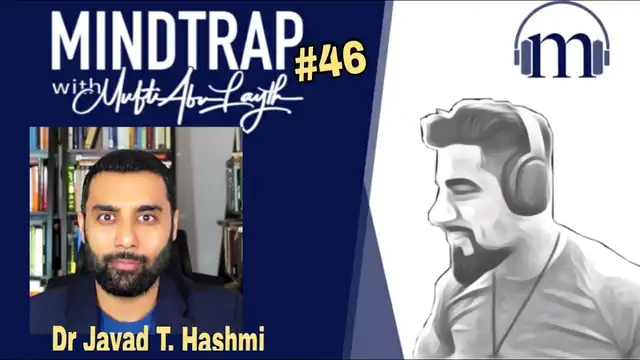 Play from 1:34:56
The video loads from YouTube only when you press play. Click a time in the transcript to seek.
Watch this part
Open on YouTube at 1:34:56The player starts at 1:34:56, the beginning of this part.
This segment1:34:56 to 1:39:02 · 4 min 06 sA view quoted in order to be discussed, not a position held
What this part covers
machinesummary, machine-writtenThe guest says the angels at Badr are a literary description of God strengthening the believers' hearts, since the named Muslims who killed the enemy chiefs are known, and that the same reading applies to earlier prophets' stories.
In more detail
The guest says the only supernatural event in the Prophet's mission described in the Quran is the angels coming down at the battle of Badr. Citing Khalafallah, who quotes classical scholars, he asks why thousands of angels would be needed when one, as Jibril says in another report, could destroy them all, and notes that the names of the Muslims who killed the enemy chiefs are known. He concludes that this is rhetorical, literary language describing God strengthening the believers' hearts, not angels literally fighting, and that the same understanding applies to the stories of earlier prophets. When Mufti Abu Layth asks him to restate the point, he repeats it.
Position stated
This segment presents a view in order to discuss or respond to it. It is recorded as quoted, never as held, and no position is attributed from it.
Kind: a view quoted in order to be discussed, not a position held Speakers: host and guest; guest speech is labelled and excluded from positionsTranscript
machine1:34:56 to 1:39:02 · click a time to seek · dotted terms open the glossary
A guest speaks in this segment. Guest speech is labelled and is excluded from the positions layer.
This segment states a view in order to discuss it. It is recorded as a quoted view, not as a position held.
I'm getting there. I'm really getting [laughter] this this is the the straightforward response. Wait till we get to the other the complex response. [laughter] So, I'm going to say one more point. No, go for it. Go for it. Go for it. The only miracle that we could actually think about when it comes to the prophet that's mentioned in the Quran is the idea of the angels coming down on the battlefield of Badr.
Okay, that's interesting. Right now, our author Muhammad Sal, he talks about this. He says, he actually quotes the classical scholars to prove his arguments that many of them actually recognized that either these angels can be seen by you and me when they they could be seen by the prophet and the believers and uh the the enemies or they were not seen and they were unseen.
Yeah. In either case though in either case if they were first of all he says why did I don't know I forget how many angels it mentions. I think sometimes 7,000 sometimes 70,000 I don't remember exactly. He says why do they even need to send why did God need to send down thousands of angels? One angel could have done the job. Remember in the story angel Jab Gabri uh Gabriel Gabriel says that if you want I can destroy them all for you.
Right? So he says why does it say multiple angels? We only needed one angel. Secondly, he said, "We know we know who killed we have the names of the people who killed the [clears throat] infidel the chiefs of the infidels." So, so the point that Yeah. Go ahead. Sorry. No, I was going to say carry on just saying I'm just getting uh this thing for my throat. It's just right here. But carry on. But I put you up here so people are just hearing you. Do do proceed. Just one one second.
I can wait for you. It's okay. I'll wait. Uh no, no, carry on because people can just see you anyway. Okay. Okay. Okay. I got you. So what he is arguing is that um clearly this is rhetorical literary language that's being used to convey the idea that God is strengthening the hearts of the believers and it's using literary artistic language to do that which is the idea of sending down angels on the battlefield.
That doesn't mean that literally angels came down on the battlefield. It means that God strengthened the hearts of the believers. So now that we've understood that the Quran does describe something that's a miracle in the lifetime, something not it may not be a technical uh uh miracle in the technical Islamic sense, but it is a kind of supernatural event in the Quran that the angels are coming down. Um and we can see that there it's using a literary description and that it's not something to understand literally.
We can now use that to apply that to uh the stories of the past prophets. Their multiple stories. I got a question. Were you listening to me or did you miss that? Miyft, did you miss what I just said? Uh, you did tell me. That [laughter] was that was the crux of my argument. Oh, you gave the You answered it all. God damn.
So, I'm gonna I'm gonna repeat very quickly. No, just Yeah. The only thing that we can say that is supernatural described in the prophetic mission in the Quran, one of the only things is the angels coming down on the battlefield. However, we have the reports of the Muslims who killed the chiefs of the of the infidels. We don't have any. First of all, if they saw them with their own eyes, they would have just fled. We don't have that.
Instead, we know who killed who. And so even the classical exites many of them recognized that this didn't literally happen but instead what was happening was this is a and now this is our my author speaking this is a literary artistic description of God strengthening the hearts of the believers. So it's not that literally angels came down to the to the um uh to the ground and fought the infidels.
It's that the Quran is using a description like this to describe God sending down resolve in the heart believers. [clears throat] Therefore, this is ex we can apply this same this understanding to the stories of past prophets. Just a little footnote there that uh I do have a clip. It's quite a very um it's not your average kind of response on this thing about the angels at the battlefield of Badrar which is mentioned in the Quran.
Paragraphs overlapping 1:34:56 to 1:39:02. Full text on the recording page.
Cite this segment
Stable id, transcript version and tier are part of the citation. Every change to a transcript is logged.Mufti Abu Layth Archive, segment 2020-12-11b-S23, auto-transcribed, may contain errors. https://muftiabulayth.org/r/zasz48lx_wi/s/23/ (accessed 1 November 2026)
- APA 7
Mufti Abu Layth. (2020, December 11). Did angels really fight at the battle of Badr? [Video, segment 2020-12-11b-S23, auto-transcribed, may contain errors]. Mufti Abu Layth Archive. Retrieved November 1, 2026, from https://muftiabulayth.org/r/zasz48lx_wi/s/23/
- Chicago author-date
Mufti Abu Layth. 2020. "Did angels really fight at the battle of Badr?" Video, segment 2020-12-11b-S23, auto-transcribed, may contain errors. Mufti Abu Layth Archive. Recorded December 11, 2020. Accessed November 1, 2026. https://muftiabulayth.org/r/zasz48lx_wi/s/23/
- BibTeX
@misc{abulayth-2020-12-11b-S23,
  author = {Mufti Abu Layth},
  title = {{Did angels really fight at the battle of Badr?}},
  year = {2020},
  month = {12},
  date = {2020-12-11},
  howpublished = {\url{https://muftiabulayth.org/r/zasz48lx_wi/s/23/}},
  url = {https://muftiabulayth.org/r/zasz48lx_wi/s/23/},
  organization = {Mufti Abu Layth Archive},
  urldate = {2026-11-01},
  note = {Segment 2020-12-11b-S23, auto-transcribed, may contain errors}
}
Something wrong here?
Tell us what is wrong and it will be checked against the recording. Nothing changes until a person has reviewed it.
Sending a note needs JavaScript, which is off or unavailable in this browser. Nothing has been sent.
No name, email address or account is asked for or stored, and the inbox does not store your IP address. For rate limiting it keeps an unreadable fingerprint of your connection for 48 hours, and our database provider's own logs record connections as every website's do. Only your note, its kind, the page and the moment in the recording are kept, for review.