
Recordings › Dr Javad T. Hashmi | Axis of Morality & Archetypal Myths in the Quran | MindTrap 46 |Mufti Abu Layth · 11 Dec 2020 › Segment 24 of 36
Who were the riders seen at Badr?
muftis koran quraan al-quranMufti Abu Layth's footnote on Badr: the Karen knights theory, and the guest's objection
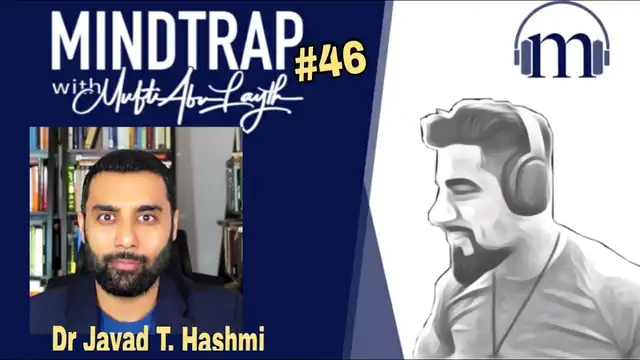 Play from 1:39:02
The video loads from YouTube only when you press play. Click a time in the transcript to seek.
Watch this part
Open on YouTube at 1:39:02The player starts at 1:39:02, the beginning of this part.
This segment1:39:02 to 1:42:25 · 3 min 23 sGeneral teaching
What this part covers
machinesummary, machine-writtenMufti Abu Layth takes the Badr angels as strength and vigour rather than a physical event and floats a theory that the riders seen were Persian knights of the House of Karen; the guest prefers a purely literary reading.
In more detail
Mufti Abu Layth says he goes along with the guest that the angels sent to reinforce the believers at Badr are about meaning, strength and vigour rather than a physical event, but adds that he has a clip on reports of riders in green seen cutting through the enemy. He describes a theory that intrigues him, that these were knights of the House of Karen brought via Salman al-Farisi, who are described in similar terms at other battles involving the Sasanians. The guest says this is where they disagree: he would rather take the story as literary language than make the sacred profane through such explanations, which he finds ad hoc, and says the point of the story is that the believers risked their lives to defend their freedom of belief, which a literal reading denies them. Mufti explains a viewer's joke about 'Karens' by saying it is the name of a Persian house, not a feminine name.
- Guest speech overlaps this segment
Position stated
Waiting for the speaker checkA guest speaks in this segment and the captions do not say who said what. The view found here is held back until the speaker-separated transcript confirms the words are his, or the channel verifies it. The transcript and recording are published in full.
Kind: general teaching Speakers: host and guest; guest speech is labelled and excluded from positionsTranscript
machine1:39:02 to 1:42:25 · click a time to seek · dotted terms open the glossary
A guest speaks in this segment. Guest speech is labelled and is excluded from the positions layer.
It's that the Quran is using a description like this to describe God sending down resolve in the heart believers. [clears throat] Therefore, this is ex we can apply this same this understanding to the stories of past prophets. Just a little footnote there that uh I do have a clip. It's quite a very um it's not your average kind of response on this thing about the angels at the battlefield of Badrar which is mentioned in the Quran.
Now I do explain that yes I go in line with what you're saying when Allah says we sent angels to reinforce uh this is more it's not something which is a physical you know it's something which is more about meaningful and this kind of strength and the that kind of vigor and the whole thing but when people said that they saw these these you know they said we saw for example these people with this particular green cladding they were on these horses and that, you know, they would they were just just chopping through the enemies and doing all of this.
I have this uh I've gone I found interesting this theory [snorts] that they were uh that it's likely that this was a particular that they were particular knights that had been brought it through via Salman Al Farci, the knights of the house of of Karan and that they were people who were often described with these same descriptions and they had appeared through other historians you see at other battles especially around the the where the uh the Sassinids were fighting off certain people and they had come they were not
part of the Sassinids per se but they um and I've been quite intrigued by that perspective yeah that 30% where we disagree I I think that's where I would go back to Iben Rush and I would say no no let's take a literal understanding of the story, but understand it in a that it's a literary uh language that's being used. And let's not mess that up because what you're doing is you're actually taking something that's sacred and making it profane.
So, you're actually belittling the language of the Quran by saying that it this is my view and you can No, no, sure. Sure, sure. Say the same. I'm saying that and then it's also ad hoc and you're constantly having to reinterpret every single and and it I prefer that biting the bullet and it's more systematic and it's saying that this is just a literary description that's talking about strengthening the hearts of the believers and if God had actually sent angels down and I know you're not saying that but if they had sent literal angels down then what is the what is the great thing that the believers did they the whole purpose is that they risked their lives lives in
battle uh to defend their freedom of belief. That is what the story is about. That is what the historical event is about. So you actually deny them that when you take a literal understanding of scripture. So now finally now I [laughter] hope I'm getting it. Somebody said the the Karens are unstoppable. [laughter] What does that mean? What are the No, because I had said I know what Karens are. No, but cuz I had said from the the house of although it's spelled like that Karen, it's not a fe a feminine name in Persian where it was it was just the name of the the household.
So the same about the angel story that I said the knights from the house of uh Karin. So how how am I doing as far as audience? Are they are they uh hating it or are they they it's all good. I mean people are finding it uh intriguing and some people finding it interesting and some people finding it as you'll get the normal questions. [laughter] Okay. So, so now to come to the meat of the issue.
Paragraphs overlapping 1:39:02 to 1:42:25. Full text on the recording page.
Cite this segment
Stable id, transcript version and tier are part of the citation. Every change to a transcript is logged.Mufti Abu Layth Archive, segment 2020-12-11b-S24, auto-transcribed, may contain errors. https://muftiabulayth.org/r/zasz48lx_wi/s/24/ (accessed 1 November 2026)
- APA 7
Mufti Abu Layth. (2020, December 11). Who were the riders seen at Badr? [Video, segment 2020-12-11b-S24, auto-transcribed, may contain errors]. Mufti Abu Layth Archive. Retrieved November 1, 2026, from https://muftiabulayth.org/r/zasz48lx_wi/s/24/
- Chicago author-date
Mufti Abu Layth. 2020. "Who were the riders seen at Badr?" Video, segment 2020-12-11b-S24, auto-transcribed, may contain errors. Mufti Abu Layth Archive. Recorded December 11, 2020. Accessed November 1, 2026. https://muftiabulayth.org/r/zasz48lx_wi/s/24/
- BibTeX
@misc{abulayth-2020-12-11b-S24,
  author = {Mufti Abu Layth},
  title = {{Who were the riders seen at Badr?}},
  year = {2020},
  month = {12},
  date = {2020-12-11},
  howpublished = {\url{https://muftiabulayth.org/r/zasz48lx_wi/s/24/}},
  url = {https://muftiabulayth.org/r/zasz48lx_wi/s/24/},
  organization = {Mufti Abu Layth Archive},
  urldate = {2026-11-01},
  note = {Segment 2020-12-11b-S24, auto-transcribed, may contain errors}
}
Something wrong here?
Tell us what is wrong and it will be checked against the recording. Nothing changes until a person has reviewed it.
Sending a note needs JavaScript, which is off or unavailable in this browser. Nothing has been sent.
No name, email address or account is asked for or stored, and the inbox does not store your IP address. For rate limiting it keeps an unreadable fingerprint of your connection for 48 hours, and our database provider's own logs record connections as every website's do. Only your note, its kind, the page and the moment in the recording are kept, for review.