
Recordings › Homosexuality and Islam -Mufti Abu Layth · 20 Dec 2018 › Segment 2 of 3
Were there Muslim scholars and caliphs in history known to be homosexual?
hadeeth ahadith ahaadeeth hadis hadees ahaadith imaam imams prayer leader faqih faqeeh fuqaha muftis muhaddith muhaddithun muhadith muhaddithin muhaddithoon kufr kuffar kafir kaafir kufar kaafirun 'ayn al-ayn nazar jahannam jahanam jahannum koran quraan al-quran ayah aya ayat ayaat aayah aayat khalifah khulafa khilafah khilafat caliphate khilafa 'alim aalim ulema ulamaaScholars and caliphs of the Abbasid era known for homosexuality: the qadi of Basra and Ibn Dawud
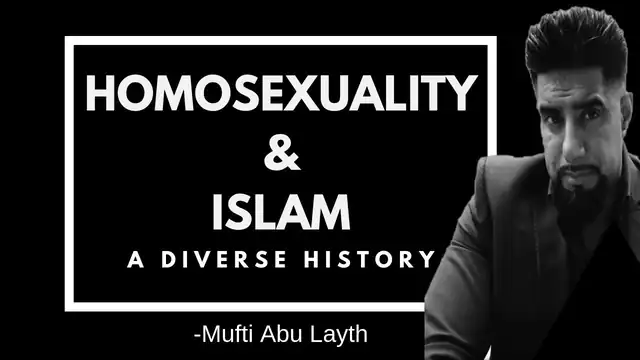 Play from 7:56
The video loads from YouTube only when you press play. Click a time in the transcript to seek.
Watch this part
Open on YouTube at 7:56The player starts at 7:56, the beginning of this part.
This segment7:56 to 18:27 · 10 min 31 sA view quoted in order to be discussed, not a position held
What this part covers
machinesummary, machine-writtenMufti Abu Layth reports, without endorsing their views, that several celebrated Abbasid-era figures were known for homosexuality, including a chief judge of Basra who argued for it from the Quran, the caliphs al-Amin and al-Ma'mun, and Muhammad ibn Dawud al-Zahiri. He cites al-Dhahabi and the poetry of the period as his sources.
In more detail
Mufti Abu Layth says, while stressing that he does not agree with them, that there have been great scholars who held homosexuality to be fine. He describes a judge he identifies as the supreme judge of Basra, Yahya ibn Aktham [?], a hadith scholar and jurist, contemporary and friend of Imam Ahmad until a late falling-out, and a favourite of the caliph al-Ma'mun until a dispute in the caliph's last months over the created Quran. He reports that this judge was openly homosexual and argued for it from the Quran, reading 'wealth and sons are the adornment of this life' and 'made pleasing to men is the love of desires, women and sons' as referring to boys alongside women. He says the caliph al-Amin was known for the same and al-Ma'mun for both, that some ulama hold these to be lies attributed to the judge while al-Dhahabi and others transmit them as well known, and recounts a poem about al-Amin's attachment to his slave Kawthar [?] and his wazir, the rise in the price of eunuch slaves in that period, and al-Ma'mun teasing the judge with a poet's lines about a judge who punishes the adulterer but sees no punishment for the one who commits the act of Lut. He then describes Muhammad, the son of Dawud al-Zahiri, as an openly homosexual scholar who wrote a book for the youth he loved, Muhammad ibn Jami al-Saydalani [?], also known as Ibn Zukhruf [?], and tells the anecdote of the youth covering his face with a towel so that Ibn Dawud [?] would be the first to see his beauty. The segment closes with laughter and an Urdu couplet about love as a means of destruction.
- Some terms in this segment are uncertain
Position stated
This segment presents a view in order to discuss or respond to it. It is recorded as quoted, never as held, and no position is attributed from it.
Kind: a view quoted in order to be discussed, not a position heldTranscript
machine7:56 to 18:27 · click a time to seek · dotted terms open the glossary
This segment states a view in order to discuss it. It is recorded as a quoted view, not as a position held.
that on the left there is nobody are you talking about this thing this is part of this is my couch it's one of those reclining uh so now ignore him makes this statement saying that this is the greatest crime after disbelief is just sodomy and he says sodomy with anybody or anything it's just the greatest sin ever and it's greater than murder arguably which is ridiculous and i don't want to go into a psychoanalysis right there because i don't want to be disrespectful to hypno but we know what psychoanal analysis would kind of lead us to there
but uh this kind of thing is absurd and people said nobody first of all no let me kind of uh let me kind of just add something here first of all this is gonna come as a real shock to people they have actually even been scholars that have said homosexuality is fine right so i'm just going to scare the hell out of everybody by saying that i'm not saying i agree with those scholars but i'm saying that they have been scholars great scholars like al qaddi who was a great scholar
he was the grand supreme judge of he was the supreme judge of basra he was a contemporary of imam ahmed and he was a good friend of imam ahmad and until their later years they've had a falling out and then they no longer kind of talk to each other he was a great scholar of hadith and philip um and he had his own way like his own kind of way of method of doing things he didn't matter usually implies of a great following it wasn't like that but he was a man of great resp respect he also was very close to the caliph
moon hence he became quite untouchable so people say why because he became he was very close very close to the caliph moon loved him it's only in the last few months of mahmoud's life that he had a falling out with him over the quran creation issue and they say moon kind of spoke a bit bad about him and distance but that was only for a few months and then ma moon dies but otherwise moon loved him muhammad allah mean that these people were really good with him these were the caliphs the sons of
haruna rasheed now he was openly homosexual and he used to say that homosexuality he used to prove it from the quran he used to say allah is in the quran and he was a great faking judge of his time and he used to use the verses of the quran like that wealth and boys are the beauty of this world that was his take and he also went to the uh he used the verse of the quran that zuyinali nasih that
these desires have been made pleasing to men right the following desires have been made pleasing to men men and nisa of women and boys most people understood boys here to mean sons but he said it was connected right with women so he said allah is showing this that this so he was a clear proponent who openly argued by the way and the caliph openly used to be homosexual as well like in fact amin was very became strongly just homosexual
and moon was kind of both way he was just sexual he was just i suppose it's fair game [Laughter] kind of thing so so they weren't really like he just wasn't fussed boy girl you know wife cousin sims him [Laughter] he was kind of like like that so he didn't really have much of an issue now and and by the way some ulama say that this some thing these are lies attributed to him so there are many scholars that uh try to dissociate between him
and these opinions but the truth is this is so well known even many you know people like all the even zahabi will transmit them all these people will say that some people say okay maybe people exaggerated but this was so well known about him it wasn't like a little unknown there was a poem uh i had this poem somewhere that uh
that people had said about this was slightly just before him this was about amin who was by the way i mean was obsessed with this particular slave boy of his called kotha right and they said about him and he gave him this position as well and they said about him and they said that you know the uh the homosexuality of the wazir of the khalifa is just it's like a wonder of the world it's kind of thing and most amazing than that
it's something so like wow what the hell most um uh astonishing than that is what the minister gets the portion of the minister fahada he said well this one does and that one gets done and he said for god's sake things have just taken a different turn and he kind of like uh said about that and by the way in his time in a means time and moons time uh eunuchs like these kind of boy
slave boys that were um you know that were eunuchs so for whatever reason they they were of no use sexually as active sexual males their prices massively increased and you can check the books of history why because they were purchasing them like mad and there was this craze about purchasing them and so the reason i've said this is just to show that these things were you know so when people say and i'm not saying i agree with these things and these may come as a shock but these things were known and there was actually a poem the khalifa
moon once got uh this was so well known that poets had made poems about him and they uh he the caliph himself came across this poem so he said to him once to wind him up he said he said yeah yeah he said what do you think about this this poet who said uh and the poet's name was something like ahmadine and he said what he said hey who was the poet who said this and he says the poem that god judge
he says a judge who says that you should punish the adulterer but he says there is no punishment for the one committing homosexuality he says who was the poet that said that he was winding him up and he follows on by saying uh he said god yahya says well that was and he goes on to read another line of his where he's also attacking the caliph and he says he's the one who also says this by the way so he kind of has a go at him now this the reason i'm saying this is just to show you that whoa and he was
a great scholar now after him by the way there was after him the great uh yeah junior to him was uh or a contemporary of him was the great scholar uh his son muhammad was also a known open homosexual in fact this book is an analysis of book which was written for
if i can find it here uh it was written for the boy who he was madly in love with and his name was muhammad ibn assad learning he was madly in love with him and it was such a well-known thing and in fact they say about him that
used to be known by another name as well of uh ibn zucherov he was known by ibn zuchroff as well that one day of like their love was so well known that one day ibn zukhruff they say was looking in the mirror and and he thought to himself wow i am actually good looking and he thought that i might give myself the evil eye so he covered his face with a towel and he walked to ibn who was a great scholar by the way and and he and dawud says why the hell have you why
have you covered your face like this he said that i saw myself with such beauty such good looks and i thought the first person to see me should be you ah [Laughter] what's that damn there's one of those like shadowhunt poses going on here this is uh this this one love this one what's that uh faraz says he says
that there were many ways to destroy and destroy me for us that there were many ways if you thought about it [Laughter] [Music] i wonder why they only thought of love [Laughter] so this thing you see the reason i've said this is to not to kind of
Paragraphs overlapping 7:56 to 18:27. Full text on the recording page.
Cite this segment
Stable id, transcript version and tier are part of the citation. Every change to a transcript is logged.Mufti Abu Layth Archive, segment 2018-12-20-S02, auto-transcribed, may contain errors. https://muftiabulayth.org/r/yfej-qks-km/s/2/ (accessed 1 November 2026)
- APA 7
Mufti Abu Layth. (2018, December 20). Were there Muslim scholars and caliphs in history known to be homosexual? [Video, segment 2018-12-20-S02, auto-transcribed, may contain errors]. Mufti Abu Layth Archive. Retrieved November 1, 2026, from https://muftiabulayth.org/r/yfej-qks-km/s/2/
- Chicago author-date
Mufti Abu Layth. 2018. "Were there Muslim scholars and caliphs in history known to be homosexual?" Video, segment 2018-12-20-S02, auto-transcribed, may contain errors. Mufti Abu Layth Archive. Recorded December 20, 2018. Accessed November 1, 2026. https://muftiabulayth.org/r/yfej-qks-km/s/2/
- BibTeX
@misc{abulayth-2018-12-20-S02,
  author = {Mufti Abu Layth},
  title = {{Were there Muslim scholars and caliphs in history known to be homosexual?}},
  year = {2018},
  month = {12},
  date = {2018-12-20},
  howpublished = {\url{https://muftiabulayth.org/r/yfej-qks-km/s/2/}},
  url = {https://muftiabulayth.org/r/yfej-qks-km/s/2/},
  organization = {Mufti Abu Layth Archive},
  urldate = {2026-11-01},
  note = {Segment 2018-12-20-S02, auto-transcribed, may contain errors}
}
Something wrong here?
Tell us what is wrong and it will be checked against the recording. Nothing changes until a person has reviewed it.
Sending a note needs JavaScript, which is off or unavailable in this browser. Nothing has been sent.
No name, email address or account is asked for or stored, and the inbox does not store your IP address. For rate limiting it keeps an unreadable fingerprint of your connection for 48 hours, and our database provider's own logs record connections as every website's do. Only your note, its kind, the page and the moment in the recording are kept, for review.