
Recordings › Apostasy has NO punishment in Islam: A Qur'an & Sunnah Analysis by Mufti Abu Layth · 10 May 2018 › Segment 4 of 13
Did the Prophet ever execute anyone for leaving Islam?
salah salat salaah namaz salaat namaaz as-salah al-salah salawat hadeeth ahadith ahaadeeth hadis hadees ahaadith janazah janaza salat al-janazah namaz-e-janaza janaza prayer janazah prayer muftis hukm ahkam hukam ahkaam ruling kufr kuffar kafir kaafir kufar kaafirun akhirah akhira aakhirah akhirat hereafter al-dajjal dajjaal ad-dajjal antichrist koran quraan al-quran ayah aya ayat ayaat aayah aayat mecca makka mekka rahmah rahma rahmatThe Prophet's life: no one executed for disbelief or apostasy
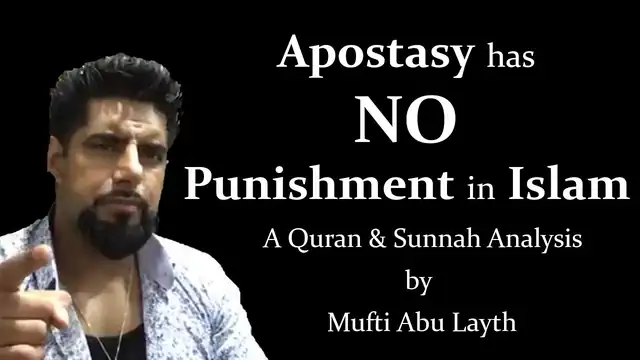 Play from 11:49
The video loads from YouTube only when you press play. Click a time in the transcript to seek.
Watch this part
Open on YouTube at 11:49The player starts at 11:49, the beginning of this part.
This segment11:49 to 15:42 · 3 min 53 sGeneral teaching
What this part covers
machinesummary, machine-writtenThe Prophet never executed anyone for disbelief or apostasy: he spared the hypocrite Abdullah ibn Ubayy, traded with Jews until his death, did not act against Ibn Sayyad and pardoned Abdullah ibn Abi Sarh.
In more detail
Mufti Abu Layth asks why an apostate would deserve to be killed: if the reason ('illah) is disbelief, then by the same logic every disbeliever would deserve death, yet the Prophet spent his life preaching and never killed anyone for disbelief. He notes that the Prophet did not execute the known hypocrite Abdullah ibn Ubayy, who plotted against him, and even prayed his funeral prayer, and that he traded with Jewish people until his death, citing the report that he died with his shield pledged to a Jewish man for wheat, which he says contradicts any idea of killing a disbeliever and taking his wealth, and the verse 'we have not sent you except as a mercy to the worlds' (21:107). He cites, without accepting it, the Dajjal-related report of Ibn Sayyad [?], who accepted the Prophet's message and then asked whether the Prophet accepted him as a messenger, which would make him an apostate whom the Prophet did not order killed. He also cites Abdullah ibn Abi Sarh, a relative of Uthman, who had committed treason and left Islam yet was pardoned by the Prophet at Uthman's intercession after the conquest of Makkah, and asks how that could be if killing were a fixed hadd.
- Some terms in this segment are uncertain
Position stated
Mufti Abu Layth says the Prophet never executed anyone for disbelief or apostasy, pointing to his treatment of Abdullah ibn Ubayy, his dealings with Jews until his death, Ibn Sayyad and his pardon of Abdullah ibn Abi Sarh.
“according to that hadith which most of these people accept that person became an apostate did the Prophet instruct for him to be executed never”
Category: historical claim
Kind: general teachingTranscript
machine11:49 to 15:42 · click a time to seek · dotted terms open the glossary
be killed why sorry why does the person deserve to be killed why and they would say well because he's disbelieved and he said well that's interesting because that would mean them disbelief deserves to be killed that anybody that Co far deserved to be killed because they also disbelieve does it not does that logic not follow so by that logic you would argue that all Co far deserve to be killed because what is the reason that you say that the ill our we call a no solution
yeah Luther the allure of the hukum what is what is it resting on so if you're saying well its resting on disbelief then disbelief also is found amongst so far did the Prophet just two people for being go far never never ever in fact a greater did the Prophet kill the hypocrites in his time afterlife no be was a known hypocrite he he used to plot against the Prophet did the Prophet have him executed never had him executed never even did that in fact even when to
pray his Genessa when he died the Prophet spent his entire life with people certain people who are not Muslim right up until his death there was the Jewish people thing that he was trading with even when he died the hadith inside Muslim he had loaned a certain amount taken the certain certain bags of wheat and left his shield as a kind of dick was it now is this he could have said oh my god that's a Kaffir kill him and take the you know he's well from the Prophet never did that so this is antithetical
to the message that that were of the messenger of allah sallallahu alayhi wasallam and against the verse of the quran wa ma arsalnaka illa rahmatan lil al-amin we have not sent you except as a mercy for mankind another hadith by the way these people use hadith of let's say the Dajjal now they say there was a Jewish person now even though I would have problems with that hadith but let's since all these people accept them that would make these claims let's okay there's a hadith of softness
again who was a Jewish person that the Prophet went to him and said to him do you accept that I'm the messenger of allah that there is no god and i'm and he said yes so now technically he's become a muslim and then he said to the prophet now do you accept I'm the messenger of God and the Prophet said like what in that hadith what is that supposed to even mean so according to that hadith which most of these people accept that person became an apostate did the Prophet instruct for him to be executed never I mean not that I accept
this narration as mean that the jail but still these people do the the companion Abdullah ibn ABI Sarah who was the relative of earth man that had betrayed and committed treason and left Islam yet when he went to Makkah and they caught him and he was worthy of that kind of punishment for the kind of damage he'd caused and how he had compromised the lives of many Muslims yet Osman came and said to the Prophet will you let him you know this person is relative and he's changed and he's you know he's made amends and the Prophet
let him be if that was a hug that you had to establish how could the Prophet let him be right so this somebody saying what a mess in you in you in your narratives in dealing with mortar there is not no mess let's take a look at some of these adi and this is why by the way this is why the narrations that come from Amaro de la langue that come from these people say that a person that was a mortar you would give them the chance you would give them the chance to why would you give them a chance if this was had from
Paragraphs overlapping 11:49 to 15:42. Full text on the recording page.
Cite this segment
Stable id, transcript version and tier are part of the citation. Every change to a transcript is logged.Mufti Abu Layth Archive, segment 2018-05-10-S04, auto-transcribed, may contain errors. https://muftiabulayth.org/r/vyawdwthpa4/s/4/ (accessed 1 November 2026)
- APA 7
Mufti Abu Layth. (2018, May 10). Did the Prophet ever execute anyone for leaving Islam? [Video, segment 2018-05-10-S04, auto-transcribed, may contain errors]. Mufti Abu Layth Archive. Retrieved November 1, 2026, from https://muftiabulayth.org/r/vyawdwthpa4/s/4/
- Chicago author-date
Mufti Abu Layth. 2018. "Did the Prophet ever execute anyone for leaving Islam?" Video, segment 2018-05-10-S04, auto-transcribed, may contain errors. Mufti Abu Layth Archive. Recorded May 10, 2018. Accessed November 1, 2026. https://muftiabulayth.org/r/vyawdwthpa4/s/4/
- BibTeX
@misc{abulayth-2018-05-10-S04,
  author = {Mufti Abu Layth},
  title = {{Did the Prophet ever execute anyone for leaving Islam?}},
  year = {2018},
  month = {5},
  date = {2018-05-10},
  howpublished = {\url{https://muftiabulayth.org/r/vyawdwthpa4/s/4/}},
  url = {https://muftiabulayth.org/r/vyawdwthpa4/s/4/},
  organization = {Mufti Abu Layth Archive},
  urldate = {2026-11-01},
  note = {Segment 2018-05-10-S04, auto-transcribed, may contain errors}
}
Something wrong here?
Tell us what is wrong and it will be checked against the recording. Nothing changes until a person has reviewed it.
Sending a note needs JavaScript, which is off or unavailable in this browser. Nothing has been sent.
No name, email address or account is asked for or stored, and the inbox does not store your IP address. For rate limiting it keeps an unreadable fingerprint of your connection for 48 hours, and our database provider's own logs record connections as every website's do. Only your note, its kind, the page and the moment in the recording are kept, for review.