
Recordings › Apostasy has NO punishment in Islam: A Qur'an & Sunnah Analysis by Mufti Abu Layth · 10 May 2018 › Segment 2 of 13
Does the sanctity of life in Islam rule out killing apostates?
hadeeth ahadith ahaadeeth hadis hadees ahaadith imaam imams prayer leader shariat sharee'ah maaliki malikite malikiyyah maliki school maqasid al-sharia maqaasid maqasid ash-shariah aims of the law muftis halaal permitted lawful haraam mubah mubaah koran quraan al-quran 'alim aalim ulama ulema ulamaa sheikh shaikh sheik shuyukh shaykhs deen al-din ad-deen ad-dinThe sanctity of life and the aims of the shari'ah
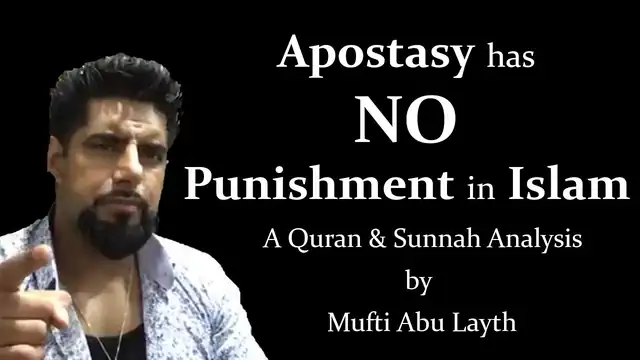 Play from 5:16
The video loads from YouTube only when you press play. Click a time in the transcript to seek.
Watch this part
Open on YouTube at 5:16The player starts at 5:16, the beginning of this part.
This segment5:16 to 7:52 · 2 min 36 sGeneral teaching
What this part covers
machinesummary, machine-writtenLife has conclusive sanctity in Islam, and preserving life and freedom of religion for everyone are among the aims of the shari'ah.
In more detail
Mufti Abu Layth cites 5:32, that whoever kills a single soul is as though he has killed all mankind and whoever saves one life is as though he has saved mankind, and says the sanctity of life is conclusive (qat'i) in Islam. He reports that Imam al-Shatibi writes in al-Muwafaqat that Islam and all religions came to preserve five matters, beginning with life, and that forbidden things may even be made permissible to preserve life. He lists the others as he puts them: freedom of religion for everyone, not only Muslims, progeny, reason and wealth, which are known as the maqasid al-shari'ah. He then turns to the objection that there were rulings in Islam taken by scholars on the basis of certain hadith, saying he will show that some of those hadith are deeply problematic, and introduces Shaykh Abdullah bin Bayyah's discussion of the matter.
Position stated
Mufti Abu Layth says the sanctity of life is conclusive in Islam and that the preservation of life and freedom of religion for everyone are among the aims of the shari'ah.
“so these things we understand that the sanctity of life is cotton it is cut i ok the sanctity of life is conclusive”
Category: teaching
Kind: general teachingTranscript
machine5:16 to 7:52 · click a time to seek · dotted terms open the glossary
attack but once matters were slightly stable for Islam to have some security that from now on in the world Islam would could could go wherever it wanted to go these things any such measures were abrogated and it mentions like gravity okay so this is from the the clear verses of the Quran okay the other verses we know in from the Quran is where Allah is speaking about taking a life Mottola whosoever kills for animal cattle and nasa jimmy on whoever takes a
single soul is as though he has killed everybody woman i hear her and whosoever brings one life saves one life it is as though he has saved mankind so these things we understand that the sanctity of life is cotton it is cut i ok the sanctity of life is conclusive in fact imam shot to be clearly writes in his morphic art and other people right that islam came and all religions came for the preservation of these five matters and beginning with
enough save the nerves okay saving life that this was conclusive the haram martyrs would even be made halal to preserve life and and the freedom of religion at the for anybody in everybody not just for Muslims okay unnecessary people to have progeny and offspring a local reason promote reason and wealth surprisingly to me this is what religion actually came for these this is known as Maha siddhis Sharia so when people speak these are the
methoxy so just to kind of I wanted to kind of just open that up now yes people will say that they were rulings in Islam but would you not say there are certain rulings in Islam that scholars had taken based on certain hadith now I will come to some hadith and show how they are massively problematic but there are other hadith and teachings now yes we've got to understand something in
the past in the past so great scholars today by the way people like cher Abdullah bin ve a great Maliki scholar one of the teachers of share Hamza Yusuf in his sonata for tower in his machine he'd in his other articles as well in in his conference there was a conference which is which is available online as well or the transcript to it he discussed in depth these kind of situations saying that look in the past yes it is true that certain many scholars did go with certain rulings but you've got to look in they day and age
Paragraphs overlapping 5:16 to 7:52. Full text on the recording page.
Cite this segment
Stable id, transcript version and tier are part of the citation. Every change to a transcript is logged.Mufti Abu Layth Archive, segment 2018-05-10-S02, auto-transcribed, may contain errors. https://muftiabulayth.org/r/vyawdwthpa4/s/2/ (accessed 1 November 2026)
- APA 7
Mufti Abu Layth. (2018, May 10). Does the sanctity of life in Islam rule out killing apostates? [Video, segment 2018-05-10-S02, auto-transcribed, may contain errors]. Mufti Abu Layth Archive. Retrieved November 1, 2026, from https://muftiabulayth.org/r/vyawdwthpa4/s/2/
- Chicago author-date
Mufti Abu Layth. 2018. "Does the sanctity of life in Islam rule out killing apostates?" Video, segment 2018-05-10-S02, auto-transcribed, may contain errors. Mufti Abu Layth Archive. Recorded May 10, 2018. Accessed November 1, 2026. https://muftiabulayth.org/r/vyawdwthpa4/s/2/
- BibTeX
@misc{abulayth-2018-05-10-S02,
  author = {Mufti Abu Layth},
  title = {{Does the sanctity of life in Islam rule out killing apostates?}},
  year = {2018},
  month = {5},
  date = {2018-05-10},
  howpublished = {\url{https://muftiabulayth.org/r/vyawdwthpa4/s/2/}},
  url = {https://muftiabulayth.org/r/vyawdwthpa4/s/2/},
  organization = {Mufti Abu Layth Archive},
  urldate = {2026-11-01},
  note = {Segment 2018-05-10-S02, auto-transcribed, may contain errors}
}
Something wrong here?
Tell us what is wrong and it will be checked against the recording. Nothing changes until a person has reviewed it.
Sending a note needs JavaScript, which is off or unavailable in this browser. Nothing has been sent.
No name, email address or account is asked for or stored, and the inbox does not store your IP address. For rate limiting it keeps an unreadable fingerprint of your connection for 48 hours, and our database provider's own logs record connections as every website's do. Only your note, its kind, the page and the moment in the recording are kept, for review.