
Recordings › The Role Of Reason In Religion - Mufti Abu Layth · 9 Apr 2018 › Segment 16 of 19
If reason judges religion, whose reason counts, and what about rituals?
malik ibn anas malik bin anas imam maalik imam malik ibn anas imaam imams prayer leader maaliki malikite malikiyyah muftis imaan eemaan eeman madinah madina al-madinah madeenah yathrib 'alim aalim deen al-din ad-deen ad-dinAnswering the objections: scaremongering, rituals, 'whose reason', and Malik's rule
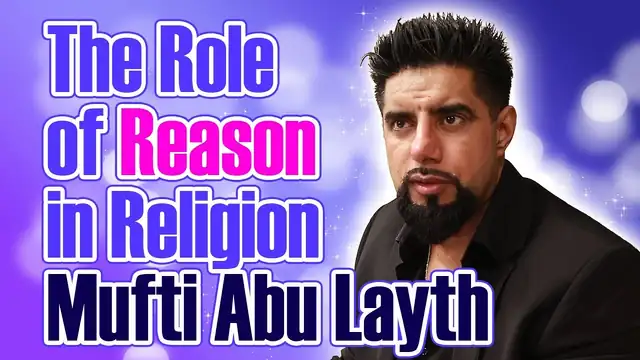 Play from 1:14:24
The video loads from YouTube only when you press play. Click a time in the transcript to seek.
Watch this part
Open on YouTube at 1:14:24The player starts at 1:14:24, the beginning of this part.
This segment1:14:24 to 1:17:02 · 2 min 38 sGeneral teaching
What this part covers
machinesummary, machine-writtenThe concept of ritual must make sense, not every detail; the shared judgement of a healthy mind is the standard; and, by Malik's rule that only the Messenger's words are beyond rejection, following a school is not belonging to a cult.
In more detail
Mufti Abu Layth says the scaremongering must be ignored: those who do not want to question may stay at that lower level of iman, but they should not prevent others from aspiring to the higher level Allah commands. To the objection that rituals are not derived from reason he repeats that the concept of ritual is what must make sense, not each detail, and he dismisses the reductio that reasoning would lead one to stop praying, since nobody thinks that way. To 'whose reason?' he returns to the Hinduism example: people accept intersubjectivity and the healthy mind's judgement there, and should not be swayed by opinions that merely became popular over time. He cites Imam Malik's saying that everyone's words are taken and rejected except the Messenger of Allah's, and says that although he follows and teaches the Maliki school with passion, having studied the other schools, this is Malik's own teaching: Islam is a tradition, not a cult.
Position stated
Mufti Abu Layth says that the concept of ritual rather than its details must accord with reason, that the shared judgement of a healthy mind is the standard of reason, and that following the Maliki school does not make one a cult member, since Malik taught that everyone's words may be rejected except the Messenger's.
“the concept of ritual is what you make sense of as to the actual rituals it's fine”
Category: method
Kind: general teachingTranscript
machine1:14:24 to 1:17:02 · click a time to seek · dotted terms open the glossary
because people are gunning down this kind of scarecrow this kind of like straw man of religion that you are putting up and it is being ridiculed day in day out the number of X Muslims is massively disproportionately on the increase because people religion doesn't make sense to people so this is why this scare mongering we need to ignore that yes if people don't want to look if people say I don't want a reason I don't want a question that's fine that's your choice I accept that that's that lower level of Iman that's your faith fine but
don't prevent people too from aspiring to the higher level of Iman that Allah told them to aspire to so that's the important kind of message here and and as to these kind of criticisms where people say things like well one rituals were yre by that like this and well that's not it's not it's not meant to be like the concept of ritual is what you make sense of as to the actual rituals it's fine people go over if I use my article then I don't want to pray but that doesn't make any sense because that's not see this kind of ad absurdum that I'm gonna argue this ad
absurdum till it gets absurd like oh so then I'm not gonna want to do anything but that's not what people that's not how people think most people don't think like this the most reason and then people say but whose reason Oh so is it your uncle is it your uncle who's up culture let's go back to that Hinduism how is it wrong Oh moussaka your uncle my uncle why is the overly you can accept intersubjectivity you can accept a healthy mind and judgment and now you've got a problem with it and let's not be swayed by just a democratic kind of
opinion held by certain people over time look Allah and His Messenger on Authority Imam Malik said cool Ouya dooming holy he were you rod Allah saw a bottle cover he said everybody we accept and reject except the Messenger of Allah this is our this is how we understand Islam I am I personally stick to I mean I do follow the school of Medina the Maliki method I've studied different methods I'm passionate about the Maliki method you know I teach the Maliki method for I mean I will resume I used to teach it I will resume teaching it and I'm very
passionate about it but it doesn't mean even the Malik this is Imam Malik teaching you these are the principles that look it's not about like having it we're not a cult it's like somebody said to me oh well if that's the case you know you and what's shocking is when people want to refute me this is this is a this is the logic people have so what they'll do is they'll find a scholar that I've spoken highly of and I got aha so like okay recently I don't know if you guys have watched but there was this whole thing about I had tackled I was asked a question about this tree in the time of the Prophet that apparently
Paragraphs overlapping 1:14:24 to 1:17:02. Full text on the recording page.
Cite this segment
Stable id, transcript version and tier are part of the citation. Every change to a transcript is logged.Mufti Abu Layth Archive, segment 2018-04-09-S16, auto-transcribed, may contain errors. https://muftiabulayth.org/r/uuldzklvxvo/s/16/ (accessed 1 November 2026)
- APA 7
Mufti Abu Layth. (2018, April 9). If reason judges religion, whose reason counts, and what about rituals? [Video, segment 2018-04-09-S16, auto-transcribed, may contain errors]. Mufti Abu Layth Archive. Retrieved November 1, 2026, from https://muftiabulayth.org/r/uuldzklvxvo/s/16/
- Chicago author-date
Mufti Abu Layth. 2018. "If reason judges religion, whose reason counts, and what about rituals?" Video, segment 2018-04-09-S16, auto-transcribed, may contain errors. Mufti Abu Layth Archive. Recorded April 9, 2018. Accessed November 1, 2026. https://muftiabulayth.org/r/uuldzklvxvo/s/16/
- BibTeX
@misc{abulayth-2018-04-09-S16,
  author = {Mufti Abu Layth},
  title = {{If reason judges religion, whose reason counts, and what about rituals?}},
  year = {2018},
  month = {4},
  date = {2018-04-09},
  howpublished = {\url{https://muftiabulayth.org/r/uuldzklvxvo/s/16/}},
  url = {https://muftiabulayth.org/r/uuldzklvxvo/s/16/},
  organization = {Mufti Abu Layth Archive},
  urldate = {2026-11-01},
  note = {Segment 2018-04-09-S16, auto-transcribed, may contain errors}
}
Something wrong here?
Tell us what is wrong and it will be checked against the recording. Nothing changes until a person has reviewed it.
Sending a note needs JavaScript, which is off or unavailable in this browser. Nothing has been sent.
No name, email address or account is asked for or stored, and the inbox does not store your IP address. For rate limiting it keeps an unreadable fingerprint of your connection for 48 hours, and our database provider's own logs record connections as every website's do. Only your note, its kind, the page and the moment in the recording are kept, for review.