
Recordings › From the Mind of a Mufti
Thoughts on Muhammad Hijab's talk on Liberalism & Islam | Mufti Abu Layth
malik ibn anas malik bin anas imam maalik imam malik ibn anas imaam imams prayer leader maaliki malikite malikiyyah maliki school hanafite hanafiyyah hanafi school muftis iman imaan eemaan eeman jahannam jahanam jahannum koran quraan al-quran shiah shiite shi'i twelver ithna ashari salafis salafism wahhabism sufis sufism soofi ulama ulema ulamaa ummah umma ummat hijaab hejab hijabi alhamdulilah al-hamdu lillah alhumdulillah alhamdulillaah hamdulillah amanah amana amaanah amanat deen al-din ad-deen ad-din rahmah rahma rahmatvideo · 43:24 · 19,000 views · 4 Aug 2019 · 7 segments · Open on YouTube
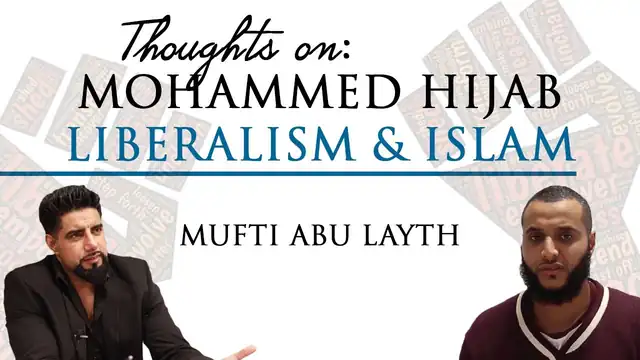 Press play to load from YouTube. Nothing loads until you do.
7 segments
machine7Each block is a segment in time order. Click to open it.All segments · in time order
Transcript
machineauto-transcribed, may contain errors · source: youtube auto · click a time to seek · dotted terms open the glossarybut let's focus let's let's cover Mohammed hijabs talk on liberalism because I think this is quite important a few people did send it to me it's a recent talk done by Mohammed hijab in I'm not exactly sure where it is I think it's the Netherlands and so it's it's on YouTube and Mohamed hijab it's at a university he's giving a thorough discussion ad uh it's not a dialogue really but a thorough kind of lecture if you like a detailed or apparently
allegedly detailed lecture on liberalism what it means an Islamic viewpoint how it's wrong how it's baseless how they don't have any valid arguments to argue from that they don't have a valid standpoint and this is this is the kind of claim being made by Mohammed a job so I did I watch the lecture just to see what what is this about now I'd like to clarify a few things like what I what I
thought about this lecture I think that this I did read especially in the comments that it seemed to be very well received it was in a university setting but the assumption the impression I got is that it was to a Muslim audience okay because it seems to be very kind of playing to that Muslim kind of sentiment so I'm not sure if they were if it was a heavily mixed crowd or not but it doesn't seem like that front by the way
the talk is delivered okay so Muhammad a jab begins by defining liberalism what is liberalism now just to I I want to make a few pointers and then go into some of the discussions that he had just to kind of give an overview first of all I feel that either Muhammad hijab doesn't either he hasn't understood the whole she hasn't fully holistically grasped the concept which I'm not so sure because he's an intelligent person Mohammadi job is very
intelligent you know he's not somebody stupid or somebody naive so I'm not sure if that stands true or is he deliberately kind of going down a particular particular route of of argument just to kind of win his case and get points I don't know or is it that he's I don't know he's being he's being told to say things in a particular way I don't know what the reasoning is I mean he knows a lot of them but I think
it was a very poor job it was it was done very poorly in my perspective he's kind of breakdown of liberalism because what he was doing is he was arguing against liberalism the way Muslims have sectarian debates so this was his point like like let's say you are about to argue with the Shia for example I'll use the wrong word let's say you're about to have a debate with the Shia or with the Sufi over the Hanafy or with the Maliki
or with the Wahhabi or with a religious this is how Muslims within religion debate what they do is they find out what that person adheres to then they will use the figures so let's say now I'm going to debate against a Hanafy so what I'll do is I'll find out ok what dudes a great Hanafy scholars scholars have to say about a particular whatever the issue is and then I'm going to say to them ah but look look you're saying this but imam abu hanifa
himself used to do ruffle yadaim for example or I'm gonna say ah you're saying this but you know even at a mia he used to go and visit Sufi graves so how can you be against so what we do is we argue from a point of compelling leadership compelling Authority so we assume that that figurehead is an absolute authority for this person so we're going to say well you know you you
claim to be Maliki so ah so Imam Malik said this ha now you're stuck you're stuck now because I quoted your Imam this is the kind of polemics that happened within unfortunately but within religion within Islam especially that is how all of these Muslim ik Islamic debates take place so if you're gonna argue the Shia oh here is a Shia book your Imam said this this particular Imam Ayatollah said this now you're stuck
I've got you so even if that person says yeah but I don't really follow no no no what do you mean you don't follow the Imam Miceli it's in the cafe's if it's against the shia or it's you know it's in the madonna by imam malik oh it's in red dorm at ry the Hanafi so what we do is we argue from an angle of compelling Authority compelling leadership so Muhammad hijab was using this tactic okay against liberties that doesn't make any sense because outside of religion
people don't see the world like that okay so you have to understand that people don't this they don't feel that they compel to some kind of Allegiance this is to begin with so what maja a job did in this lecture he began a thorough part of this lecture a huge part of this was dedicated to to the figureheads of historical liberalism so what does liberalism mean although
muhammad hijab didn't really I mean he just touch upon it to be fair but just just to explain liberalism is simply a stance against authoritarianism that's all it is in essence so it is a trend if you want to say trend it is a feeling a sentiment that you do not like others being authoritarian it is the resistance okay that is what liberalism in essence
is in essence now what muhammad hijab did is we focused on people like john locke who's had a historical figures had a huge hundreds of you know from the into the 18th century where he's argued about liberalism in his day and age that why you should have what does it mean to have rights the rights of properties a fundamental fundamental intrinsic human right that we have this should be preserved and so john locke is optically made invaluable contributions not saying
he hasn't but yes so how many have spent a a considerable amount of time explaining this that look john locke or what they john locke based this upon john locke himself was a christian so he based it upon what he believed was God empowered these rights what did Thomas Hobbes based his theories on on the that he was a Christian what did so he spends a considerable amount of time speaking about philosophers from a few hundred years ago who in essence were Christian most of them someone but mo
and then he argues that they enshrined this ability to have rights in religion which they may have I mean I'm not arguing against that I'm not saying that's not true he then spent a considerable amount of time saying that the human rights charter that has been drawn up by the United Nations which is called human rights is a this is a kind of modern term which he says look if you search the internet and he brings up some charts it didn't exist before the 1940s I mean there's very little mention
of human rights people refer to these things as naturalistic rights and human rights you know they it's only being since the UN and this is fundamentally a continuation of John Locke and Hobbes and Rousseau and all these people from the 17th century in the 18th century who were Christians so today and this is and this follow Locke and Rousseau and Thomas Hobbes and all these people all you are just a hypocrite and you cannot actually claim to be a
liberal I mean this is absurd that is the worst kind of reasoning that I've ever seen I mean I've seen it being used in religion but that is ridiculous and preposterous and to use that kind of reasoning when debating matters of trends of politics and life and viewpoints against Authority to use these kind of things it makes no sense that oh just because I believe in that
they shouldn't be authoritarianism and this view was also echoed by John Locke I must now be a Christian because John Locke's ad der rebe that's ridiculous so this so that's one very important file see that needs to be highlighted unfortunately you'll see these kind people like Muhammad hijab and other people resort to this quite often we're speaking about non-muslims they will they will use religious debate tactics which the world doesn't abide by I mean
it makes no sense in the real world these sectarian debates sectarian rules of polemics sectarian rules of debate that are but you're speaking of a liberalism John Locke spoke for liberalism can't spoke for liberalism so you must by necessity either uphold all of Kantian philosophy or you have no claim to liberalism uh I don't think so make a claim whatever the hell I want it doesn't make any sense like why do I
need to abide by what if Kantian philosophy I think I'm not saying it's so problematic but why do i why am I even bound by that this may you see so this is one fallacy that needed to be pointed out right so the the other thing is that so during the during the lecture
do during the lecture Mohammed hijab makes reference to many people they will say today things like oh if you claim to be a liberal so he says that look many people will say today that look oh okay but I still have concerns what's wrong with homosexuality what's wrong with these things you know why don't we you know people in causing harm they're not doing anything and he says well you know we say to these people these are unnatural istic and so on I just want to make a I'd like to make a point here let me see I don't
I don't like really making these points time and time again reason being one I've got a detailed clip explaining this but two I feel that it just lonely kind of pigeon-holed a person because but just to clarify the point I feel that we as Muslims should really leave the LGBTQ people alone okay stop making this about you this is
a look let them be right their sexuality their lives just let it be this is not a fight that you're going to win okay now I'm just being very real and in your failure you will drag down the religion and that's something you have no right to do so my point isn't your standpoint okay my point is that you will in this obstinate kind of or stubborn form of resistance let's say you will
deface Islam because this is not a fight that you're going to win let's just be honest this the the civil rights movement today in this in our day right now is centered on the LGBTQ community so and they've won the cultural wars so just let people be look whatever is is there right it's day people not whoever wants to do whatever they want to do stop forcing religion in me because
unfortunately it's just it's making a fight out of something that didn't need to be like that okay so that's my that's that's a kind of word of advice that I would like to give people I don't people may not listen to me and that's fine but I would say look let people be so he gave this example saying look we explain to people that homosexuality is unnatural another thing we need to stop saying is that in my understand that it's unnatural because that isn't actually accurate that is not
an accurate description of homosexuality if we're going to be if we want to be precise and accurate because if you're saying it's unnatural that means it's not found in nature now the truth is by and large most species of creatures are bisexual most species so it's actually heavily found in nature contrary to Mohammed the jibes argument of incest so if you see the studies presented that
many species do like to mate with with the opposite sex that is of a close genetic resemblance so the genetic GS a genetic sexual attraction TV shows that for example mice or other things when they found certain let's say mice that shade strong resemblance a strong kind of smell and things like that to their own family they have wanted to mate with them so they've got loads of studies and we can
google them and this in fact Diamond Jarrod brings it also in his the third chimp he brings a set of studies near as well in his book it's a it's a great book by the way if you haven't been through it now but you will see that when the mice or these other these subjects whenever they were presented in these in these observations with their actual siblings so a mouse was presented with the actual sister as opposed to somebody related to him even when he'd
never met I'm using the term here sister in that sense even when he had never met that sibling before ever he would not mate with the actual sibling but he would choose a mate that resembles her over other mates that don't resemble her so the genetic sexual attraction theory is there but the Westermarck effect will the other effects that people or not sorry this wasn't just people creatures do not choose their actual siblings to mate with
so this incest rule is not found nate I'm not saying it's never found and hence it's found in humans as well but it's not it's not generally found so if you were to use the term it's not natural that's fine it's not commonly or not generally found in nature it may be found as a kind of odd occurrence and that's fine so this was another point that that Muhammad hijab had kind of made heavily relying on this the other thing I'd like to clarify is you see
there is an over-reliance on removing agency from people in kind of assuming that human beings don't think of things for themselves so I'm at hijab kept referring throughout this lecture to people that look when you say this your rules your laws are based in religion without that you wouldn't have had a morality and it is true that look most laws throughout the world are archaically you're classically based on some kind of religion that is true like
so let's say within the UK these laws common laws and the well the common laws were based on a judeo-christian kind of heritage unquestionably as it was throughout Europe and other places and but human beings do not need let's just be honest because he touched up on a discussion of saying that there would be no morality otherwise if he didn't have that you'd have nothing because he's saying that you're basing it on these people who were anchored in religion that's why they came up with it but the truth is human beings would know that to kill is
wrong they wouldn't need in all honesty they wouldn't need to be told that by scripture as the only method of discerning that it's wrong how do we know that well we know that through nature primates have a sense of morality that is a much lower sense than than us but they have a sense of justice so chimpanzees will retaliate they understand a sense of justice they understand that being attacked is what what is right what is wrong they understand these concepts at a very low
level I mean at a primate level they do have is these if we want to call them concepts or instincts the morality instinct at that low level it exists in nature it's not something that so for example this gives the assumption that human beings are totally dumb like human beings had no idea that the kill was wrong until the the commandment came that thou shalt not kill and then human being said ah oh we shouldn't kill that's stupid
of course they knew that to kill was wrong the commandment simply came as a reinforcement they knew that anyway the commandments came to tell them that to reinforce the the significance and and how sacred this law is that's all they didn't mean that if the commandment was never revealed people had no idea they would just go around killing each other Oh have I done something wrong I didn't realize that's that's absurd human beings of course
we can decipher these things right so to say that rook we have if there was no if there was if you were to remove scripture human beings would not have any morality that is a flawed argument and if we're to be honest if were to just observe the world as it is today most European societies which are definitely secular have arrived I mean I'm not saying they've arrived on a perfect ethics but they've arrived at
ethics without God if we're to be honest and their ethics definitely seem to be much more ethical than the Muslim world if we're gonna be honest like let's just be honest about that you and I gave the example to somebody the other day I said look let's just be honest like if I'm in the UK if I found if I'm going to buy a car and I have an option of buying it from an English guy a white guy and I have an option of buying it from a Muslim and this is very unfortunate to say this but I'm gonna end up choosing because I'm gonna think mmm
Muslims I know that something's gonna be dodgy with that car I mean I'm embarrassed to say that but that is unfortunately the reality on the ground that we we know that we are very dodgy in many things we don't have a good sense of ethics and that's being born and raised here in the Muslim countries they totally don't we don't trust it we don't trust things in the Muslim country let's be honest it's heavily corrupt if you went to Pakistan you wouldn't know trust what's got me so
if we just be honest let's put our biases aside they have kind of arrived at ethics without God so I disagree strongly with this kind of derision of saying oh well you couldn't do it without Scripture you couldn't do it without Scripture you could because Scripture was just remember what I said it was the key and if it was just I mean the kidsong sorry hypothesis that it was just what society already had anyway so yeah so I thought that was quite important to to emphasize
that the other thing was that if we were to take the example of let's say ethics from if we were to reject that human beings continue to develop in ethics then by that example Mohammed a job would have to accept if he denied that he would have to accept the slavery today's his is fine but there's nothing wrong with slavery because in the 7th century slavery existed so when the Quran was revealed slavery was ubiquitous it was everywhere and the
Quran acknowledged its ubiquitous nature he just kind of just took it as a given and is carried on it didn't kind of really address the issue because it knew that to address the issue right now wouldn't be the time to address it so if you are to claim that our morality does not develop over time and ethics do not evolve then and we must only go by the ethics that existed in the 7th century then today you'd have to argue that slavery is fine you may say it's illegal
but it's fine like if I to enslave another human being it's nothing ethically wrong with that on a morally wrong with that on a personal basis level you might say well society doesn't accept it but I think personally it's fine you'd have to argue that which i think is once again ridiculous so so these things robbing the agency from individuals individuals don't think like that you see when a person has a liberal attitude today that he doesn't want he doesn't like people being authoritarian that doesn't mean you have that attitude
because you read a ton of books by John Locke and it doesn't mean that you have that attitude because you've been reading jean-jacques Rousseau I mean you may have but most people haven't been reading jean-jacques Rousseau and they haven't been reading these kind of philosophers they just have that feeling and they have that understanding they're not automatons they can't think for themselves the the other issue would be that if you took this if you took this principle then that's to say everything
in Islam that was first championed by other people must belong to them and we must honor them so that's like saying because Aristotle because Socrates spoke of God in the soul before Islam did therefore if we speak of the soul we have to believe in what Socrates said now we have to acknowledge everything goes back to Socrates and to Plato because they spoke about it before we did so I mean but this is a seal this is a theory that infantilizes it treats human beings like infants it's not true
that human beings we are very capable agents we are constructing our worldview as we going along so normal so you can stop a person on the street and he will be against certain matters like I'm against capital punishment if you stop people in England most people sane people thank Hut and in Europe thank God sane people are against capital punishment if you stop somebody on the street and ask them would you agree with capital punishment they will say no is
that because they've read jean-jacques Rousseau or is that because they agree 100% with John Locke or is it have they been you know pondering over the arguments presented by Jeremy Bentham and of course not most people have many people make some people may know who these people are other people may not even know who these people are but they on these aspects so for me to reject death penalty today and you know if you're gonna find a philosopher that
rejected it let's say Bertrand Russell if you're gonna say well Bertrand Russell kind of rejected that as well I'd say well great awesome rock on but does that mean now I have to agree with everything Bertrand Russell said and for you to find something that Bertrand Russell had said and catch me out on it absolutely not absolutely not so this was an important factor the other thing was that there was this huge discussion that Muhammad hijab had about the death penalty and he said well look
ah but America and about apostates and he said well Islam and I feel here that Muhammad hijab kind of he was semi he was kind of like slightly hesitant and I think Muhammad hijab has probably moved on from the Salafi Wahabi understanding of saying and some of the people's understanding of saying that we should kill apostates but he's probably too worried to say it out publicly so he's taken the stance that apostasy is
treason which fine I I agree that I feel that many scholars did feel that apostasy was treason in later especially in the later in centuries but may I remind Mohamed hijab here that most of his favorites covers that he always would quote would disagree Everly even the same year and all these people if not kmo josiya all these people will
say kill the apostate kill the apostate they will have no mercy and the overwhelming majority of anima in the past would have said kill the apostate so here he liked it naughty naughty so Mohammed hijab he here has kind of like abandoned the scholars for the in light of reason and I like that but he I think
he tried it he did it on the slice like is anybody looking no I'll jump ship which is brie I love the fact that he's jumped ship on that and he's saying that it's about treason and not about faith although he was a bit unclear in between I was trying to say well you know he wasn't being and he spoke of an Islamic state and in the Islamic state and I don't know what on earth in Islamic state is but anyway that's a different discussion for a different day but this thing of and then he said look well you can kill people today in the amendment
and in the American whatever Constitution and certain amendment and certain articles and and certain states still allow capital punishment aha so what are you gonna say about that and he said well if somebody comes to you and they are against capital punishment then you're gonna say well haha you know John Locke and these people and even did you know they believed in capital punishment and he spent ah haha and you know in the American Constitution and in the in in the Bill of Rights and this and this amendment it said this and in this article it said this aha
what would you have to say but he completely ignored the fact that the other person would just say well I don't care I condemn that too why would you assume that there is an allegiance this isn't a religion if British law I had capital punishment then I would kill debit I don't give a damn if it's in the unwritten Constitution of the UK or the routine Constitution of America I
wouldn't kill let I couldn't care less if it's wrong it is wrong I don't have no allegiance to some bill of rights or some Constitution if it's wrong so I don't and this sentiment that I'm saying is shared by so many people because this what why is meant by liberalism in the sense that you are against authoritarianism is a sentiment that's all it is it's just a feeling and that feeling people some people may have had it hundreds of years ago and other
people may have it today and some people in the future but it doesn't mean you have to be it's a kind of tribe not all once you have a use you're stuck with the tribe and everything that whole tribe you have to dress like them and walk like them and talk like them I mean that's a ridiculous somebody asked what have I got against capital punishment I have answered that in other places but look let check this out
the state says to kill people is wrong it is wrong to kill anybody is wrong ant is okay just the network slightly lingered there I find that so ironic that to stop people from killing people we kill people that's like imagine somebody around here was breaking the glass of windows so we say stop it stop it and then we smash a window to show them
that stop smashing windows stop killing people otherwise we're gonna kill you [Laughter] I find it absurd I feel that human beings can rise above that and alhamdulillah we have that on earth we have that in the European especially in in Europe and in at some other parts of the world there is no death penalty ok so human beings have that capacity don't underestimate what humans can do
see that people will say yeah but if you don't kill people then it's gonna go out of control but it doesn't look at Europe I mean what it's not perfect but it doesn't go out of control that's all I'm saying so yeah right so I right just coming back to this Muhammad he Jeb thing and to wrap that up so I feel that look there was a lot of talk about this about the death penalty and giving traitors treason people who have committed treason the death penalty as a justification that it's okay to do people for changing their faith I find
that stupid and absurd as an argument because look but then what to be fair mohammed hijab did put the caveat in there that oh well is it really about faith it's actually about allegiance to a state right so okay so there was there was some uncertainty where he lies on that principle that said I I respect that move of his but overall I feel that just to find this bringing in death penalties from America and things like that are a poor argument and they don't
justify anything and to say that look so there was this point where he said something about look without Scripture you guys would be no way in Islam gives Islam always gave sacred rights I that sit there was a part where he spoke about voting and he said look this is only 100 years old women have been given you know the suffragettes movement and things like this but Islam gave these rights 1400 years ago sure look these things are nice but look you've got to be real you are not if you if we were
talking in the time of the suffragettes then that's fine Islam has surpassed them and it has given many more rights but we are talking in 2019 everybody that's alive today is not from that era of the suffragettes movements and oh and the civil rights movement and stuff like that so to them it doesn't matter it's not about saying AHA but you know we said that they pointed but what are you saying today what is this am saying today okay it was
great if you're saying in you know fourteen hundred years ago gave the right to to vote but why is it still backwards today this is the question that they're gonna have they're not gonna have this oh wow that's awesome kind of thing so I think we have to always keep it real so there's no harm in mentioning these things when the time is right but it really isn't something to be gloating over if you're going to be pushing rulings that are still out of thinking out of date so that's my point then the other thing is there's a lot of blinding with with terminology so in the talk
like when you give when you drop a lot of philosophical names philosophical arguments the kind of terminologies to do with them things like this it gives the impression that there's a lot being said here but the truth is there isn't and a lot of those things aren't really that relevant and this was one of the problems that some people were doing when arguing against atheists and the arguments for God they were doing the same thing they were just mentioning constantly philosophical and you know you've got the categorical imperative and you've got this and you've got that and they mentioning a lot of
philosophical terms which sound impressive to people who don't know what they are they sound like wow I don't even know what that is this person so learn it but what it does to people who do know and to non-muslims it further it makes you look much weaker than you actually are so if you are going to take on an argument and I has no relevant very irrelevant to the discussion like if I'm just discussing
and I just keep throwing in jargon I say oh well the you know the ontological perspective here sheds it really challenges some angles of the categorical imperative which then was really which which was really quite fascinating when viewed from Koons perspective of of the scientific unpredictability which then when viewed in light of the quantum entanglement I mean what the hell am I even saying I
mean it's not just about just throwing you know just okay it's it's like my point is take it by the wounds and be constructive if you are going to don't just blind people with jargon that sounds quite impressive but it has no relevance it has no room because it just shows that you actually did a very poor job actually dealing with the issue so if you were to speak about liberalism the real argument would be how do we
define it what is are there some fascist versions of liberalism today and I agree that there are all that can they be dangerous yes because fascism in any form can be dangerous and to just present that to say make liberalism a separate religion what does liberalism have to offer Islam is it ridiculous not separate like Islam is a religion liberalism is is it is a way of kind of thinking and an attitude so it's an attitude that doesn't like
Authority being asserted on me now how does that manifest itself in many were shaped and forms so yeah so overall I felt it was a it was a poor job and really taking down liberalism it was there was a kind of straw man argument that was made in the sense that it was all resting on John Locke how how was it Hobbs and Hobbesian kind of philosophy and cantons philosophy and and then just taking that down and saying well look oh
well they based it on God anyway so don't you talk to me and there's a huge there was a lot of that so yeah so that was my thoughts on it I hope maybe Mohammed hey Jeb might watch this and think about it and yeah I mean maybe not chello you'ii get it they will say it nevertheless cool people
Something wrong here?
Tell us what is wrong and it will be checked against the recording. Nothing changes until a person has reviewed it.
Sending a note needs JavaScript, which is off or unavailable in this browser. Nothing has been sent.
No name, email address or account is asked for or stored, and the inbox does not store your IP address. For rate limiting it keeps an unreadable fingerprint of your connection for 48 hours, and our database provider's own logs record connections as every website's do. Only your note, its kind, the page and the moment in the recording are kept, for review.
Cite this recording
Stable id, transcript version and tier are part of the citation. Every change to a transcript is logged.Mufti Abu Layth Archive, auto-transcribed, may contain errors. https://muftiabulayth.org/r/j6pxwgpnwd0/ (accessed 1 November 2026)
- APA 7
Mufti Abu Layth. (2019, August 4). Thoughts on Muhammad Hijab's talk on Liberalism & Islam | Mufti Abu Layth [Video, auto-transcribed, may contain errors]. Mufti Abu Layth Archive. Retrieved November 1, 2026, from https://muftiabulayth.org/r/j6pxwgpnwd0/
- Chicago author-date
Mufti Abu Layth. 2019. "Thoughts on Muhammad Hijab's talk on Liberalism & Islam | Mufti Abu Layth." Video, auto-transcribed, may contain errors. Mufti Abu Layth Archive. Recorded August 4, 2019. Accessed November 1, 2026. https://muftiabulayth.org/r/j6pxwgpnwd0/
- BibTeX
@misc{abulayth-j6pXWGpnWd0,
  author = {Mufti Abu Layth},
  title = {{Thoughts on Muhammad Hijab's talk on Liberalism \& Islam | Mufti Abu Layth}},
  year = {2019},
  month = {8},
  date = {2019-08-04},
  howpublished = {\url{https://muftiabulayth.org/r/j6pxwgpnwd0/}},
  url = {https://muftiabulayth.org/r/j6pxwgpnwd0/},
  organization = {Mufti Abu Layth Archive},
  urldate = {2026-11-01},
  note = {Auto-transcribed, may contain errors}
}