
Recordings › Thoughts on Muhammad Hijab's talk on Liberalism & Islam | Mufti Abu Layth · 4 Aug 2019 › Segment 5 of 7
Ethics evolve: slavery, human agency and the genetic fallacy
muftis koran quraan al-quran hijaab hejab hijabi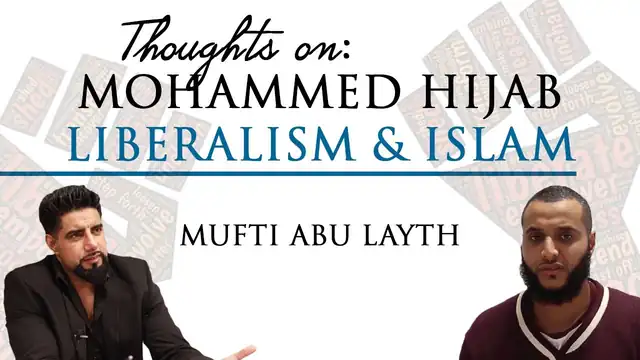 Play from 24:46
The video loads from YouTube only when you press play. Click a time in the transcript to seek.
Watch this part
Open on YouTube at 24:46The player starts at 24:46, the beginning of this part.
This segment24:46 to 29:52 · 5 min 06 sGeneral teaching
What this part covers
machinesummary, machine-writtenMufti Abu Layth argues that if ethics do not develop over time and only seventh-century ethics count, one would have to say slavery is fine, since the Quran acknowledged its ubiquity without abolishing it at the time, which he calls ridiculous. He says people hold liberal attitudes without having read Locke or Rousseau, being capable agents, not automatons. By the lecture's logic, he says, everything in Islam first championed by others would belong to them, as Socrates and Plato spoke of God and the soul first, which he calls an infantilising theory. He gives his own opposition to capital punishment, shared by most people in Europe, as an example of a view held without allegiance to Rousseau, Locke, Bentham or Bertrand Russell.
Position stated
Mufti Abu Layth says that human beings are very capable agents who construct their worldview as they go along, not people who adopt views because they read philosophers.
“human beings we are very capable agents we are constructing our worldview as we going along”
Category: teaching
Kind: general teachingTranscript
machine24:46 to 29:52 · click a time to seek · dotted terms open the glossary
if we just be honest let's put our biases aside they have kind of arrived at ethics without God so I disagree strongly with this kind of derision of saying oh well you couldn't do it without Scripture you couldn't do it without Scripture you could because Scripture was just remember what I said it was the key and if it was just I mean the kidsong sorry hypothesis that it was just what society already had anyway so yeah so I thought that was quite important to to emphasize
that the other thing was that if we were to take the example of let's say ethics from if we were to reject that human beings continue to develop in ethics then by that example Mohammed a job would have to accept if he denied that he would have to accept the slavery today's his is fine but there's nothing wrong with slavery because in the 7th century slavery existed so when the Quran was revealed slavery was ubiquitous it was everywhere and the
Quran acknowledged its ubiquitous nature he just kind of just took it as a given and is carried on it didn't kind of really address the issue because it knew that to address the issue right now wouldn't be the time to address it so if you are to claim that our morality does not develop over time and ethics do not evolve then and we must only go by the ethics that existed in the 7th century then today you'd have to argue that slavery is fine you may say it's illegal
but it's fine like if I to enslave another human being it's nothing ethically wrong with that on a morally wrong with that on a personal basis level you might say well society doesn't accept it but I think personally it's fine you'd have to argue that which i think is once again ridiculous so so these things robbing the agency from individuals individuals don't think like that you see when a person has a liberal attitude today that he doesn't want he doesn't like people being authoritarian that doesn't mean you have that attitude
because you read a ton of books by John Locke and it doesn't mean that you have that attitude because you've been reading jean-jacques Rousseau I mean you may have but most people haven't been reading jean-jacques Rousseau and they haven't been reading these kind of philosophers they just have that feeling and they have that understanding they're not automatons they can't think for themselves the the other issue would be that if you took this if you took this principle then that's to say everything
in Islam that was first championed by other people must belong to them and we must honor them so that's like saying because Aristotle because Socrates spoke of God in the soul before Islam did therefore if we speak of the soul we have to believe in what Socrates said now we have to acknowledge everything goes back to Socrates and to Plato because they spoke about it before we did so I mean but this is a seal this is a theory that infantilizes it treats human beings like infants it's not true
that human beings we are very capable agents we are constructing our worldview as we going along so normal so you can stop a person on the street and he will be against certain matters like I'm against capital punishment if you stop people in England most people sane people thank Hut and in Europe thank God sane people are against capital punishment if you stop somebody on the street and ask them would you agree with capital punishment they will say no is
that because they've read jean-jacques Rousseau or is that because they agree 100% with John Locke or is it have they been you know pondering over the arguments presented by Jeremy Bentham and of course not most people have many people make some people may know who these people are other people may not even know who these people are but they on these aspects so for me to reject death penalty today and you know if you're gonna find a philosopher that
rejected it let's say Bertrand Russell if you're gonna say well Bertrand Russell kind of rejected that as well I'd say well great awesome rock on but does that mean now I have to agree with everything Bertrand Russell said and for you to find something that Bertrand Russell had said and catch me out on it absolutely not absolutely not so this was an important factor the other thing was that there was this huge discussion that Muhammad hijab had about the death penalty and he said well look
Paragraphs overlapping 24:46 to 29:52. Full text on the recording page.
Cite this segment
Stable id, transcript version and tier are part of the citation. Every change to a transcript is logged.Mufti Abu Layth Archive, segment 2019-08-04-S05, auto-transcribed, may contain errors. https://muftiabulayth.org/r/j6pxwgpnwd0/s/5/ (accessed 1 November 2026)
- APA 7
Mufti Abu Layth. (2019, August 4). Ethics evolve: slavery, human agency and the genetic fallacy [Video, segment 2019-08-04-S05, auto-transcribed, may contain errors]. Mufti Abu Layth Archive. Retrieved November 1, 2026, from https://muftiabulayth.org/r/j6pxwgpnwd0/s/5/
- Chicago author-date
Mufti Abu Layth. 2019. "Ethics evolve: slavery, human agency and the genetic fallacy." Video, segment 2019-08-04-S05, auto-transcribed, may contain errors. Mufti Abu Layth Archive. Recorded August 4, 2019. Accessed November 1, 2026. https://muftiabulayth.org/r/j6pxwgpnwd0/s/5/
- BibTeX
@misc{abulayth-2019-08-04-S05,
  author = {Mufti Abu Layth},
  title = {{Ethics evolve: slavery, human agency and the genetic fallacy}},
  year = {2019},
  month = {8},
  date = {2019-08-04},
  howpublished = {\url{https://muftiabulayth.org/r/j6pxwgpnwd0/s/5/}},
  url = {https://muftiabulayth.org/r/j6pxwgpnwd0/s/5/},
  organization = {Mufti Abu Layth Archive},
  urldate = {2026-11-01},
  note = {Segment 2019-08-04-S05, auto-transcribed, may contain errors}
}
Something wrong here?
Tell us what is wrong and it will be checked against the recording. Nothing changes until a person has reviewed it.
Sending a note needs JavaScript, which is off or unavailable in this browser. Nothing has been sent.
No name, email address or account is asked for or stored, and the inbox does not store your IP address. For rate limiting it keeps an unreadable fingerprint of your connection for 48 hours, and our database provider's own logs record connections as every website's do. Only your note, its kind, the page and the moment in the recording are kept, for review.