
Recordings › Thoughts on Muhammad Hijab's talk on Liberalism & Islam | Mufti Abu Layth · 4 Aug 2019 › Segment 4 of 7
Can people be moral without religion?
muftis koran quraan al-quran hijaab hejab hijabi amanah amana amaanah amanat deen al-din ad-deen ad-dinCan humans have morality without scripture?
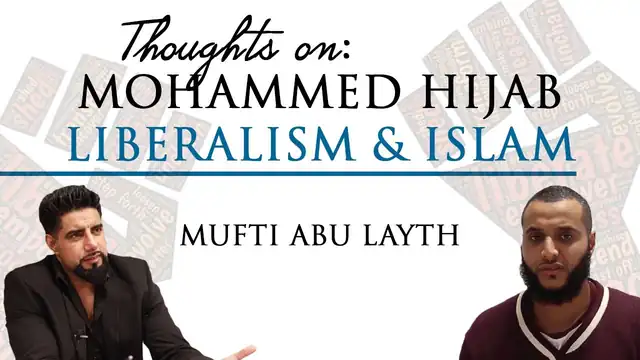 Play from 19:02
The video loads from YouTube only when you press play. Click a time in the transcript to seek.
Watch this part
Open on YouTube at 19:02The player starts at 19:02, the beginning of this part.
This segment19:02 to 24:46 · 5 min 44 sGeneral teaching
What this part covers
machinesummary, machine-writtenYes: humans know that killing is wrong without scripture, which came to reinforce it, and secular European societies have reached ethics without God. He strongly disagrees with deriding that.
In more detail
Mufti Abu Layth says the lecture over-relies on removing human agency by claiming that without religion there would be no morality. He accepts that most laws, such as English common law, have a Judeo-Christian heritage, but says humans would know killing is wrong without scripture, noting that primates such as chimpanzees have a basic sense of justice, and that the commandment 'thou shalt not kill' came to reinforce what people already knew. He says largely secular European societies have arrived at ethics without God that, though not perfect, seem more ethical than the Muslim world, giving his own embarrassment that he would trust a non-Muslim car seller over a Muslim one and saying Muslim countries are heavily corrupt. He says he strongly disagrees with deriding the idea that people could reach ethics without scripture.
Position stated
Mufti Abu Layth says human beings knew killing was wrong without scripture, and the commandment came only to reinforce it.
“of course they knew that to kill was wrong the commandment simply came as a reinforcement”
Category: teaching
Kind: general teachingTranscript
machine19:02 to 24:46 · click a time to seek · dotted terms open the glossary
so this incest rule is not found nate I'm not saying it's never found and hence it's found in humans as well but it's not it's not generally found so if you were to use the term it's not natural that's fine it's not commonly or not generally found in nature it may be found as a kind of odd occurrence and that's fine so this was another point that that Muhammad hijab had kind of made heavily relying on this the other thing I'd like to clarify is you see
there is an over-reliance on removing agency from people in kind of assuming that human beings don't think of things for themselves so I'm at hijab kept referring throughout this lecture to people that look when you say this your rules your laws are based in religion without that you wouldn't have had a morality and it is true that look most laws throughout the world are archaically you're classically based on some kind of religion that is true like
so let's say within the UK these laws common laws and the well the common laws were based on a judeo-christian kind of heritage unquestionably as it was throughout Europe and other places and but human beings do not need let's just be honest because he touched up on a discussion of saying that there would be no morality otherwise if he didn't have that you'd have nothing because he's saying that you're basing it on these people who were anchored in religion that's why they came up with it but the truth is human beings would know that to kill is
wrong they wouldn't need in all honesty they wouldn't need to be told that by scripture as the only method of discerning that it's wrong how do we know that well we know that through nature primates have a sense of morality that is a much lower sense than than us but they have a sense of justice so chimpanzees will retaliate they understand a sense of justice they understand that being attacked is what what is right what is wrong they understand these concepts at a very low
level I mean at a primate level they do have is these if we want to call them concepts or instincts the morality instinct at that low level it exists in nature it's not something that so for example this gives the assumption that human beings are totally dumb like human beings had no idea that the kill was wrong until the the commandment came that thou shalt not kill and then human being said ah oh we shouldn't kill that's stupid
of course they knew that to kill was wrong the commandment simply came as a reinforcement they knew that anyway the commandments came to tell them that to reinforce the the significance and and how sacred this law is that's all they didn't mean that if the commandment was never revealed people had no idea they would just go around killing each other Oh have I done something wrong I didn't realize that's that's absurd human beings of course
we can decipher these things right so to say that rook we have if there was no if there was if you were to remove scripture human beings would not have any morality that is a flawed argument and if we're to be honest if were to just observe the world as it is today most European societies which are definitely secular have arrived I mean I'm not saying they've arrived on a perfect ethics but they've arrived at
ethics without God if we're to be honest and their ethics definitely seem to be much more ethical than the Muslim world if we're gonna be honest like let's just be honest about that you and I gave the example to somebody the other day I said look let's just be honest like if I'm in the UK if I found if I'm going to buy a car and I have an option of buying it from an English guy a white guy and I have an option of buying it from a Muslim and this is very unfortunate to say this but I'm gonna end up choosing because I'm gonna think mmm
Muslims I know that something's gonna be dodgy with that car I mean I'm embarrassed to say that but that is unfortunately the reality on the ground that we we know that we are very dodgy in many things we don't have a good sense of ethics and that's being born and raised here in the Muslim countries they totally don't we don't trust it we don't trust things in the Muslim country let's be honest it's heavily corrupt if you went to Pakistan you wouldn't know trust what's got me so
if we just be honest let's put our biases aside they have kind of arrived at ethics without God so I disagree strongly with this kind of derision of saying oh well you couldn't do it without Scripture you couldn't do it without Scripture you could because Scripture was just remember what I said it was the key and if it was just I mean the kidsong sorry hypothesis that it was just what society already had anyway so yeah so I thought that was quite important to to emphasize
that the other thing was that if we were to take the example of let's say ethics from if we were to reject that human beings continue to develop in ethics then by that example Mohammed a job would have to accept if he denied that he would have to accept the slavery today's his is fine but there's nothing wrong with slavery because in the 7th century slavery existed so when the Quran was revealed slavery was ubiquitous it was everywhere and the
Paragraphs overlapping 19:02 to 24:46. Full text on the recording page.
Cite this segment
Stable id, transcript version and tier are part of the citation. Every change to a transcript is logged.Mufti Abu Layth Archive, segment 2019-08-04-S04, auto-transcribed, may contain errors. https://muftiabulayth.org/r/j6pxwgpnwd0/s/4/ (accessed 1 November 2026)
- APA 7
Mufti Abu Layth. (2019, August 4). Can people be moral without religion? [Video, segment 2019-08-04-S04, auto-transcribed, may contain errors]. Mufti Abu Layth Archive. Retrieved November 1, 2026, from https://muftiabulayth.org/r/j6pxwgpnwd0/s/4/
- Chicago author-date
Mufti Abu Layth. 2019. "Can people be moral without religion?" Video, segment 2019-08-04-S04, auto-transcribed, may contain errors. Mufti Abu Layth Archive. Recorded August 4, 2019. Accessed November 1, 2026. https://muftiabulayth.org/r/j6pxwgpnwd0/s/4/
- BibTeX
@misc{abulayth-2019-08-04-S04,
  author = {Mufti Abu Layth},
  title = {{Can people be moral without religion?}},
  year = {2019},
  month = {8},
  date = {2019-08-04},
  howpublished = {\url{https://muftiabulayth.org/r/j6pxwgpnwd0/s/4/}},
  url = {https://muftiabulayth.org/r/j6pxwgpnwd0/s/4/},
  organization = {Mufti Abu Layth Archive},
  urldate = {2026-11-01},
  note = {Segment 2019-08-04-S04, auto-transcribed, may contain errors}
}
Something wrong here?
Tell us what is wrong and it will be checked against the recording. Nothing changes until a person has reviewed it.
Sending a note needs JavaScript, which is off or unavailable in this browser. Nothing has been sent.
No name, email address or account is asked for or stored, and the inbox does not store your IP address. For rate limiting it keeps an unreadable fingerprint of your connection for 48 hours, and our database provider's own logs record connections as every website's do. Only your note, its kind, the page and the moment in the recording are kept, for review.