
Recordings › Thoughts on Muhammad Hijab's talk on Liberalism & Islam | Mufti Abu Layth · 4 Aug 2019 › Segment 2 of 7
What is liberalism, and do liberals have to follow John Locke?
malik ibn anas malik bin anas imam maalik imam malik ibn anas imaam imams prayer leader hanafite hanafiyyah hanafi school muftis jahannam jahanam jahannum shiah shiite shi'i twelver ithna ashari hijaab hejab hijabi deen al-din ad-deen ad-dinLiberalism is a stance against authoritarianism, not allegiance to Locke
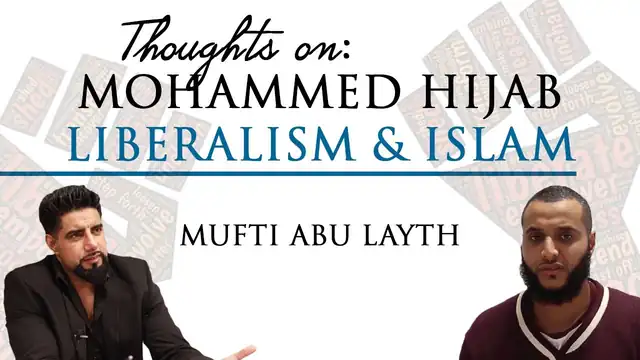 Play from 6:24
The video loads from YouTube only when you press play. Click a time in the transcript to seek.
Watch this part
Open on YouTube at 6:24The player starts at 6:24, the beginning of this part.
This segment6:24 to 12:43 · 6 min 19 sGeneral teaching
What this part covers
machinesummary, machine-writtenLiberalism is essentially a stance against authoritarianism, not allegiance to historical philosophers. Agreeing with Locke on one point does not make anyone a Christian or bind them to his whole philosophy.
In more detail
Mufti Abu Layth says liberalism is, in essence, simply a stance or sentiment against authoritarianism. He says Mohammed Hijab spent much of the lecture on historical figures such as John Locke, Thomas Hobbes and Rousseau, arguing that they were Christians who grounded rights in God, and that the term human rights barely existed before the United Nations charter of the 1940s, so a liberal who rejects their religion is a hypocrite. He calls this the worst kind of reasoning he has seen outside religion, since holding a view against authoritarianism that Locke also held does not make one a Christian, nor bind one to all of Kantian philosophy. He calls this a fallacy that people like Mohammed Hijab often resort to with non-Muslims.
Position stated
Mufti Abu Layth says liberalism is, in essence, simply a stance against authoritarianism.
“liberalism is simply a stance against authoritarianism that's all it is in essence”
Category: teaching
Kind: general teachingTranscript
machine6:24 to 12:43 · click a time to seek · dotted terms open the glossary
I've got you so even if that person says yeah but I don't really follow no no no what do you mean you don't follow the Imam Miceli it's in the cafe's if it's against the shia or it's you know it's in the madonna by imam malik oh it's in red dorm at ry the Hanafi so what we do is we argue from an angle of compelling Authority compelling leadership so Muhammad hijab was using this tactic okay against liberties that doesn't make any sense because outside of religion
people don't see the world like that okay so you have to understand that people don't this they don't feel that they compel to some kind of Allegiance this is to begin with so what maja a job did in this lecture he began a thorough part of this lecture a huge part of this was dedicated to to the figureheads of historical liberalism so what does liberalism mean although
muhammad hijab didn't really I mean he just touch upon it to be fair but just just to explain liberalism is simply a stance against authoritarianism that's all it is in essence so it is a trend if you want to say trend it is a feeling a sentiment that you do not like others being authoritarian it is the resistance okay that is what liberalism in essence
is in essence now what muhammad hijab did is we focused on people like john locke who's had a historical figures had a huge hundreds of you know from the into the 18th century where he's argued about liberalism in his day and age that why you should have what does it mean to have rights the rights of properties a fundamental fundamental intrinsic human right that we have this should be preserved and so john locke is optically made invaluable contributions not saying
he hasn't but yes so how many have spent a a considerable amount of time explaining this that look john locke or what they john locke based this upon john locke himself was a christian so he based it upon what he believed was God empowered these rights what did Thomas Hobbes based his theories on on the that he was a Christian what did so he spends a considerable amount of time speaking about philosophers from a few hundred years ago who in essence were Christian most of them someone but mo
and then he argues that they enshrined this ability to have rights in religion which they may have I mean I'm not arguing against that I'm not saying that's not true he then spent a considerable amount of time saying that the human rights charter that has been drawn up by the United Nations which is called human rights is a this is a kind of modern term which he says look if you search the internet and he brings up some charts it didn't exist before the 1940s I mean there's very little mention
of human rights people refer to these things as naturalistic rights and human rights you know they it's only being since the UN and this is fundamentally a continuation of John Locke and Hobbes and Rousseau and all these people from the 17th century in the 18th century who were Christians so today and this is and this follow Locke and Rousseau and Thomas Hobbes and all these people all you are just a hypocrite and you cannot actually claim to be a
liberal I mean this is absurd that is the worst kind of reasoning that I've ever seen I mean I've seen it being used in religion but that is ridiculous and preposterous and to use that kind of reasoning when debating matters of trends of politics and life and viewpoints against Authority to use these kind of things it makes no sense that oh just because I believe in that
they shouldn't be authoritarianism and this view was also echoed by John Locke I must now be a Christian because John Locke's ad der rebe that's ridiculous so this so that's one very important file see that needs to be highlighted unfortunately you'll see these kind people like Muhammad hijab and other people resort to this quite often we're speaking about non-muslims they will they will use religious debate tactics which the world doesn't abide by I mean
it makes no sense in the real world these sectarian debates sectarian rules of polemics sectarian rules of debate that are but you're speaking of a liberalism John Locke spoke for liberalism can't spoke for liberalism so you must by necessity either uphold all of Kantian philosophy or you have no claim to liberalism uh I don't think so make a claim whatever the hell I want it doesn't make any sense like why do I
need to abide by what if Kantian philosophy I think I'm not saying it's so problematic but why do i why am I even bound by that this may you see so this is one fallacy that needed to be pointed out right so the the other thing is that so during the during the lecture
do during the lecture Mohammed hijab makes reference to many people they will say today things like oh if you claim to be a liberal so he says that look many people will say today that look oh okay but I still have concerns what's wrong with homosexuality what's wrong with these things you know why don't we you know people in causing harm they're not doing anything and he says well you know we say to these people these are unnatural istic and so on I just want to make a I'd like to make a point here let me see I don't
Paragraphs overlapping 6:24 to 12:43. Full text on the recording page.
Cite this segment
Stable id, transcript version and tier are part of the citation. Every change to a transcript is logged.Mufti Abu Layth Archive, segment 2019-08-04-S02, auto-transcribed, may contain errors. https://muftiabulayth.org/r/j6pxwgpnwd0/s/2/ (accessed 1 November 2026)
- APA 7
Mufti Abu Layth. (2019, August 4). What is liberalism, and do liberals have to follow John Locke? [Video, segment 2019-08-04-S02, auto-transcribed, may contain errors]. Mufti Abu Layth Archive. Retrieved November 1, 2026, from https://muftiabulayth.org/r/j6pxwgpnwd0/s/2/
- Chicago author-date
Mufti Abu Layth. 2019. "What is liberalism, and do liberals have to follow John Locke?" Video, segment 2019-08-04-S02, auto-transcribed, may contain errors. Mufti Abu Layth Archive. Recorded August 4, 2019. Accessed November 1, 2026. https://muftiabulayth.org/r/j6pxwgpnwd0/s/2/
- BibTeX
@misc{abulayth-2019-08-04-S02,
  author = {Mufti Abu Layth},
  title = {{What is liberalism, and do liberals have to follow John Locke?}},
  year = {2019},
  month = {8},
  date = {2019-08-04},
  howpublished = {\url{https://muftiabulayth.org/r/j6pxwgpnwd0/s/2/}},
  url = {https://muftiabulayth.org/r/j6pxwgpnwd0/s/2/},
  organization = {Mufti Abu Layth Archive},
  urldate = {2026-11-01},
  note = {Segment 2019-08-04-S02, auto-transcribed, may contain errors}
}
Something wrong here?
Tell us what is wrong and it will be checked against the recording. Nothing changes until a person has reviewed it.
Sending a note needs JavaScript, which is off or unavailable in this browser. Nothing has been sent.
No name, email address or account is asked for or stored, and the inbox does not store your IP address. For rate limiting it keeps an unreadable fingerprint of your connection for 48 hours, and our database provider's own logs record connections as every website's do. Only your note, its kind, the page and the moment in the recording are kept, for review.