
Recordings › Karbala & it's precursors | Mufti Abu Layth · 16 Oct 2020 › Segment 6 of 18
Why did the Muslims fight each other at Siffin?
muftis khalifah khalifa caliph khulafa khilafah khilafat khilafaAli's caliphate, the Umayyad governors, and the civil war to Siffin
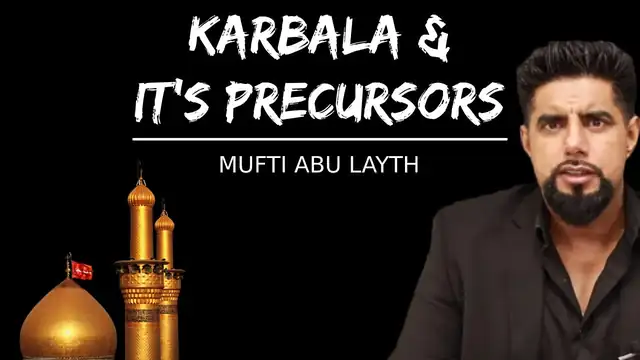 Play from 21:33
The video loads from YouTube only when you press play. Click a time in the transcript to seek.
Watch this part
Open on YouTube at 21:33The player starts at 21:33, the beginning of this part.
This segment21:33 to 24:18 · 2 min 45 sGeneral teaching
What this part covers
machinesummary, machine-writtenWhen Ali tried to remove Uthman's Umayyad governors the old rivalry flared into civil war, and Mufti Abu Layth calls Siffin the point of no return that left Muslims forever divided.
In more detail
Mufti Abu Layth says that after the murder of Uthman the rebels pledged allegiance to Ali, who first declined and then accepted. He says Ali found that the governors everywhere, in Damascus, Egypt, Africa, Iraq and Yemen, were of Banu Umayya, who demanded that Uthman's murder be dealt with, and that his attempt to remove them was taken as an open declaration of hostility, setting the old rivalry alight. Civil war followed, including the battle between Ali and Aisha, which he says had nothing to do with the clans, and then the intense battle of Siffin against Muawiya, which he calls a point of no return after which the Muslims became forever divided. He describes the arbitration that went wrong, proposing to remove everyone from power, and Ali's martyrdom before it could meet again.
Position stated
Mufti Abu Layth says the battle of Siffin was a point of no return for Muslim history, after which the Muslims became forever divided.
“And it ends up with a kind of um it is a point of no return for Muslim history. Because here you the Muslims become forever divided.”
Category: historical claim
Kind: general teachingTranscript
machine21:33 to 24:18 · click a time to seek · dotted terms open the glossary
And he's already established there as a governor. So, Bani Umayya are quite powerfully in control. And this obviously triggers problems and then people complained about Uthman as well. People said he wasn't doing this right, he wasn't doing that right. But, I mean I'm you know, I'm not we can't discuss all everything that has its own you know, has to be judged on its own merit. But, the point is Bani Bani Umayya are now in very powerful positions.
Now, you fast forward to the martyrdom of Uthman. What happens is the rebels who take over um they eventually pledge their allegiance with Ali. They all want. Now, Ali takes the the the allegiance eventually. So, initially he declined, but then he takes it.
Now, what what he realizes is the powerhouses everywhere like in Damascus, in Egypt, in Africa, in Iraq, in Yemen, everywhere the power the governors the rulers are all Bani Umayya. So, they are going to be incredibly annoyed because they are going to say that Uthman's been murdered and we need to deal with that.
And so at this stage there's certain things that happen. And Ali tries to depose them, remove them from their positions. This to them becomes an outright declaration of animosity. So, it you the fuel is is set alight.
That old rivalry of Bani Hashim and Bani Umayya is is absolutely alive and kicking. So, what follows are some more tragedies, some wars, some infighting amongst Muslims, the civil war, the the battle between Ali and Aisha and her. Although that didn't really have anything to do with Bani Umayya and Bani Hashim, but that was still the the kind of civil war Ali ends up in.
And then the battle of Siffin against Muawiyah. Now, this was a very intense battle. Many Muslim lives were lost. And it ends up with a kind of um it is a point of no return for Muslim history. Because here you the Muslims become forever divided.
And what should they be doing? And they do set an arbitration which still kind of goes goes wrong. Uh they set some people who eventually say, "Okay, we're going to remove everyone from power. We remove Ali, we remove Muawiyah, we remove everyone. We're going to meet again and then we'll decide." And then before they can meet again uh Ali is martyred.
So, and there's an attempt to martyr Muawiyah as well, but it's unsuccessful. And then Ali's son Hassan is given rulership. So, Hassan you know, in my understanding I not I my opinion of Hassan and it very high opinion of Hassan. It may appear very controversial to certain people, but I actually feel out of all the you know, out of the three out of Ali and his two sons Hassan and Hussein, I feel that Hassan out of all three was
Paragraphs overlapping 21:33 to 24:18. Full text on the recording page.
Cite this segment
Stable id, transcript version and tier are part of the citation. Every change to a transcript is logged.Mufti Abu Layth Archive, segment 2020-10-16-S06, auto-transcribed, may contain errors. https://muftiabulayth.org/r/iabl5vis3rg/s/6/ (accessed 1 November 2026)
- APA 7
Mufti Abu Layth. (2020, October 16). Why did the Muslims fight each other at Siffin? [Video, segment 2020-10-16-S06, auto-transcribed, may contain errors]. Mufti Abu Layth Archive. Retrieved November 1, 2026, from https://muftiabulayth.org/r/iabl5vis3rg/s/6/
- Chicago author-date
Mufti Abu Layth. 2020. "Why did the Muslims fight each other at Siffin?" Video, segment 2020-10-16-S06, auto-transcribed, may contain errors. Mufti Abu Layth Archive. Recorded October 16, 2020. Accessed November 1, 2026. https://muftiabulayth.org/r/iabl5vis3rg/s/6/
- BibTeX
@misc{abulayth-2020-10-16-S06,
  author = {Mufti Abu Layth},
  title = {{Why did the Muslims fight each other at Siffin?}},
  year = {2020},
  month = {10},
  date = {2020-10-16},
  howpublished = {\url{https://muftiabulayth.org/r/iabl5vis3rg/s/6/}},
  url = {https://muftiabulayth.org/r/iabl5vis3rg/s/6/},
  organization = {Mufti Abu Layth Archive},
  urldate = {2026-11-01},
  note = {Segment 2020-10-16-S06, auto-transcribed, may contain errors}
}
Something wrong here?
Tell us what is wrong and it will be checked against the recording. Nothing changes until a person has reviewed it.
Sending a note needs JavaScript, which is off or unavailable in this browser. Nothing has been sent.
No name, email address or account is asked for or stored, and the inbox does not store your IP address. For rate limiting it keeps an unreadable fingerprint of your connection for 48 hours, and our database provider's own logs record connections as every website's do. Only your note, its kind, the page and the moment in the recording are kept, for review.