
Recordings › Karbala & it's precursors | Mufti Abu Layth · 16 Oct 2020 › Segment 2 of 18
Who were the Shia who invited Husayn to Kufa?
muftis sahabah sahaba sahabiyyah sahabiyat companions khalifah khalifa khulafa khilafah khilafat caliphate khilafa sunni ahl al-sunnah ahl as-sunnah ahlus sunnah ahl al-sunna shiah shiite shi'i twelver ithna ashari fitnah fitna fitan strifeThe journey to Kufa: who the early Shia were and the interception at Karbala
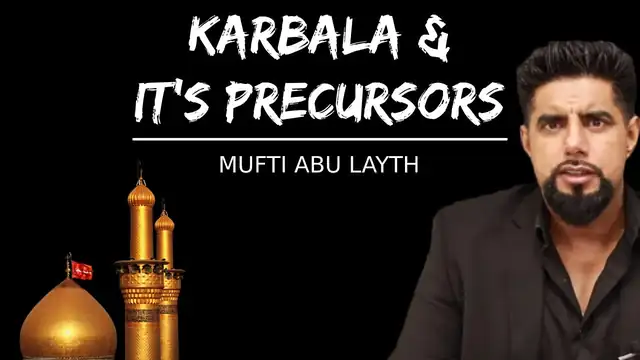 Play from 1:50
The video loads from YouTube only when you press play. Click a time in the transcript to seek.
Watch this part
Open on YouTube at 1:50The player starts at 1:50, the beginning of this part.
This segment1:50 to 6:25 · 4 min 35 sGeneral teaching
What this part covers
machinesummary, machine-writtenThe Shia who invited Husayn to Kufa were a political faction favouring Ali, not today's sect; a force of perhaps a couple of hundred under Umar ibn Sa'd intercepted him at Karbala.
In more detail
Mufti Abu Layth describes Husayn travelling to Kufa with some seventy men, as well as women and children, because he had been invited by the Shia. He distinguishes the sect of Shia today, a theological group, from the Shia of early Islam, which he says was mainly political, those who favoured Ali, with only a theological undertone. He calls Karbala an eruption of pressures long building up, and notes that the name evokes karb, pain, and bala, trial. He says Husayn was intercepted on the way by a force that some Shia sources describe as vast, which he calls a fabrication, assuming it was a couple of hundred men, led by Umar ibn Sa'd ibn Abi Waqqas, son of the great companion, in the time of Yazid, with Ubaydullah ibn Ziyad as governor of Kufa. He then pauses the story to go back in time to its causes.
Position stated
Mufti Abu Layth says that in early Islam Shia was more a political than a theological thing, meaning those who favoured Ali.
“In early Islam, Shi'a was more a political thing. It wasn't a theological thing. There was slight There was a undertone theological undertone, but it was really political. So, it was about those people who favored Ali.”
Category: historical claim
Kind: general teachingTranscript
machine1:50 to 6:25 · click a time to seek · dotted terms open the glossary
I mean, that that's I don't think any Muslim, generally speaking, I'm going for the most part, uh would ever disagree on that. Okay? The events of Karbala are pretty much I mean, for for the most part, the in summation, like looking at the the kind of huge the major events of it are are known.
Okay? There are minor details that there is a a disagreement about. So, briefly, what is it that's happened for those people that don't know? Well, what happens, and I will go back to the pre- to the precursor, but let's look at this stage, Hussein radiyallahu anhu is traveling with maybe they say about 70 odd people with him who are men, and and then women separately and children.
They're traveling. He's on his way to Kufa. Why is he going there? He's going there because he uh has been invited by the Shi'a. Okay? Now, the Shi'a are You see, the Shi'a are of two types, by the way. Like, when I when I use the word Shi'a, Shi'a can mean two things. It's the sect today that you have, like the Shi'a as opposed to the Sunnis.
This is a theological Shi'a. This is somebody who has a particular sectarian belief. They believe certain things. They I I don't mean it necessarily like that. In early Islam, Shi'a was more a political thing. It wasn't a theological thing. There was slight There was a undertone theological undertone, but it was really political. So, it was about those people who favored Ali.
And this lies in with all the precursors that we'll briefly look at as well. That the build-up because Karbala is really a kind of a blowing point, an eruption of so many things that have so much pressure that has been building up. Okay?
So, in this in this event of Karbala And you know, it's interesting, the name Karb actually means like pain, like a suffering. And Bala, a test. Okay? So, even though the the name doesn't actually mean, but it that's what it is, Karbun wa Bala. It is just a tragedy of pain and suffering.
So, Hussein radiyallahu anhu took his family over there. What he was going there because the people of Iraq had invited him to come over so they can give him the Shi'a of of his time. Uh that means the political Shi'a of his time had invited him to Kufa, and they were going to give him a pledge of allegiance.
Right. And what happens is he is intercepted uh en route at the place of Karbala by an army. When I mean, to be Okay, in in in the generals When I say army, it wasn't like I know sometimes some Shi'a sources say they were a massive army as huge as the Roman army, and I don't I think these are just huge fabrications, but they I assume were a couple of hundred people.
So, it was like that kind of a a battalion that had been sent out to intercept them. And they did intercept them. It had uh it was led by Umar uh ibn Sa'd ibn Abi Waqqas. So, the son of the great Sahabi. The son of the great Sahabi. Now, he It was dispatched This is in the time of Yazid.
And we have to stop these events here. Right? Because what happens is at this place, Hussein is martyred. We've got to slightly go back in time to understand what is going on here. Why is Hussein going here? What is Yazid is in Damascus. He's the governor not the governor, he's the ruler, the caliph uh of of the Muslims at the time.
Uh you've got another governor uh who he has set called uh Ubayd in Kufa, who's dispatched this army. What is What is all of this about? So, we have to pause this and go back. People, there has been some nastiness in in Muslim politics, okay? But that's that's the norm in old politics.
This thing about Rajniti, about Siyasa, is it it's problematic massively. And the truth is that really, the roots of Karbala are way before Islam. They start with a kind of rivalry that begins with two clans of Quraysh.
Paragraphs overlapping 1:50 to 6:25. Full text on the recording page.
Cite this segment
Stable id, transcript version and tier are part of the citation. Every change to a transcript is logged.Mufti Abu Layth Archive, segment 2020-10-16-S02, auto-transcribed, may contain errors. https://muftiabulayth.org/r/iabl5vis3rg/s/2/ (accessed 1 November 2026)
- APA 7
Mufti Abu Layth. (2020, October 16). Who were the Shia who invited Husayn to Kufa? [Video, segment 2020-10-16-S02, auto-transcribed, may contain errors]. Mufti Abu Layth Archive. Retrieved November 1, 2026, from https://muftiabulayth.org/r/iabl5vis3rg/s/2/
- Chicago author-date
Mufti Abu Layth. 2020. "Who were the Shia who invited Husayn to Kufa?" Video, segment 2020-10-16-S02, auto-transcribed, may contain errors. Mufti Abu Layth Archive. Recorded October 16, 2020. Accessed November 1, 2026. https://muftiabulayth.org/r/iabl5vis3rg/s/2/
- BibTeX
@misc{abulayth-2020-10-16-S02,
  author = {Mufti Abu Layth},
  title = {{Who were the Shia who invited Husayn to Kufa?}},
  year = {2020},
  month = {10},
  date = {2020-10-16},
  howpublished = {\url{https://muftiabulayth.org/r/iabl5vis3rg/s/2/}},
  url = {https://muftiabulayth.org/r/iabl5vis3rg/s/2/},
  organization = {Mufti Abu Layth Archive},
  urldate = {2026-11-01},
  note = {Segment 2020-10-16-S02, auto-transcribed, may contain errors}
}
Something wrong here?
Tell us what is wrong and it will be checked against the recording. Nothing changes until a person has reviewed it.
Sending a note needs JavaScript, which is off or unavailable in this browser. Nothing has been sent.
No name, email address or account is asked for or stored, and the inbox does not store your IP address. For rate limiting it keeps an unreadable fingerprint of your connection for 48 hours, and our database provider's own logs record connections as every website's do. Only your note, its kind, the page and the moment in the recording are kept, for review.