
Recordings › Should We Debate Quranists? | Mufti Abu Layth · 25 Oct 2021 › Segment 3 of 3
Should I debate Quranists?
salat salaah namaz prayer salaat namaaz as-salah al-salah salawat fiqah jurisprudence fikh hadeeth ahadith ahaadeeth hadis hadees ahaadith malik ibn anas malik bin anas imam maalik imam malik ibn anas imaam imams prayer leader muftis sunna sunnat sunan prophetic practice mawdu' mawdoo maudu mawdhu kufr kafir kaafir kufar kaafirun disbelief koran quraan al-quran ahl al-sunnah ahl as-sunnah ahlus sunnah ahl al-sunna sunnis shiah shiite shi'i twelver ithna ashari salafism wahabi wahhabism ummah umma ummat amanah amana amaanah amanat al-din ad-deen ad-din religionWhy arguing with Quranists achieves nothing, and seeing them with compassion
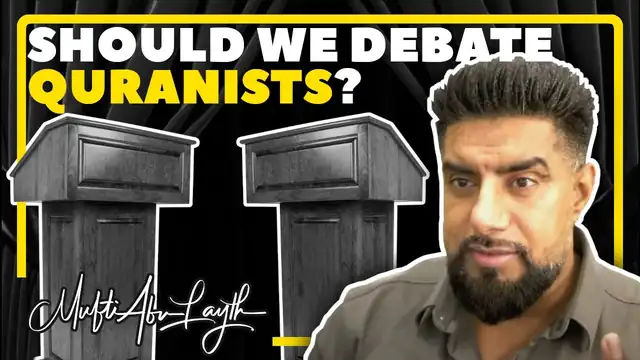 Play from 7:07
The video loads from YouTube only when you press play. Click a time in the transcript to seek.
Watch this part
Open on YouTube at 7:07The player starts at 7:07, the beginning of this part.
This segment7:07 to 12:52 · 5 min 45 sGeneral teaching
What this part covers
machinesummary, machine-writtenNo: arguing never changes anyone's mind and only breeds hatred, so give your view if asked and see Quranists with compassion. He finds their case weaker than they think, since fiqh was built on the living tradition, not on hadith.
In more detail
Mufti Abu Layth says that if a Quranist wants his view he will give it, but arguing gets nowhere: nobody has ever been argued into a belief, and humiliating someone in a debate may massage one's ego but leaves them hating you more. He cites Imam Malik's advice, when asked about debating over the sunnah, to answer if asked but not to argue. He says the Prophet looked at people through a lens of compassion, citing the report that he stood for the funeral of a Jewish woman and said it was a soul, and that Salafis, Shia, Quranists and others are each coming from a place of love for the deen. He explains the Quranist reasoning that because some hadith are certainly fabricated it is safer to discard them, and says they assume fiqh is built on hadith as it is today because of the Salafi movement, whereas before it fiqh was built on the living tradition, which he says is why Quranists did not exist in the past and why he does not find their argument as convincing as they think. He closes that they should not be bashed or humiliated.
Position stated
Mufti Abu Layth says he does not think debates really yield results, since humiliating someone in an argument only makes them hate you more.
“if it's a debate i don't think these really uh yield results”
Category: teaching
Kind: general teachingTranscript
machine7:07 to 12:52 · click a time to seek · dotted terms open the glossary
for 200 years were people not praying you see islam was taught from parent to child and in community and this is how it got transmitted by the living tradition and so this is how we learn things like salah this is how we learn things like song the main features of islam and people disagreed i get that wherever interpretation wherever there was interpretation people disagreed but this is how it was taught now i do uh advise and advocate to embrace the tradition of islam and i feel that this is the inherited tradition is not in that sense about these things corrupt it's not like the
five praise for example is not a corruption it's actually the living tradition but let's say if somebody didn't accept that if somebody said to me look mostly i don't accept any of this because i can't trust it and i feel you know the this kind of quran is as i'm assuming the archetypal kind of quran is now or the stereotypical sorry quranis i is he fine okay if they want my view i will give it but you see arguing doesn't get us anywhere because to be honest nobody has ever said in an argument oh wow you know what you beat me so bad in that argument i'm gonna believe you
that's never happened in human history all that happens is you can humiliate someone in an argument and what happens they just hate you even more okay you might win it like i might debate someone and i might be able to mesmerize them because of certain things and and run rings around them and humiliate them now i might win that so people might say wow you know mostly you know did a number on this guy blah blah blah and it serves my ego it really massages that but this person is just walked away hating my guts and hates everything that i stand for and that argument even more so this is why when imam malik was asked
shall we debate over the sunnah he said he said he said if you they ask you you just answer but don't argue over it don't cause it to become a a something that spreads this kind of animosity so that's for the arguing angle so i would say that you know it's not if somebody wants a genuine conversation that's fine and you could give your side they could give their side you could think about it they could think about it but if it's a debate i don't think these really uh yield results and and i get it look you know quranists uh in that stereotypical sense i get it
as well they too you know a lot of you see one of the problems is we don't look you know the prophet salallahu salem he looked at people through a lens of compassion it doesn't matter whether they were kuffar mushrikeen they were machusi nasarani yahoodi he understood that this is a human who's who's trying to come at it with some in his version of integrity you know that they brought the the dead body of the jewish woman who's going the prophet stood up out of and out of respect and they were like what's the prophet doing standing up jewish
the prophet looked and he said it's a soul you know where's your human compassion so the point is that you see you have to understand that even people who disagree with you salafi be they uh wahhabi will be they she are be they whatever group brill video when the jamaat islam whatever you want to see
they everybody in their own way is trying to come from a position of love for the deen and you have to understand the angle because once you see from compassion you realize okay i see where you come even if you feel they've missed the mark but you see they're not coming at it from this great propaganda to trick everyone whether they be salafi shia you know qurani anything they they are still coming at it from a place of love now the qurani quranist is coming at it from this angle that look
these because some hadith are definitely made up which some definitely are everybody knows that we've got books of fabricated hadith so therefore because there is doubt so the safe side is that let's not we can't attribute any of this to the prophet because there's too much doubt in all of this and this has been used as a power of manipulation and whatever etc etc etc and let's throw this all out and with it they've thrown out of most of them because they assume fit was also part of hadith or built on hadith as it is today because of the salafi movement
so you see but in the past it was never like this is why in the past where were the quranists in the past because pre this if you predate the salafia fek was never built from hadith it was built from the living tradition so you never had this argument so it's only with the selfies they start to build from hadith then people start to problematize the hadith and therefore say let's throw everything out the window so the argument isn't to me um it isn't as convincing as they think it is you see this is to me it isn't as convincing because to me there are many examples that i can show from philip
that it would be impossible for people sects that are so ad averse and adverse to each other like shia sunni to all agree on certain factors of fear that that would be impossible they hated each other unless this was the living tradition you know you triangulate it and you arrive at hmm i i get it now so but i do understand that look these people too are trying to come from a position of love so let's not you see it shouldn't be about trying to bash them you know let's get them in a corner and i want to bash them and humiliate them because that's that's going to make them just
hate this even more so yeah that's that's what i'd like to say i think it's important
Paragraphs overlapping 7:07 to 12:52. Full text on the recording page.
Cite this segment
Stable id, transcript version and tier are part of the citation. Every change to a transcript is logged.Mufti Abu Layth Archive, segment 2021-10-25-S03, auto-transcribed, may contain errors. https://muftiabulayth.org/r/ht0qjv5om9o/s/3/ (accessed 1 November 2026)
- APA 7
Mufti Abu Layth. (2021, October 25). Should I debate Quranists? [Video, segment 2021-10-25-S03, auto-transcribed, may contain errors]. Mufti Abu Layth Archive. Retrieved November 1, 2026, from https://muftiabulayth.org/r/ht0qjv5om9o/s/3/
- Chicago author-date
Mufti Abu Layth. 2021. "Should I debate Quranists?" Video, segment 2021-10-25-S03, auto-transcribed, may contain errors. Mufti Abu Layth Archive. Recorded October 25, 2021. Accessed November 1, 2026. https://muftiabulayth.org/r/ht0qjv5om9o/s/3/
- BibTeX
@misc{abulayth-2021-10-25-S03,
  author = {Mufti Abu Layth},
  title = {{Should I debate Quranists?}},
  year = {2021},
  month = {10},
  date = {2021-10-25},
  howpublished = {\url{https://muftiabulayth.org/r/ht0qjv5om9o/s/3/}},
  url = {https://muftiabulayth.org/r/ht0qjv5om9o/s/3/},
  organization = {Mufti Abu Layth Archive},
  urldate = {2026-11-01},
  note = {Segment 2021-10-25-S03, auto-transcribed, may contain errors}
}
Something wrong here?
Tell us what is wrong and it will be checked against the recording. Nothing changes until a person has reviewed it.
Sending a note needs JavaScript, which is off or unavailable in this browser. Nothing has been sent.
No name, email address or account is asked for or stored, and the inbox does not store your IP address. For rate limiting it keeps an unreadable fingerprint of your connection for 48 hours, and our database provider's own logs record connections as every website's do. Only your note, its kind, the page and the moment in the recording are kept, for review.