
Recordings › Karbala & it's precursors | Mufti Abu Layth · 16 Oct 2020 › Segment 16 of 18
Was Yazid a kafir, and is it right to curse him?
malik ibn anas malik bin anas imam maalik imam malik ibn anas imaam imams prayer leader muftis mubah mubaah kufr kuffar kaafir kufar kaafirun disbelief jahannam jahanam jahannum hijra hijrat hijri migration shiah shiite shi'i twelver ithna ashari ulema ulamaaDoes he absolve Yazid? A tyrant, but not a kafir, and not to be cursed
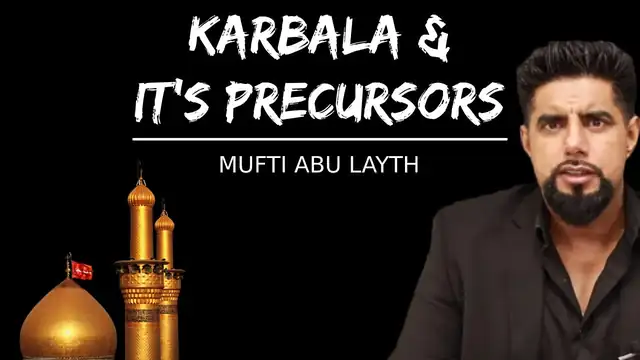 Play from 56:51
The video loads from YouTube only when you press play. Click a time in the transcript to seek.
Watch the answer
Open on YouTube at 56:51The player starts at 56:51, where the answer begins.
This segment56:51 to 1:00:00 · 3 min 09 sGeneral teaching
The answer in brief
machinesummary, machine-writtenNo: Mufti Abu Layth calls Yazid a wretched, arrogant tyrant, but he does not call him a kafir or curse him, since he rejects a culture of cursing. He can believe Yazid would not have killed Husayn himself.
In more detail
Mufti Abu Layth reads a viewer's question asking whether he absolves Yazid. He says he does not: he feels Yazid was wretched in what he did, an utter disappointment, a tyrant and arrogant, believing rule belonged to his tribe, and cites coins dating his reign from year one rather than the Prophet's hijrah, adding that dressing a donkey in a designer suit does not change what it is. He says he does not go to the extreme of calling Yazid a kafir and does not curse him or encourage others to, because he does not believe in a culture of cursing; he notes that some scholars such as Imam Ahmad ibn Hanbal held cursing him permissible, while Abu Hanifa disagreed and Imam Malik generally did not curse. On a further question whether he accepts that Yazid would not personally have killed Husayn had he reached him, he says it is hypothetical but he can believe it, though he thinks Yazid had no remorse; Yazid died shortly afterwards.
Question as read aloud · questioner not identifiedDo you absolve Yazid? And do you accept the claim that he personally would not have killed Husayn if it had come to him?
- The question was reconstructed from Mufti Abu Layth's restatement; the questioner's own words are not in the recording
Position stated
Mufti Abu Layth says he does not curse Yazid or encourage people to curse him, because he does not believe in a culture of cursing.
“I don't believe he was a kafir and I don't I don't curse him I don't encourage people to curse him I but that's generally I don't believe in a culture of cursing”
Category: teaching
Kind: general teachingTranscript
machine56:51 to 1:00:00 · click a time to seek · dotted terms open the glossary
acknowledge that it was a huge tragedy but I don't feel it needs to be kind of mourned every year as an anniversary if a person personally does that sure that's fine but I don't think this this is to be like ritualized the way the Shia have it ritualized but that said if they want to do it you know it's a it's a free world it doesn't really that's their take of Islam and they want to do it you know fine I mean but I don't I don't personally see it I don't see it in my understanding it's not the Islamic thing to do but I get that that's their take
of it obviously somebody said has Mufti did Mufti absolve do you absolve Yazid I don't I feel that Yazid um was kind of wretched in what he did I feel he was an utter disappointment he was a tyrant and he was somebody who you know is very arrogant in his thing uh I I feel he felt that that rulership kind of just belonged in his tribe and this is why you know some of the coins that he printed he prints them from his year as year one
you know uh that he prints his his year of reign his year of rule on the coin as year one not the prophet's Hijrah his own and this is part of these coins have been found and and I think that's part of the arrogance and you know you know it's who the hell are you to to you know like you've got the Hijrah of the prophet and you
you know if you dress up a donkey in in like a solid suit like a Gucci suit it's still people are going to say at the end even if they try to praise it they're going to say yeah what what a donkey so I don't look I don't respect him like that but I don't go to the extremes of uh I don't believe he was a kafir and I don't I don't curse him I don't encourage people to curse him I but that's generally I don't believe in a culture of cursing that's why um so it's not I do recognize that some
ulama like Imam Ahmad ibn Hanbal and these people did say it was permissible to curse him uh but it's not how I but Imam Abu Hanifah disagreed and uh Imam Malik generally didn't curse and it's not like Islam generally doesn't teach a culture of cursing so that's why I wouldn't curse um but I don't I see him for who he was but I don't call him a kafir as as to the question on do I accept the claim there's a claim that do I accept that he personally wouldn't have killed him if if it come to now that's just a hypothetical because
it never happened but I I can believe it. I can believe it. Although I don't think he had much he had any remorse for it happening. See, there's a difference. Like I don't really give a like somebody does something, I don't give a damn. But yeah, maybe if I was doing it, I wouldn't have done it. I wouldn't have gone that whole way, but they did it. I don't really care. And I think that was his approach. And he died shortly after and yeah, so that's my take on the whole Karbala thing.
Um I do feel that the real culprits Honestly, I feel that you know the real culprits. Like I feel there's a collective. But that they are all it's like a joint venture. They're all responsible at the top level, but there's in what order?
Paragraphs overlapping 56:51 to 1:00:00. Full text on the recording page.
Cite this segment
Stable id, transcript version and tier are part of the citation. Every change to a transcript is logged.Mufti Abu Layth Archive, segment 2020-10-16-S16, auto-transcribed, may contain errors. https://muftiabulayth.org/r/iabl5vis3rg/s/16/ (accessed 1 November 2026)
- APA 7
Mufti Abu Layth. (2020, October 16). Was Yazid a kafir, and is it right to curse him? [Video, segment 2020-10-16-S16, auto-transcribed, may contain errors]. Mufti Abu Layth Archive. Retrieved November 1, 2026, from https://muftiabulayth.org/r/iabl5vis3rg/s/16/
- Chicago author-date
Mufti Abu Layth. 2020. "Was Yazid a kafir, and is it right to curse him?" Video, segment 2020-10-16-S16, auto-transcribed, may contain errors. Mufti Abu Layth Archive. Recorded October 16, 2020. Accessed November 1, 2026. https://muftiabulayth.org/r/iabl5vis3rg/s/16/
- BibTeX
@misc{abulayth-2020-10-16-S16,
  author = {Mufti Abu Layth},
  title = {{Was Yazid a kafir, and is it right to curse him?}},
  year = {2020},
  month = {10},
  date = {2020-10-16},
  howpublished = {\url{https://muftiabulayth.org/r/iabl5vis3rg/s/16/}},
  url = {https://muftiabulayth.org/r/iabl5vis3rg/s/16/},
  organization = {Mufti Abu Layth Archive},
  urldate = {2026-11-01},
  note = {Segment 2020-10-16-S16, auto-transcribed, may contain errors}
}
Something wrong here?
Tell us what is wrong and it will be checked against the recording. Nothing changes until a person has reviewed it.
Sending a note needs JavaScript, which is off or unavailable in this browser. Nothing has been sent.
No name, email address or account is asked for or stored, and the inbox does not store your IP address. For rate limiting it keeps an unreadable fingerprint of your connection for 48 hours, and our database provider's own logs record connections as every website's do. Only your note, its kind, the page and the moment in the recording are kept, for review.